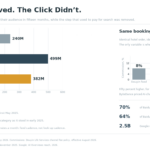
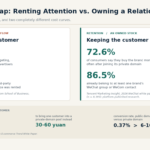
A 1% Click Drop Is a 1% Revenue Drop. It Is Also 18% of Your Profit.
A click-through rate drifting from 6.64% to 6.57% reads like a rounding error. Run it through the funnel and it stays a rounding error. Run it through a net margin of 5.61% and it becomes roughly a sixth of your profit.
That distinction is the whole story, and almost everyone gets it backwards.
What the dashboard says
The weekly report flags the change, labels it not statistically significant, and moves on. The recommendation is always the same: watch it, revisit next quarter. Nothing in that report is wrong. It is answering a question nobody asked, namely whether the movement was real, rather than whether it was expensive.
What the arithmetic actually does
Here is where the popular version of this insight breaks. The familiar claim is that a 1% leak at the top of the funnel compounds into something far larger than 1%. It does not.
Revenue is impressions × click-through rate × conversion rate × order value. Cut any single factor by 1% and revenue falls by exactly 1%. Cut each of the three in turn and you get the same 1% every time. Multiplication carries a percentage change straight through; it never inflates it. The funnel multiplies quantities; percentages ride through untouched.
So where does the damage come from? The denominator.
The multiplier lives in the margin
Take 5 million monthly impressions at a 6.64% click-through rate, an 8.18% conversion rate, and an illustrative $400 order value. That is about $10.86 million of monthly revenue.
Lose 1% of the click rate and you lose 3,320 clicks, 272 orders, and $108,630 in a month. Annualized, $1.3 million. Still 1% of revenue, exactly.
Then set it against net margin. NYU Stern puts general retail at 5.61% net, specialty retail at 5.19%, and the entire listed US market at 9.74%. One percent of revenue is not 1% of profit; it is 17.8% of profit at the retail line, 19.3% at specialty, and still 10.3% across the whole market.
The same leak leads to three very different conversations with the CFO.
The second bill
There is a bill nobody invoices. Replacing those 3,320 clicks at the $5.42 median cost per click runs about $216,000 a year, spent to recover traffic you already had. That is fresh cash on top of revenue that already left, and it lands at roughly 3% of annual net profit on a thin-margin book.
What to do Monday
Stop asking whether the change is significant. Ask what it is worth. Convert every top-of-funnel movement into money before it reaches a meeting: clicks lost × cost per click, orders lost × order value, then divide by margin. Set alerts on that number. A 1% move that clears your profit threshold deserves attention even at a p-value of 0.4; one that does not clear it deserves none at 0.01.
The funnel is honest. It passes along exactly what you give it. Your margin is where a small number becomes a large one, which is why the metric that looks like noise and the shortfall that feels like a crisis are the same event, measured in two different units.