The Loyalty Gap, Priced in Yuan: Why Retention Beats Retargeting
The most useful number in Chinese retention marketing isn’t 72.6%. It’s 30.
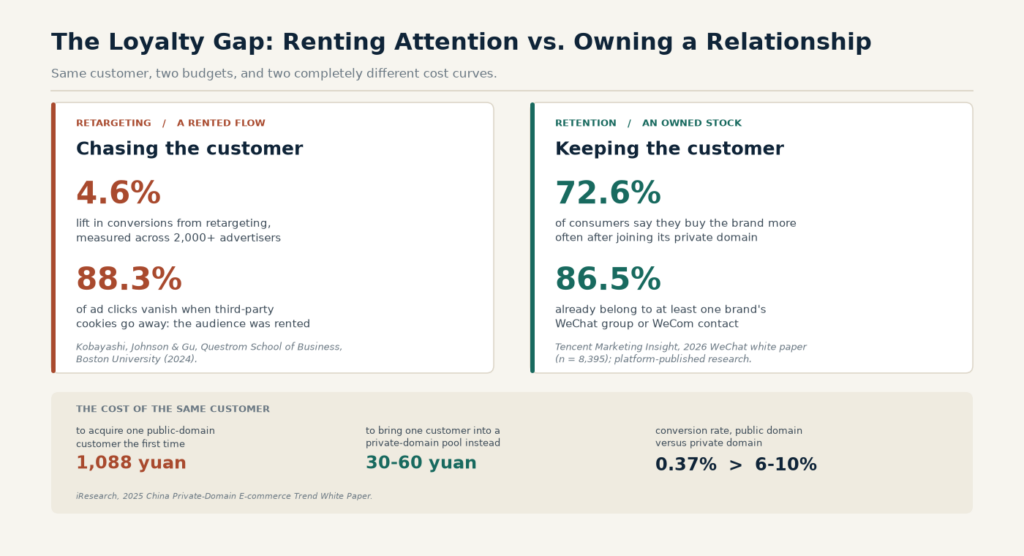
That is roughly what it costs, in yuan, to bring one customer into a private-domain pool: RMB 30 to 60, per iResearch’s 2025 private-domain e-commerce white paper. Acquiring that same person in public domain runs about RMB 1,088. Two price tags for one human being. The first you pay once. The second you pay again every month.
What retargeting actually buys
When a Western brand loses a lukewarm buyer, the reflex is to chase: follow them across the open web, pay to re-acquire attention the brand never really held, then log the click as a win. A Journal of Interactive Marketing field test, USD 5.7 million across Google and Facebook for a bed-in-a-box retailer, found prospecting beat retargeting on incremental sales. Platform attribution had been crediting retargeting for purchases that were going to happen anyway. The ad collected the trophy. It didn’t run the race.
The 88.3% that should have ended the argument
Then the identifier vanished. Across more than 2,000 advertisers, researchers at Boston University’s Questrom School of Business measured retargeting’s lift at 4.6%. Remove third-party cookies and ad clicks fell 88.3%. Nearly nine in ten. That is not a bad quarter. That is the floor giving way beneath a tactic that always borrowed someone else’s audience.
How China built the substitute
Chinese brands did not get better at chasing. They built the thing chasing substitutes for. Tencent Marketing Insight’s 2026 WeChat white paper, drawn from 8,395 consumers, found 86.5% already belong to at least one brand’s WeChat group or WeCom contact list. Among those who joined, 72.6% say they buy more often and 35.3% slide into subscription-style purchasing. Tencent sells the infrastructure behind those numbers, so treat them as platform-published, not neutral.
The mechanism, priced
Reaching a name on your list costs a message, not an auction. iResearch puts private-domain conversion at 6% to 10% against 0.37% in public domain, though the upper bound borrows social-commerce benchmarks rather than pure retail. Alibaba’s 88VIP runs the same logic at platform scale: 53 million paying members, nine times the annual spend of non-members, and more than half of top brands’ sales.
Where the retention camp overshoots
Here is what the loyalty argument usually skips. Ehrenberg-Bass Institute work keeps showing loyalty largely follows penetration: bigger brands have more buyers and slightly more loyal ones, while small brands get punished twice. In UK business banking, the largest provider reached about 42% of the market with 27% solely loyal; an 11% challenger held 3%. Loyalty there is a consequence of scale, not a lever you pull.
So the honest claim isn’t that retention beats acquisition. It is that retention is what you do with buyers you already paid for, and Chinese brands laid those rails first. Retaining harder inside a market you never won is just a slower way to shrink.
What to do Monday
Price the gap on your own P&L. Last quarter’s retargeting spend, divided by the customers it converted, then what those customers were worth twelve months on. Set that against the cost of one message to the list you already have. That number survives contact with a CFO.
Then move the exclusion list to the top of the agenda. Every converted buyer still sitting in a retargeting pool is money spent annoying someone you already own.
Retargeting is a tax on forgetting. Retention is the asset that stops you paying it twice.