Why Attention Stopped Sitting Still: The Third Screen Behind the Second-Screen Consumer
The phone in the viewer’s hand was supposed to be a leak. Advertisers spent a decade calling it attention loss, building deduplication models to cancel out the second screen, and quietly writing off the living room as the place where focus goes to die.
The data says something less comfortable. That second screen was never a leak. It was the first draft of a new structure — and a third screen has since moved in beside it.
Omdia’s November 2025 consumer research shows exactly where the growth lives. 52% of US viewers aged 45–54 were watching phone video with the TV on, up from 39% in 2022. Among 55–64s the share nearly doubled, from 20% to 35%. Meanwhile 18–24s moved two points, 61% to 63%. The habit did not trickle down from the young. It spread from niche to normal, and the last cohort to arrive was the one sitting in the middle of the house.
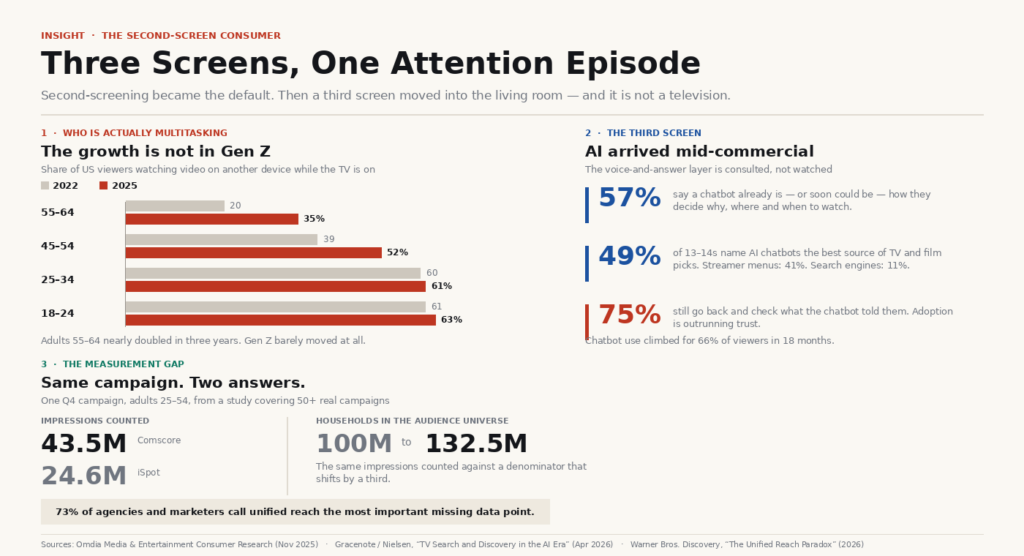
Then there is the AI layer. Gracenote’s January 2026 survey of 4,003 US chatbot users found that 66% had increased their chatbot use over the previous 12–18 months, and 57% said these tools already are, or could become, the way they decide why, where and when to watch something. Among 13–14-year-olds, 49% named AI chatbots their best source for TV and film recommendations — ahead of streamer menus at 41% and search engines at 11%.
So the living room now holds three concurrent attention layers: a passive screen telling a story, a thumb screen taking orders, and a voice layer answering questions about both. The consumer does not switch between them. They run them in parallel.
That reframes the problem. The second-screen era’s difficulty was measurement. The third-screen era’s difficulty is coordination. Being present on three screens is not the same as being coherent across them. Three uncoordinated messages inside one attention episode are three separate interruptions to one person — and Horowitz Research already finds 31% of viewers shopping for products tied to the show they are watching through QR codes or in-show links, which means the layers are being stitched together by the audience whether brands help or not.
The voice layer, notably, does not compete with the other two. A study in the Journal of Advertising Research seated participants in a living-room lab with an Alexa-style companion, tracked emotional arousal through skin response, and found that longer small talk with the AI increased its perceived humanness, reduced irritation with the ads on screen, and lifted purchase intention. The AI was not another channel. It was the thing that made the ad land.
Now the awkward part. Warner Bros. Discovery compared five measurement vendors across more than 50 real campaigns and found the same Q4 campaign counted at 43.5 million impressions by one and 24.6 million by another. Audience universes ran from roughly 100 million to 132.5 million households. Of the 154 marketers surveyed, 91% said methodology alone can meaningfully change the number, and 73% named unified reach their single most important missing data point.
So the sequence inside one episode — spot, search, question, purchase — is precisely the part nobody can currently price.
Two caveats worth holding on to. Most viewing time still has one dominant screen, and the moments when attention splits are the moments that decide the sale, not the average. And three-screen measurement is harder, not impossible; daily deduplicated program-level reporting already ships.
The takeaway is narrower than it sounds. Stop planning per screen. Plan the handoff — what the spot makes searchable, what the search makes citable, what the answer makes buyable. Consumers are already running that chain. The media plan is the only thing still running three separate ones.