The Unit Economics Behind China’s AI Boom: Cost Per Conversion, Not Model Quality
Here is a number that should bother every marketer who has ever signed an AI contract.
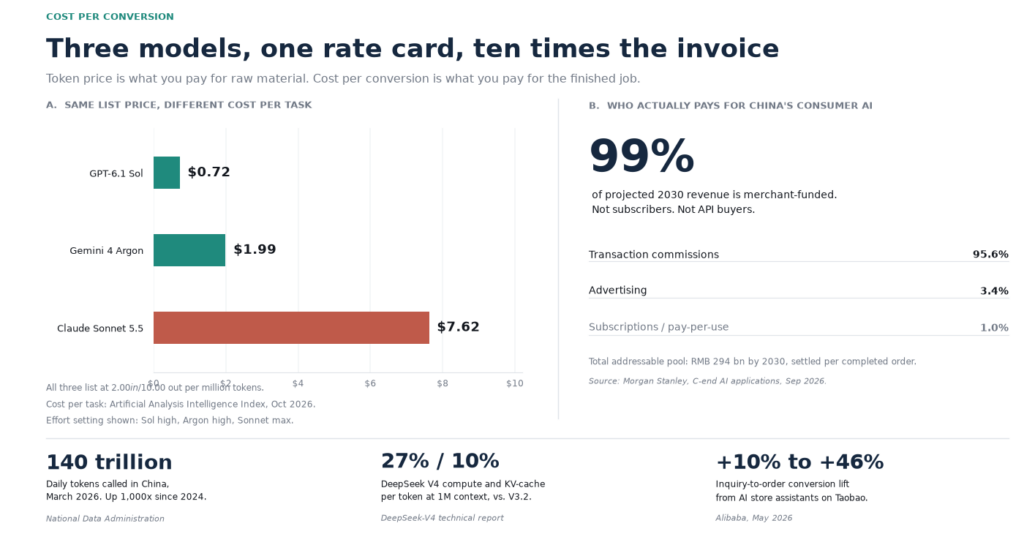
Three frontier models went to market this quarter with an identical list price: two dollars per million input tokens, ten dollars per million output. Put those same three models through the same set of agentic tasks and the bill comes back at $0.72, $1.99, and $7.62 per completed task.
Same sticker. Tenfold spread.
Nothing about model quality explains the gap. Token count does. The most expensive of the three spent roughly 193,000 output tokens finishing a single task, about seven times what a comparable model needed. It was not thinking harder in any way a customer would notice. It was simply writing more.
That is the metric almost nobody reports: cost per conversion. Not price per million tokens. Tokens burned to produce one business outcome — one order, one booking, one resolved ticket.
China arrived at this measurement years before the West did, and not because anyone there is smarter about dashboards. It arrived there because of a P&L structure.
Western AI monetizes access. You sell a subscription, or you sell API calls, and the token is the product. Chinese AI monetizes the transaction. Of the roughly RMB 294 billion in consumer AI revenue projected for 2030, about 99% is merchant-funded: transaction commissions and advertising. Subscriptions and pay-per-use account for around 1%.
When a merchant pays per completed order rather than per API call, the token stops being inventory and becomes a cost line inside a margin. The incentive inverts overnight. Every token that does not move a shopper closer to checkout is a leak.
What that pressure produced is visible in the engineering. DeepSeek’s V4 models cut per-token compute to 27% of the previous generation at million-token context, and KV-cache memory to 10%, while raising the activation count. Efficiency came from architecture, not from shrinking the model. On the commercial side, Taobao’s AI store assistant now handles most pre-sale questions at roughly 0.2 RMB per conversation, lifts inquiry-to-order conversion by more than 10% overall, by 46% at one flagship store, and cuts human handoff by 45% to 55%.
Meanwhile the West’s honest problem is not model capability. It is instrumentation. MIT’s NANDA study found 95% of enterprise GenAI pilots produced no measurable P&L impact. S&P Global found 42% of companies abandoned most of their AI initiatives, up from 17% a year earlier. Jasper’s 2026 survey found only 41% of marketers can demonstrate AI ROI — down from 49%, even as usage climbed. None of those failures trace back to a weak model. They trace back to nobody ever computing what one outcome cost.
The counterargument deserves its due. For frontier reasoning, quality does eventually win, and a model that under-converts is worse than an expensive one. But the claim was never “smaller is better.” It was “measure the ratio.” A cheap model that converts quietly beats a brilliant model that burns.
Amazon already proved the West can play this game when it ties AI to a finished order: Rufus drove nearly $12 billion in incremental 2025 sales, and shoppers who used it were 60% more likely to buy.
So the question worth taking into your next budget review is not which model leads the leaderboard. It is simpler, and considerably less comfortable: what does one conversion currently cost you, and can you prove it?