Why “100% Renewable” and 65% Are Both True
Ask a marketing team how much carbon its AI workload emits, and you will usually get a number. Ask what that number measured, and the conversation stops.
Here is the mechanism nobody in the pitch deck mentions. Corporate electricity emissions are not one figure. Under the GHG Protocol’s dual reporting structure, they are two, computed by two different methods. The location-based method asks what the local grid actually contained while you consumed. The market-based method asks what you bought on paper, netted across a year, regardless of when or where it was generated.
Both are permitted. Both can be labelled “emissions.” They rarely agree.
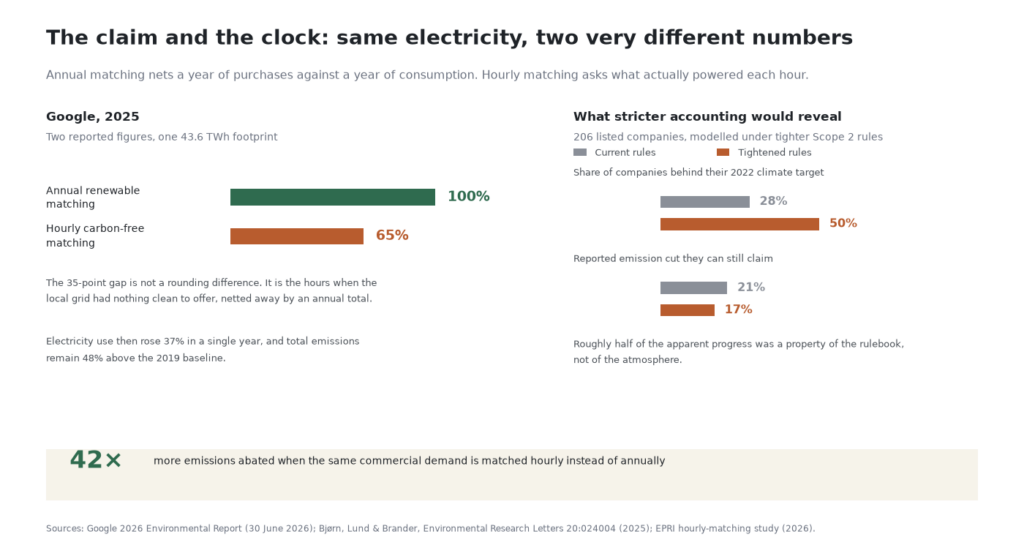
That duality is the entire story of green AI claims, and it explains a puzzle that looks like hypocrisy but is really arithmetic. Google matched 100 per cent of its electricity with renewable purchases in 2025, its ninth consecutive year. On an hourly, grid-specific basis, its carbon-free energy share was about 65 per cent. Same company, same 43.6 terawatt-hours, same twelve months, two defensible numbers separated by 35 percentage points. Neither is a lie. Only one describes what the wires carried.
Why the annual metric survives
Because it is cheap, and because until recently it was legitimate.
An annual match can be satisfied with unbundled certificates bought at the end of the year from plants that already exist and were already profitable. Critically, the certificate does not have to arrive in the same hour, or the same country, as the consumption it offsets. A midday June solar certificate can retire a midnight December load. The counterparty managed the paperwork, not the physics.
The economics explain the persistence. Unbundled certificates cost a fraction of what new generation costs, so the marginal cost of improving a reported number is near zero. Building dispatchable carbon-free capacity to cover the hours when the wind drops is expensive, and the last few percentage points are the most expensive of all — a cost curve that turns vertical precisely where the claim matters most.
This is not a fringe critique. Bjørn, Lund and Brander modelled what happens to 206 companies under tightened accounting rules. The share behind their own 2022 climate targets rises from 28 to 50 per cent. Their reported emission cut falls from 21 to 17 per cent. Roughly half of the apparent progress was a property of the rulebook, not the atmosphere.
What is changing, and who it hurts
The GHG Protocol’s Scope 2 revision proposes hourly matching and deliverability constraints, with a phased transition away from the current method. The European Union has begun writing 24/7 clean energy into policy. Meanwhile the Electric Power Research Institute found that matching the same commercial demand hourly rather than annually abates around 42 times more emissions.
The vendor response is the tell. Microsoft is reported to be weighing whether to delay or abandon its 100/100/0 hourly goal, the most ambitious commitment in the sector, while continuing to meet its annual target. When a company defends the easy metric and reconsiders the hard one, it is telling you which one it believes.
What this means if you run marketing
Three practical consequences, none of which require you to become a carbon accountant.
First, ask your AI vendors for the hourly figure, not the annual one. Most cannot supply it. That silence is itself the answer.
Second, discount any “carbon neutral AI” claim sourced to certificates alone. It is now a legal exposure in the EU, not merely a rhetorical one.
Third, and least comfortably: the same accounting looseness runs through your media carbon reporting. Campaign-level measurement in grams per thousand impressions rests on the same annual-netting logic. If you are auditing AI, audit the media plan beside it.
The uncomfortable conclusion is that the emissions number was never only a measurement. It was a choice about which question to ask. Choosing the annual one was defensible when nobody was checking. That era is closing.