Why Brussels Postponed the Expensive Rules and Kept the Cheap Ones
An Insight brief — why the deadline everyone celebrated was not the deadline that mattered.
When the Digital Omnibus cleared the European Parliament in June 2026, the vendor emails wrote themselves. Deadlines slip, compliance breathes, marketers stand down. Six weeks later Article 50 went live anyway, and the reprieve turned out to belong to somebody else.
What actually moved, and for whom
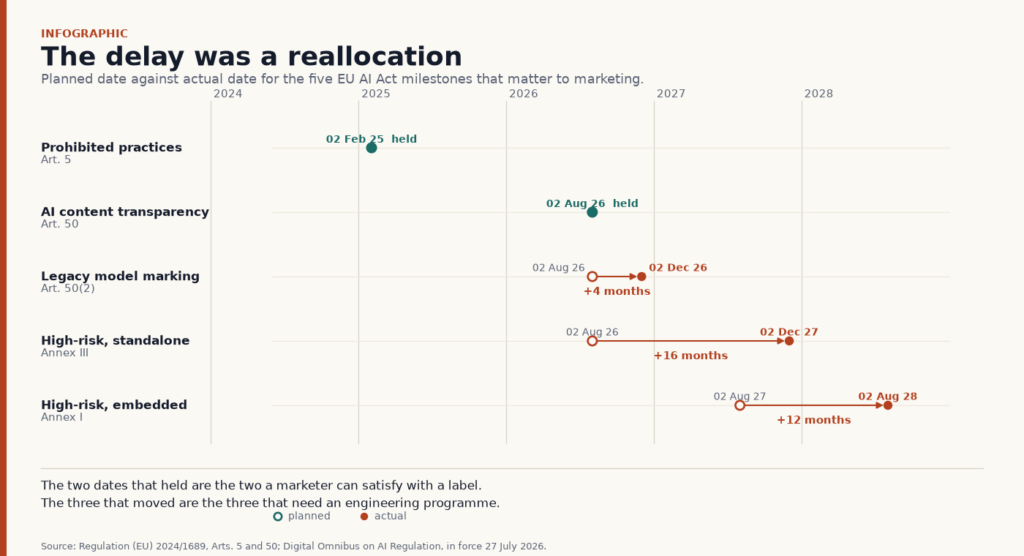
The high-risk regime is the expensive one. Conformity assessment, technical documentation, a quality management system, CE marking, registration in the EU database. Every item on that list is a cost borne by the party placing the system on the market: the provider. That is precisely the clock the Omnibus reset, to 2 December 2027 for standalone systems and 2 August 2028 for products with AI embedded.
Now look at what kept its date. Article 50 applied from 2 August 2026. A restaurant chain publishing a synthetic photo of a terrace it never built, an agency de-aging a spokesperson, a retailer whose catalogue imagery was generated and unlabelled — none of them file a technical document. They put a label on a creative. The obligation costs a few hours of process, not a seven-figure engineering programme.
The delay moved the costly duties and held the cheap ones. It was not a reprieve. It was a reallocation.
The mechanism is cost per vote
This is arithmetic, not cynicism. A regulator weighing whether to postpone an obligation weighs two numbers: the compliance cost to industry, and the political cost of appearing to weaken the law.
Postponing conformity assessment buys quiet from a concentrated, well-lawyered, capital-intensive sector, and costs almost nothing politically, because voters cannot see a technical file. Postponing deepfake labelling would have cost a great deal, because anybody can see an advert featuring a person who does not exist. So the first number won where it mattered and lost where it did not.
There is a second layer, and it is the layer marketing should internalise. Every obligation made cheaper for suppliers became more expensive for deployers — not by amendment, but by arithmetic. The provider runway grew sixteen months longer while the deployer deadline did not move at all. The gap between what a model vendor must prove and what an advertiser must disclose is now the widest it has been since the Act was drafted.
The pattern is not European
China enforces its labelling measures against publishers rather than model developers. The September 2026 case that took a Sichuan mini-program offline turned on what the company published, not what it built. California’s transparency act put latent disclosure duties on providers above a million monthly users, but its penalty of five thousand dollars per violation, each day counted separately, is survivable for a platform and existential for a mid-sized advertiser shipping a thousand assets a week. Britain skipped the statute altogether and pointed its existing advertising code at synthetic content, which is the cheapest regulatory instrument available: no new law, no new regulator, all the existing liability.
Different instruments, one direction of travel. The obligation keeps sliding toward whoever touches the consumer.
What to do with a delay announcement
Treat it as a routing signal, not a holiday. Ask which obligation moved and who pays to comply. If the answer is a technical file, it is not yours. If the answer is a label, a disclosure or a substantiation record, it very likely is.
Which means your compliance surface grows while your vendors’ shrinks. Budget for the review step, the named signatory, the label baked into the template, and the record that proves all three happened — not for audits you will never conduct.