The Incentives Behind a Product That Loses Every Lawsuit and Still Wins the Budget
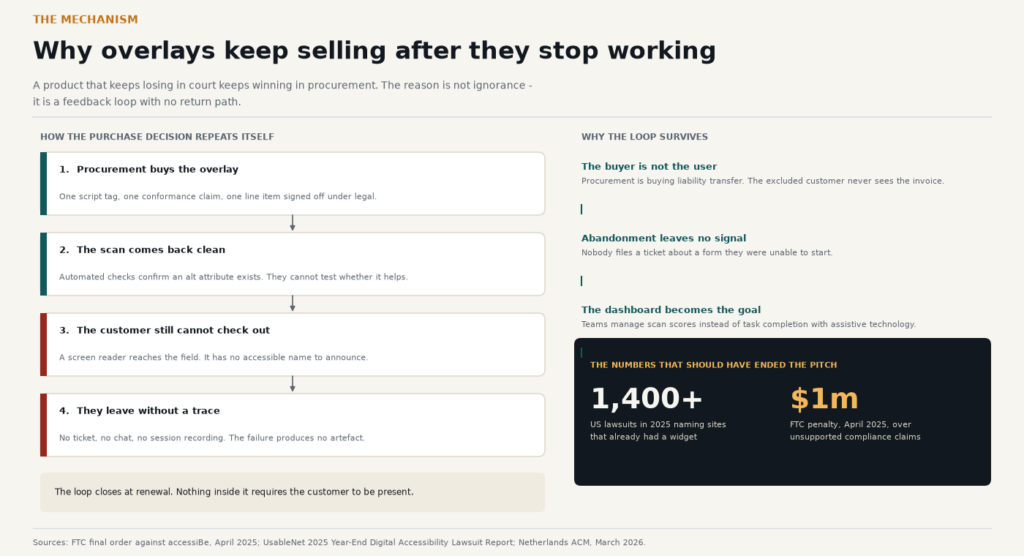
A product that keeps losing in court keeps winning in procurement. The reason isn’t ignorance. It’s a feedback loop with no return path.
There is a meeting that happens in almost every large marketing organisation after the first accessibility lawsuit lands. Legal is in the room. Digital is in the room. Somebody from procurement has a slide with three vendor logos on it.
The conversation is not about whether a blind customer can buy a coat. It is about which of the three logos most credibly reduces the odds of a second lawsuit. The cheapest credible option wins, and the cheapest credible option is almost always the overlay: one script tag, one vendor-issued conformance claim, one line item that clears in a week without touching a single template.
That is why the overlay industry keeps growing while the product keeps losing. In April 2025, the US Federal Trade Commission ordered one overlay vendor to pay $1 million over claims that its tool could make any website compliant, and barred it from repeating the claim for twenty years. In 2025, UsableNet counted more than 1,400 US lawsuits naming companies that had a widget installed. Roughly a hundred a month.
Neither fact changed the buying behaviour, because neither fact is visible to the person doing the buying.
The failure leaves no artefact
Walk through the actual experience. A customer using a screen reader reaches checkout. The form has an input with a placeholder and no label. The screen reader announces “edit text.” She does not know whether to type her name, her card number, or her postcode. She guesses. She gets an error. She guesses again. She leaves.
What did that produce inside the business? No support ticket, because she never got far enough to open a chat. No abandoned-cart record that says why, because “why” was never captured. No session recording worth watching, because to a mouse-and-keyboard observer it looks like somebody typed into a box and stopped.
The loss is real, recurring, and completely invisible. Meanwhile the overlay’s scan returns a green score, because an alt attribute exists. It does not test whether the attribute helps anyone.
When the scan becomes the goal
Once a metric is what you’re measured on, it stops measuring the thing. Accessibility targets get written as scan scores rather than task completion with assistive technology, and vendors optimise for the checks that get reported.
Put the mechanism in one sentence: procurement buys liability transfer, the dashboard confirms the purchase, the customer’s real experience never enters the system, and the loop closes at renewal with nobody in it having done anything dishonest.
What would actually break it
Make the customer present in the decision. Two or three paid sessions with assistive-technology users, recorded, watched by the people who sign the invoice. Not an audit PDF. A recording of somebody trying to buy your product and failing, in front of the person who approved the script tag.
The Dutch regulator did a version of this at market scale in March 2026, testing around a hundred of the country’s largest online stores. At 61 percent, an assistive-technology user could not complete an order at all — because the test measured the task, not the markup.
You cannot manage what you cannot see, and for a decade accessibility has been managed through a dashboard that cannot see the customer. That is not a technology problem. No script tag was ever going to fix it.