The Hidden Environmental Cost of Your AI Marketing
Try a small thought experiment. Take a marketing team that has spent three years telling everyone it is serious about sustainability. Hand it an image model, a video model, and a brief that calls for four hundred creative variants by Friday. Then ask the sustainability lead what Friday cost.
They will not know. Not approximately. Not even directionally.
That is the problem in a single exchange. Every other input in a marketing budget arrives with a price attached. Media has a rate card. Photography has a day rate. Even the coffee has an invoice. Compute does not. You press a button, something appears, and the resource it consumed has already been burned somewhere you will never see.
Which means the collision the industry is now walking into is not really a data problem. It is an honesty problem. The same departments that champion sustainability are the ones generating at the highest volume, and until very recently nobody was asking them to reconcile the two.
Where the cost actually accumulates
Training was the story. Inference is the bill.
For about five years, the public conversation about AI and energy obsessed over training runs. That framing was tidy and it was wrong, or at least badly incomplete. Training is a one-time capital expense. Inference is the monthly operating cost that arrives forever.
The United Nations University Institute for Water, Environment and Health puts the split at 80 to 90 per cent of AI energy consumption going to inference. AWS said much the same years earlier about its own cloud demand. Google reached a similar conclusion internally back in 2022, attributing roughly 60 per cent of its machine-learning energy to inference rather than training.
For a marketing department, this is the whole ballgame. You are not paying for one expensive model. You are paying for a habit.
Why an image costs more than a thousand headlines
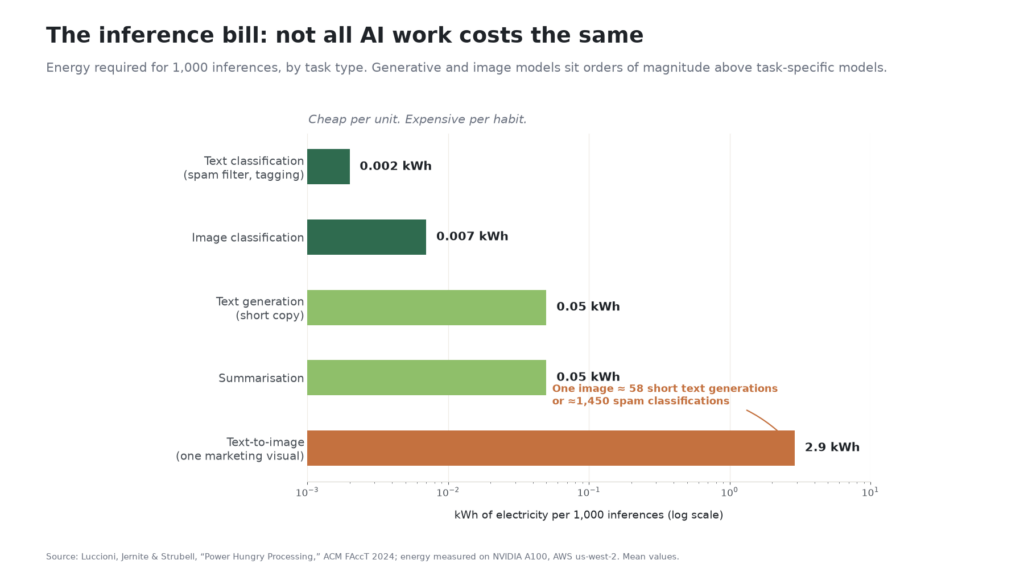
Not all generation is created equal, and the gap is not subtle. The FAccT study measured energy per 1,000 inferences across ten task types and found a spread of more than 1,450 times between the cheapest and the most expensive.
Text classification, the kind of model that tags a support ticket, averaged 0.002 kWh per thousand. Image generation averaged 2.9 kWh, with the least efficient models reaching 11.49 kWh. Put differently, generating one image consumes roughly as much electricity as fifty-eight short text generations, or around half a full smartphone charge.
The UN puts the same finding more bluntly: one AI-generated image takes about 1,450 times the energy of a basic text classification, a short AI-generated video can equal 200,000 of them, and a single high-resolution AI video clip can exceed 415 watt-hours.
Sit with that for a moment. Your team treats a headline and a hero visual as two lines in the same brief. The grid treats them as different orders of magnitude.
The opacity problem is worse than the number
Here is the part that should bother you more than any kilowatt figure.
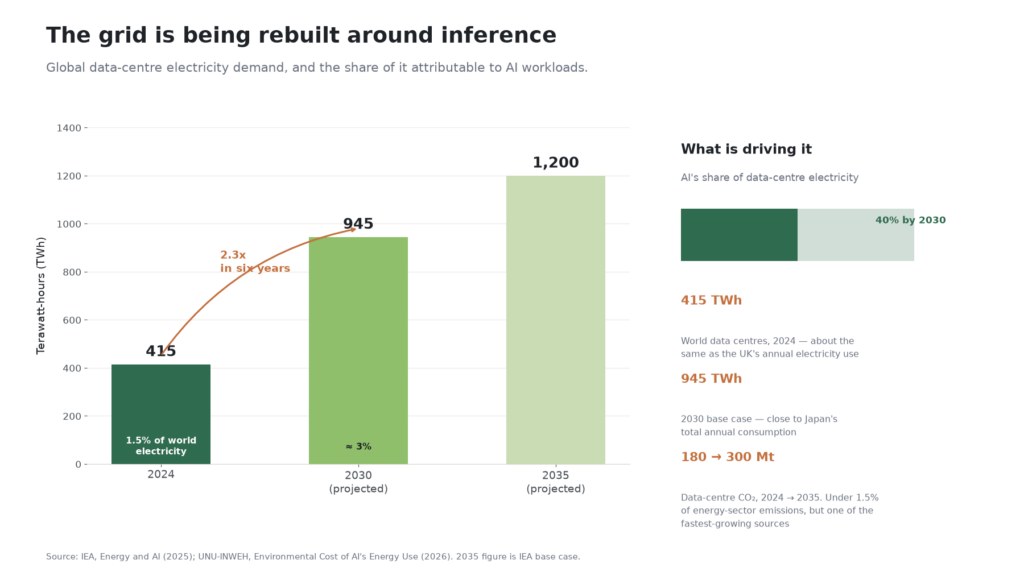
The energy a prompt consumes is not disclosed at the point of use. There is no meter on the interface, no receipt after the render, no line item your finance team can code to a cost centre. The IEA can tell you that data centres consumed about 415 terawatt-hours in 2024, roughly the annual electricity use of the United Kingdom, and that the figure is heading towards 945 terawatt-hours by 2030, close to Japan’s entire consumption. It cannot tell you what your campaign did.
That asymmetry matters because you cannot manage, reduce, or defend what you cannot see. Every other sustainability claim a brand makes rests on a number somebody can audit. The AI footprint rests on a guess.
Two priorities, one department
The same team, pulling in opposite directions
Marketing departments are, almost by construction, the loudest advocates of sustainability inside a large company. They write the copy about the packaging. They commission the report. They sit through the workshops.
They are also the fastest adopters of generative AI, because the tool solves a resourcing problem that has plagued the function for decades.
Neither instinct is wrong. Held together, they create a specific and increasingly legal exposure.
The greenwashing trap just acquired teeth
This stopped being a reputation argument in September 2026.
The EU’s Empowering Consumers for the Green Transition Directive has applied since 27 September 2026, with no transition period, and its reach extends to any business selling to consumers in the EU regardless of where that business is headquartered. It bans generic environmental claims such as “eco-friendly” or “climate-friendly” unless the company can demonstrate recognised excellent performance or explain the claim on the same advert. It requires sustainability labels to rest on independently verified certification. Most consequentially for this conversation, it forbids describing a product as “carbon neutral” or as having a reduced climate impact on the basis of offsetting, and it requires future targets such as net zero to be backed by a detailed public plan with measurable deadlines and independent review.
Now consider the position of a brand that markets carbon neutrality while quietly running an unmeasured, offset-dependent AI workflow behind its creative production. The claim and the practice sit in the same audit trail.
Enforcement is not theoretical. Fines through coordinated cross-border action must reach at least four per cent of annual turnover in the affected member state, and the commercial costs of relabelling, withdrawn stock and competitor litigation tend to be larger than the fine.
Carbon accounting is closing in on compute
The second pressure is quieter but harder to dodge.
Corporate reporting rules have been simplified, not abandoned. The EU’s Omnibus I directive, published in February 2026, narrowed the Corporate Sustainability Reporting Directive to companies above 1,000 employees and €450 million in turnover. But for the companies still in scope, value-chain emissions remain in scope, and marketing services are a value-chain line.
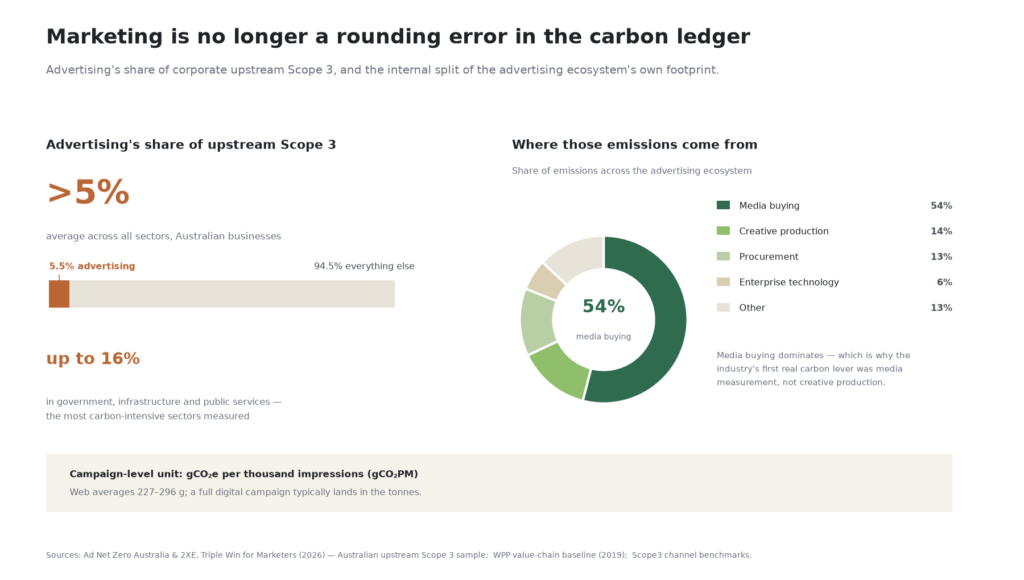
That line is no longer invisible. Ad Net Zero Australia and the consultancy 2XE published research in August 2026 finding that advertising accounts for more than five per cent of upstream Scope 3 emissions on average, and as much as sixteen per cent in government, infrastructure and public services. Within the advertising ecosystem itself, a WPP value-chain baseline put media buying at fifty-four per cent of emissions, creative production at fourteen per cent, and enterprise technology at six.
Five per cent of anything is not a rounding error. It is a line item that needs a number.
How big is it, honestly?
The perspective test
Resist the temptation to make this apocalyptic. It is not.
Data-centre emissions are projected to rise from roughly 180 million tonnes of CO₂ today to about 300 million tonnes by 2035, which remains under one and a half per cent of energy-sector emissions. Aviation, cement and steel are in a different weight class entirely.
The honest framing is material but secondary. Marketing’s AI footprint is one line in a much larger ledger, and pretending otherwise damages your credibility with the very people you need to convince.
Waste is the part you can actually cut
Within that modest total, however, sits an enormous amount of pure waste.
Regenerating an image eleven times because the model kept putting six fingers on the hand. Generating two hundred copy variants that nobody ever traffics. Pointing a frontier reasoning model at a task a spreadsheet could handle. Producing video for a channel that will only ever show a static thumbnail.
Each of these is a rounding error individually. Multiplied across a global media organisation, they become the cheapest emissions reductions available to you, because eliminating them requires no capital expenditure, no vendor negotiation, and no new technology. It requires a brief that says how many variants you actually need.
The UN report adds a delightfully blunt lever: trimming request length by thirty per cent reduces AI energy use by about a quarter. Less politeness, less preamble, less energy.
Efficiency is winning locally and losing globally
Both things are true at once, and holding both is the intellectual discipline this topic demands.
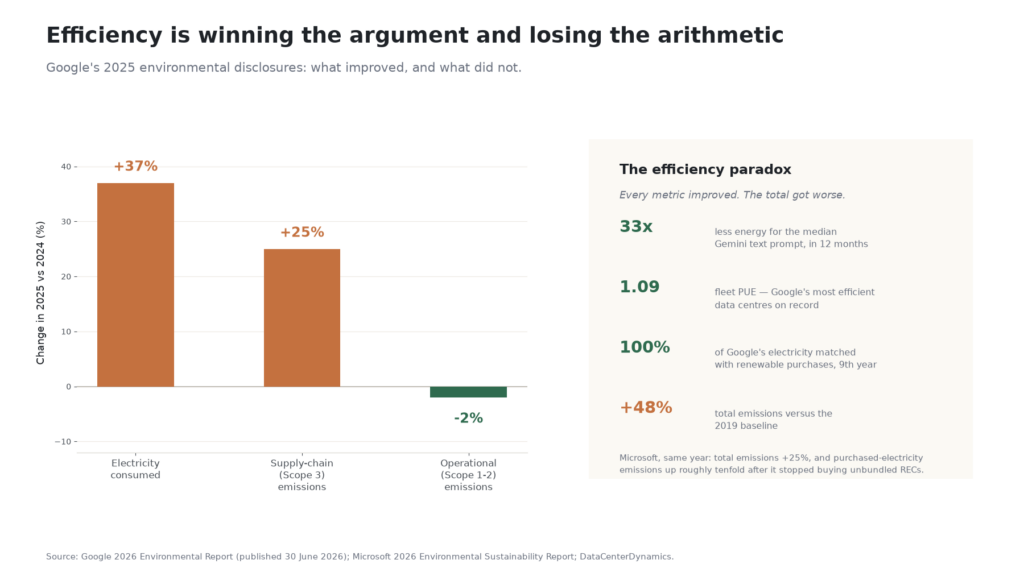
Google’s 2026 environmental report is a masterclass in the tension. The median Gemini text prompt now consumes 0.24 watt-hours, roughly the energy of five seconds of a lightbulb, and produces about 0.03 grams of CO₂. Over twelve months that represents a thirty-three-fold reduction in energy and a forty-four-fold reduction in carbon per prompt. Its fleet power usage effectiveness reached 1.09, among the best in the industry. It matched one hundred per cent of its electricity with renewable purchases for the ninth consecutive year, signed more than twelve gigawatts of new clean capacity in 2025 alone, and cut operational emissions by two per cent.
And its total electricity use rose thirty-seven per cent in 2025, to 43.6 million megawatt-hours. Supply-chain emissions rose twenty-five per cent. Total emissions remain roughly forty-eight per cent above the 2019 baseline.
Microsoft tells a cleaner, more uncomfortable version of the same story. Emissions up twenty-five per cent, purchased-electricity emissions up roughly tenfold, and a public admission that “sustainability solutions are not scaling fast enough to meet demand.” Some of that increase is accounting honesty: it stopped buying unbundled renewable energy certificates, instruments that trimmed reported emissions without adding new clean generation to any grid.
That last detail is the most useful one in this entire article. Efficiency gains and certificate purchases both improve the reported number without changing the physical world very much. The only thing that changes the physical world is generating less, or generating on cleaner electrons.
The green-AI playbook
Five moves, ordered by return on effort rather than by how good they look in a press release.
Move one: cut waste before you buy anything
Start with the brief, not the vendor. Cap variant counts. Delete unused generations from your pipeline so nobody regenerates them later. Route simple tasks to simple tools. Kill the video treatment for the placement that shows a still image. Audit last quarter’s creative library and count how many assets were generated and never used. That number is your baseline, and it will probably embarrass you.
Move two: right-size the model
Capability matched to task cuts cost and carbon simultaneously, which is why this is the rare sustainability intervention your CFO will actively support. A small fine-tuned classifier tags creative faster, cheaper and with a fraction of the energy of a frontier multimodal model asked to do the same job. Reserve the expensive models for the work that genuinely needs them. This is the same logic that governs token economics in production engineering, applied to marketing.
Move three: make clean power a procurement question
You cannot choose the grid your model runs on directly, but you can choose who supplies it, and you can ask questions.
Google is now signing corporate power purchase agreements, restarting nuclear capacity and underwriting fusion offtake. Oracle has committed to one hundred per cent carbon-free power for its AI data centres by 2035. NTT DATA has structured multi-country renewable agreements with ENGIE running to 2030. These are procurement decisions made by infrastructure buyers, and they respond to procurement pressure from customers. Add an energy-sourcing question to your RFP for AI vendors. Most will not have a good answer yet. That is precisely why asking changes behaviour.
Move four: align the claim with the consumption
This is the move that protects the brand.
If your sustainability messaging leans on carbon neutrality, offsetting or unqualified green language, it is now legally exposed in the EU and reputationally exposed everywhere else. Either measure what your AI workflow actually consumes and integrate it into the claim, or soften the claim until it matches what you can defend. Internal consistency is not a marketing virtue. It is a legal defence.
Move five: measure, then disclose
Campaign-level carbon measurement has matured faster than most marketers realise. The Ad Net Zero Global Media Sustainability Framework now provides formulae across six channels and three lifecycle phases, aligned with the GHG Protocol and ISO 14067, with an explicit data-quality hierarchy that separates supplier-contributed measurement from modelled default. Platforms including TikTok have integrated third-party emissions reporting at campaign level. The working unit is grams of CO₂ equivalent per thousand impressions.
Start with what exists. Media carbon is measurable today. Creative generation is the harder frontier, but a simple proxy, energy per generation type multiplied by volume, beats the nothing most teams currently report.
What happens next
Three shifts are already underway, and each one moves the question.
Green AI is becoming a vendor differentiator. In cloud, energy sourcing went from a footnote to a procurement criterion in under a decade. AI infrastructure is on the same curve, and the providers that publish efficiency and sourcing data will win enterprise contracts that the silent ones lose.
Efficiency will keep improving, which relocates the problem rather than solving it. As per-unit footprint falls, the question stops being “is AI green?” and becomes “are you using it deliberately?” That is a harder question, because it cannot be answered by your supplier. It can only be answered by your brief.
And carbon accounting will absorb compute. Once AI workloads sit inside audited Scope 3 inventories alongside media and production, the internal inconsistency becomes visible to auditors, investors and any journalist with a search function. The brands that resolved it early will look prescient. The rest will look like they were hoping nobody would ask.
The takeaway
Generative marketing has a real carbon cost, and it is small enough to be manageable and large enough to be indefensible if you ignore it. The teams most exposed are the ones with the loudest sustainability commitments, because that is where the gap between claim and practice is widest.
The answer is not to stop generating. It is to generate on purpose: fewer variants, lighter models, cleaner power, and a claim that survives contact with your own operations. Green AI is not a rejection of generative marketing. It is the discipline of doing it without tripping over your own values.