One Campaign, Five Rulebooks: Surviving AI Regulation in 2026
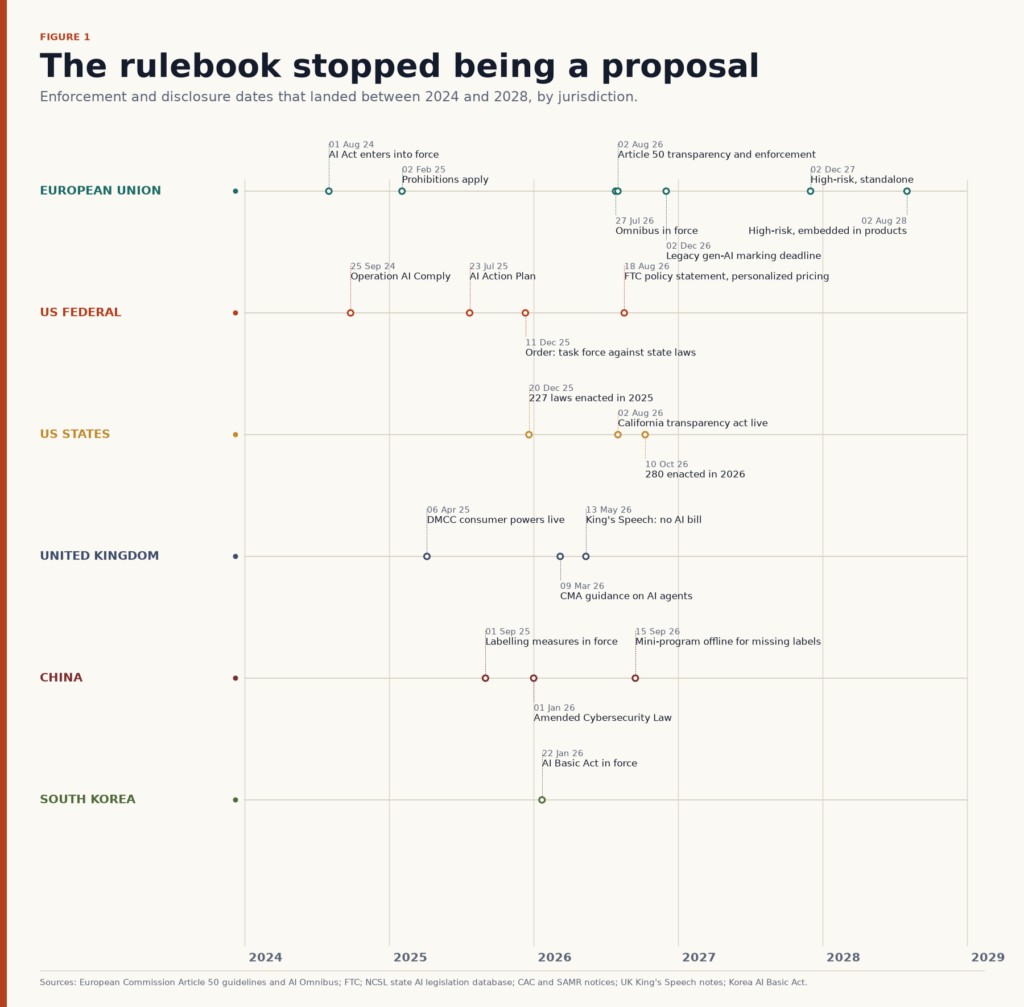
In the first week of August 2026, three obligations went live within roughly seventy-two hours of one another: the European Union began enforcing the transparency duties in Article 50 of its AI Act, California switched on its AI Transparency Act, and the Commission’s market surveillance machinery started issuing fines. A single campaign shipped to Brussels, London and Sacramento was, without anyone changing a line of copy, newly exposed in three jurisdictions at once.
That is the story of AI regulation in 2026. Not a distant legislative horizon, not a consultation paper, but a set of dated obligations that land on the people who brief creative, approve media and sign off claims. And here is the awkward part: most marketing organisations know this is coming and still have not built the machinery to handle it.
Why compliance is now a marketing job
Lawyers can tell you what the rules say. They cannot tell you whether the synthetic model in your hero image makes the product look larger than it is, whether your dynamic creative swaps a headline based on inferred income, or whether the voiceover on your 15-second cut was cloned with consent.
AI marketing touches every surface that regulators already police. Generated content raises disclosure questions. Personalisation raises data-protection questions. Targeting raises discrimination questions. Synthetic spokespeople raise likeness and transparency questions. Claims raise substantiation questions. Five regulated surfaces, one workflow, and the workflow sits with you.
The liability does too. The recurring principle across Brussels, Washington, London and Beijing is that the advertiser owns the output, not the model vendor. When the FTC pursues a company for AI washing, or the UK’s Competition and Markets Authority fines a retailer for what its agent told customers, nobody accepts the tool as a defence.
Europe: the deadline that did not move
Brussels spent most of 2025 and the first half of 2026 trying to look reasonable about its own flagship law. The Digital Omnibus on AI, proposed in November 2025, became a political agreement in May 2026, cleared the European Parliament in June, and entered into force on 27 July, days before the August deadline it was meant to soften.
What it softened: high-risk obligations now start on 2 December 2027 for standalone systems and 2 August 2028 for systems embedded in products. SMEs and small mid-caps got documentation relief.
What it did not soften, and this is the part marketing teams keep missing: Article 50. The transparency duties for generative content apply from 2 August 2026. Systems already on the market before that date got a shortened transition — until 2 December 2026 — to implement machine-readable marking. The grace period was cut from six months to three. Brussels delayed the heavy industrial compliance and accelerated the labelling.
What counts as a deepfake in an ad
The Commission’s guidelines, published on 20 July 2026, are unusually blunt about advertising. They confirm that AI-generated marketing content which makes a product appear different from reality counts as a deepfake. So do digital replicas of real people and de-aging effects applied to actors. The reduced-disclosure regime for evidently creative or satirical work exists, but it is construed narrowly, and the guidelines classify most advertising examples as not qualifying.
Two details matter more than the headline. First, intent to deceive is not required. If the content would falsely appear authentic to the audience you actually reached, the duty attaches. Second, you cannot discharge it by pointing at the provider’s invisible watermark. The label has to be perceivable by a human without special tools.
The exemptions that actually help marketers
There are genuine carve-outs, and they are worth knowing because they map onto real work. Standard editing — spelling, grammar, minor stylistic polish — needs no marking. As of the final guidelines, AI-assisted translation now falls inside that exemption too, on the reasoning that a translated sentence has not changed its informational substance. Summaries and substantive rewrites do not get the same treatment.
There is also a closed-environment carve-out for outputs used exclusively in industrial or business-to-business settings with proper access controls. Consumer-facing systems are excluded from it, which tells you where the regulator thinks the risk lives.
The United States: no AI act, plenty of exposure
Washington has no comprehensive AI statute and, as of this writing, is not close to one. That has bred a lazy assumption that American marketers face no AI-specific exposure. Wrong.
The Federal Trade Commission has been running Operation AI Comply since September 2024, and the caseload has grown past a dozen actions. The pattern is consistent: the agency is not regulating what the model does, it is regulating the distance between what a vendor promised and what the software can actually do. Settlements have reached into the tens of millions.
AI washing is the new greenwashing
If you have ever written a page claiming an AI feature that shipped in beta, or let a demo imply a level of consistency the system cannot hold, you were doing the 2026 equivalent of a vague sustainability claim. The FTC has also revived the means-and-instrumentalities doctrine, which means the agency can pursue not just the company making the claim but vendors supplying the deceptive material downstream. In a B2B funnel with resellers, that tail is long.
Worth noting for calibration: in December 2025 the Commission set aside one of its own 2024 orders against an AI writing-tool vendor, on the view that the allegations did not support a Section 5 violation and that the order chilled innovation. The current FTC wants to police deception, not the existence of generative tools. That is a narrower target and a more durable one — you will not be punished for using AI, but you will be punished for lying about it.
The states are writing the rules Congress will not
State legislatures introduced 1,539 AI bills in 2026 and enacted 280 of them by early October, up from 227 the year before. Deepfake measures were the most common type to become law, typically covering explicit content, political advertising and digital likenesses. Notification duties — telling a user they are talking to a machine — nearly tripled.
Only two of those 280 were genuine comprehensive frameworks. What you actually face is a disclosure-heavy patchwork, not a governance system.
California is the one to watch because of market size. Its AI Transparency Act became operative on 2 August 2026 for providers with more than a million monthly users: latent disclosures embedded in AI-generated image, video and audio, an optional visible manifest, and a free detection tool. Text is out of scope. Penalties run at 5,000 dollars per violation, with each day counted separately. Large platforms follow in January 2027, capture devices in 2028, and a 2026 follow-on bill passed the legislature to strike the million-user threshold entirely.
One honest caveat: election deepfake statutes in California and Hawaii have been struck down or enjoined on First Amendment grounds, and a federal task force created in December 2025 is actively challenging state AI laws. The patchwork is real, but it is also litigated, which means today’s compliance map can shift.
Britain chose a different door
The UK has no AI act and, after the May 2026 King’s Speech, no plan for one. Instead of new statute, ministers offered a Regulating for Growth Bill built around sandboxes and a strengthened growth duty for regulators. A parliamentary human rights committee spent fourteen months arguing for the opposite — a single AI bill, a statutory regulator, statutory transparency duties — and published its report in September 2026 to no immediate legislative effect.
So the rules that bite are the old ones applied to new tools. The Advertising Standards Authority and the Committee for Advertising Practice are explicit that the codes apply regardless of how content is generated, edited or targeted. There is no blanket duty to label AI in UK ads, and the regulator has warned against the lazy solution of stamping every asset. The test is materiality: would the audience be misled without disclosure, and would disclosure clarify the message rather than contradict it?
Two things give that posture teeth. The DMCC Act 2024 handed the CMA direct enforcement powers with fines up to 10 per cent of global annual turnover, no court order required. And the ASA has scaled up AI-assisted monitoring, with influencer marketing as a stated 2026 priority. A non-compliant post is now more likely to be found by a machine than reported by a member of the public.
The agent is the advertiser now
In March 2026 the CMA published guidance on AI agents that reads like a warning shot. Businesses are liable for what their agents say and do under the same principal-agent logic that applies to employees. That means disclosing that a customer is dealing with an agent, configuring it to respect statutory rights, monitoring its performance with human review, and having a remediation path ready because errors at agent scale propagate fast.
If your personalisation engine makes an offer, quotes a price, or handles a cancellation, you have an agent, whether or not you call it one.
China: labels are infrastructure, not a disclaimer
China built the strictest labelling regime in the world and then started enforcing it against marketers rather than model developers.
The Measures for Labelling AI-Generated Synthetic Content took effect on 1 September 2025, alongside mandatory national standard GB 45438-2025. The architecture has two layers. Explicit labels are what a viewer sees: for video, a prominent notice on the opening frames and around playback. Implicit labels live in file metadata and carry the generator identity, a content identifier and related fields. The explicit label has to survive download, copy and export.
What the enforcement cases actually show
The Cyberspace Administration’s September 2026 batch of typical cases is the most useful document a China-facing marketer can read. A Sichuan company’s WeChat mini-program was ordered offline — not fined, taken down — because AI-generated content carried neither explicit nor implicit labels and the export function added none. In the same batch, a Chongqing property company was penalised for running facial recognition on more than five thousand customers for attribution and marketing without separate consent, apparently the first published penalty resting directly on Article 26 of the personal information law.
Read those two together and the message is uncomfortable: the failure mode is not a modest fine, it is losing the channel. And the duty extends past developers. Publishers of AI-generated marketing material, product images and video have to declare it and keep the labels intact through editing and publishing.
The surrounding enforcement is heavy. A four-month campaign against AI misuse removed 5.61 million pieces of content, penalised 49,000 accounts and acted against more than 2,400 sites and apps. The amended Cybersecurity Law, in force since 1 January 2026, raised the ceiling on ordinary business fines. In September 2026 the Supreme People’s Court issued twenty-four articles on AI disputes, including that AI face-swapping or voice cloning without consent infringes personality rights, and that AI impersonation of a celebrity to sell products can amount to fraud with punitive damages attached.
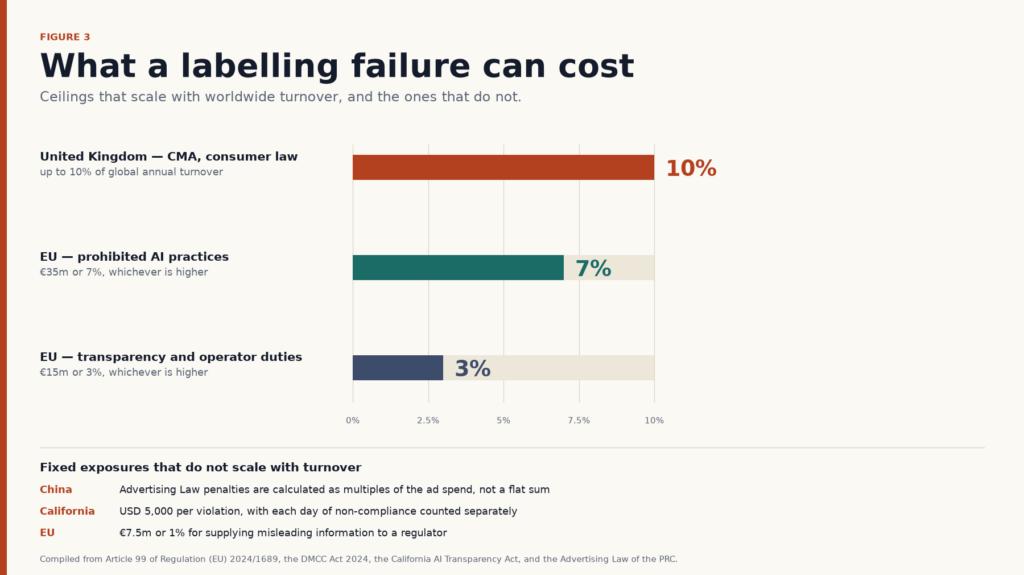
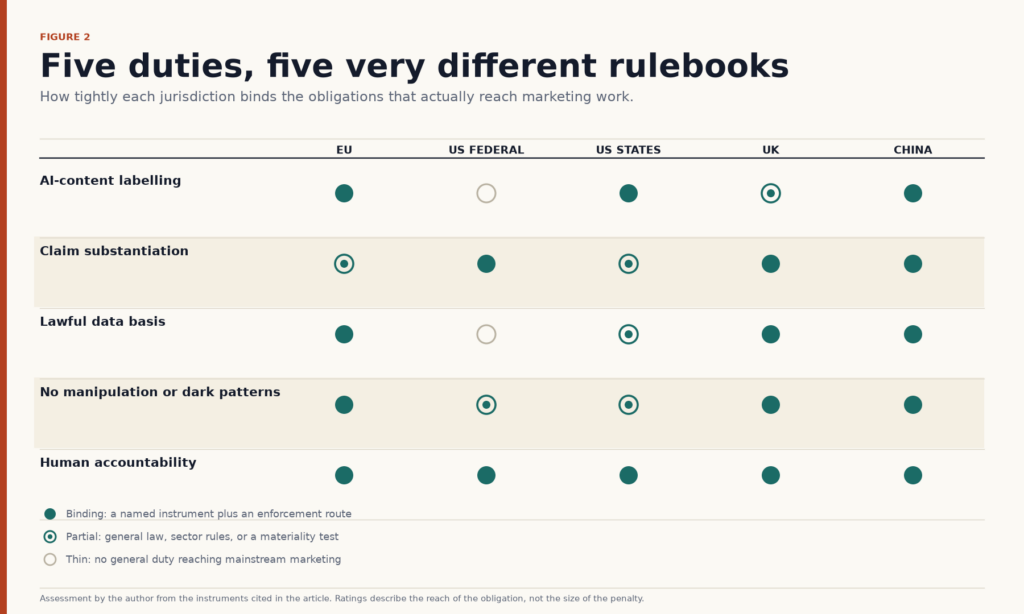
Five duties that survive translation across borders
Strip the national idiosyncrasies away and five obligations recur, in different strengths and with different instruments.
- Disclosure of synthetic content. Universal in intent, wildly variable in mechanism. Europe wants human-perceivable labels on deepfakes. California wants machine-readable provenance. China wants both, plus a metadata watermark. Britain wants disclosure only where silence would mislead.
- Substantiation of AI-generated claims. The strongest common thread, and the least forgiving. A hallucinated statistic is not a technical glitch; it is an unsubstantiated advertising claim.
- A lawful basis for the data behind personalisation. GDPR, UK GDPR, CCPA, PIPL. AI does not create a new permission to process data, and inferred attributes count as data.
- No manipulation. Europe bans subliminal and purposefully manipulative techniques where they materially distort behaviour. The FTC polices dark patterns. The CMA polices agents that exploit behavioural signals. The Commission’s own guidance says personalising ads from stated preferences is not inherently manipulative — which is a useful boundary, because it means relevance is fine and covert pressure is not.
- Human accountability. The one duty that translates perfectly. Every regime lands on a person or a company, never on a model.
A tracking discipline that fits inside a quarter
Regulatory tracking fails when it is treated as a one-off project. Here is a version that survives contact with a shipping calendar.
Inventory before you map. List every place AI touches marketing output: copy generation, image and video production, translation and localisation, dynamic creative, segmentation, bid optimisation, conversational agents, synthetic presenters. Nine or ten lines is typical, and most teams discover two they had forgotten.
Map each line to the strictest obligation it triggers, not the average one. If a single asset runs in the EU and China, it needs a human-visible label and metadata. Build for that, then subtract where a market permits. Building to the mean produces assets that are compliant nowhere.
Put the disclosure in the template, not the checklist. A label that has to be remembered at the end of a production cycle will be dropped at 6pm on a Thursday. A label baked into the asset template, the CMS block or the export preset will not.
Give the review a name and a clock. The editorial exception in Europe is strict: substantive examination, fact-checking included, by a publicly identifiable responsible person. Routine or automated review does not qualify. If nobody owns the sign-off, you do not have an editorial process; you have a hope.
Keep the paperwork. Prompts, model versions, review records, label placements, the reasoning behind a personalisation decision. In every jurisdiction examined here, the outcome of a dispute turns on what you can produce.
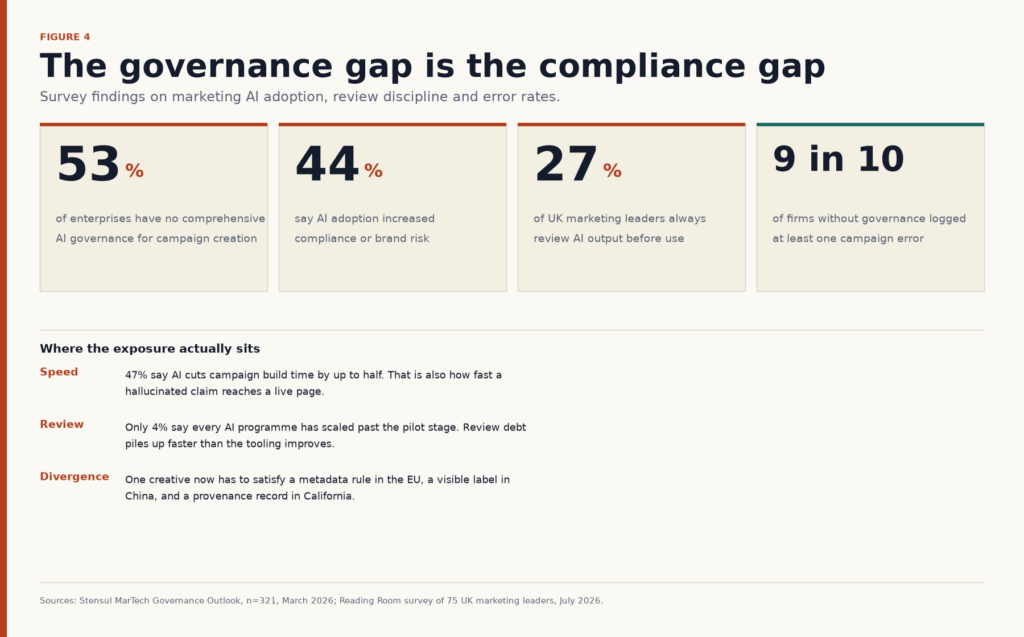
The uncomfortable caveats
Three things I would rather state than bury.
The rules are moving targets, and not always in one direction. Europe delayed high-risk compliance by sixteen months and tightened content labelling in the same instrument. The FTC withdrew one of its own AI orders. California’s election deepfake law was enjoined. Anyone selling you a fixed compliance map is selling you a snapshot.
Divergence is a genuine operational cost, not a consulting invention. One hero asset now needs a metadata payload for Europe, a visible badge for China, and a provenance record for California, and those three requirements were designed by people who were not talking to each other.
And the exemption myth deserves a quiet burial. Existing advertising and consumer law applies through the AI. There is no version of this where the model takes the blame.
What to do Monday
Pick one campaign that runs in at least two regions and audit it end to end. Find every synthetic element in it. Check whether a reasonable viewer would know. Check whether your metadata survives export. Check who signed off and whether that person could defend the claim under examination.
Then fix the template, not the campaign. Campaigns expire. Templates compound.