Your Users Are a Better Sales Force Than Your SDRs — and the Data Finally Proves It
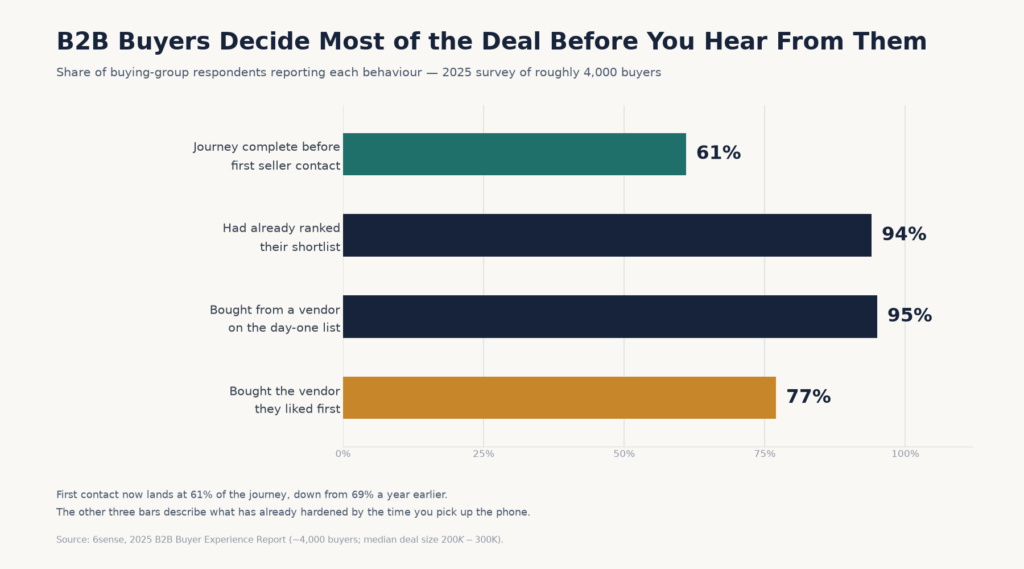
Here’s a number that should make any B2B marketer wince. When 6sense surveyed roughly 4,000 buyers for its 2025 Buyer Experience Report, it found that buying groups contact a seller about 61% of the way through their journey. By that moment, 94% had already ranked their preferred vendors. And in 95% of cases, the vendor that eventually won was on the shortlist on day one.
Sit with that. Your SDR isn’t opening the conversation — they’re arriving at the end of one. The buyer has already read, compared, asked a peer, and formed an opinion. Your first call is a confirmation hearing, not a pitch.
So where did that opinion come from? Increasingly, from other users. That’s the whole argument of community-led growth, and it’s the reason a strategy B2B spent fifteen years dismissing now looks like the cheapest growth asset on the balance sheet.
What community-led growth actually is
Community-led growth (CLG) is a growth model where your community — users, customers, practitioners — does the work that paid acquisition used to do. Members answer each other’s questions in public. They publish their own tutorials. They validate the product to strangers who trust them more than they trust you.
The important word is model, not channel. CLG is not “we have a Slack.” It’s a system where community activity maps to signups, retention, and expansion — and where someone can actually show you the mapping.
Three things community-led growth is not
It isn’t having a forum. A forum with no replies is a liability. It tells every prospect who finds it that the product’s users have better things to do.
It isn’t product-led growth with a Discord attached. PLG says the product sells itself. CLG says the users sell the product, to each other, and the product is the thing they’re gathered around. Different engine, different fuel.
It isn’t a content calendar with a community logo on it. If your “community” is mostly brand posts, you’ve built a broadcast channel with extra steps — and members can tell.
Why B2B ignored community for fifteen years
Let’s be fair to the people who said no. They weren’t stupid. They were answering the question their CFO asked.
Community is slow. It’s non-linear. It refuses to fit into a last-touch attribution model, because the value shows up as a member who read forty threads over eleven months and then booked a demo. Try putting that in a dashboard next to a LinkedIn campaign with a clean cost-per-lead. The LinkedIn campaign wins the slide deck every time.
And when acquisition was cheap, that was a defensible trade. Why fund a slow, fuzzy asset when you could buy pipeline by Thursday?
The uncomfortable part is what that trade actually built: a growth machine optimised for volume of arrivals rather than quality of fit. Which works right up until arrivals get expensive.
The math that changed
Three things moved at once, and together they broke the old arithmetic.
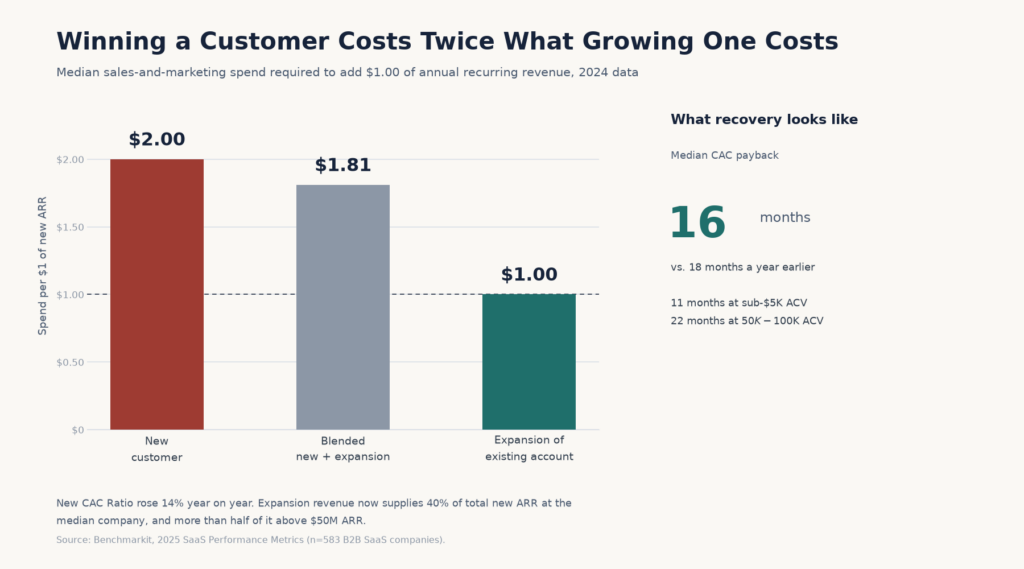
Acquisition got brutally expensive. Benchmarkit’s 2025 SaaS Performance Metrics, drawn from 583 B2B software companies, put the median New CAC Ratio at $2.00 — two dollars of sales and marketing spend for every dollar of new annual recurring revenue. That was up 14% year on year. The bottom quartile spends $2.82. Meanwhile the Expansion CAC Ratio sits at $1.00. Growing an account you already own costs half of what winning a new one costs.
Payback stretched out. The Aleph and Benchmarkit 2026 benchmarks, covering 342 companies on full-year 2025 actuals, put median CAC payback at 16 months. Sub-$5K ACV deals recover in 11. Contracts between $50K and $100K take 22. That’s a long time to carry a customer who hasn’t paid you back yet.
Expansion quietly became the growth story. In Benchmarkit’s data, expansion ARR now supplies 40% of total new ARR at the median company — and more than half above $50M ARR. If most of your growth comes from customers you already have, then acquisition stops being the main event. The question becomes: what makes an existing customer stay, grow, and bring someone with them?
Community answers all three. Not quickly. But it does.
The flywheel is around the funnel, not inside it
Most people try to slot community in as a funnel stage, somewhere between “awareness” and “consideration.” That’s the wrong mental model. Community isn’t a stage — it’s a ring that wraps the whole funnel and speeds up every part of it. Here’s the mechanics.
Acquisition
Members answer questions in public, at a volume and with a credibility your marketing team cannot buy. Ask yourself honestly: would you rather read a vendor’s case study, or a thread where three practitioners argue about whether the thing actually works? Habit says the thread.
Activation
New users get onboarded by peers. Templates get shared, “here’s how I set it up” posts get written, and support stops being the only path to a working account. This is also where the numbers get interesting: Hivebrite and Wonderly’s 2026 Community Growth & Benchmark Report, surveying 186 community professionals, found that 76.9% say events — online or in person — drive the most meaningful participation, with peer-to-peer support at 40.8%. Note what’s not at the top: brand-published content.
Retention
This is where community earns its keep and where the mechanism is easiest to explain. When a customer has answered someone else’s question in your forum, or had a problem solved by a stranger who uses the same tool, they’re no longer just a subscriber. They have standing. They have relationships. They have a reputation. Cancelling means walking away from people, not just a product.
CMX’s 2025 Community Industry Report found retention and engagement as a top objective for 19% of respondents, just behind support at 24% and success at 22%. Community people, it turns out, think of themselves as builders of the customer relationship, not of the pipeline.
Expansion
Engaged members find the advanced use cases first. They’re the ones who discover the integration nobody documented, and then write it up. They influence colleagues to expand. They become the references your sales team quotes.
That’s why Hivebrite’s data is such an awkward read for marketing leaders: when asked what they want most from community, 56.5% said stronger relationships and trust. Only 5.4% named revenue influence. The people running these programmes are not optimising for the thing their CFO asks about.
The playbook, in five moves
1. Pick a shared purpose that isn’t your marketing goal
The communities that survive cohere around a craft, a problem, or an identity — “the place where analytics engineers argue about modelling” — not around your roadmap. dbt’s origin story is almost embarrassingly literal here. Tristan Handy started a Slack channel in late 2016 with about a dozen early users because he and his clients needed somewhere to trade notes. Nobody was building a growth channel. They were trying to figure out how to work in a new way.
2. Give before you take
Community is earned. The brand has to put knowledge, access, and connection in before it pulls growth out. Programmes built to extract — free content from members, free advocacy, free sentiment — curdle. Consumers already know this is happening: in TINT’s research across thousands of consumers, 78% said the word community is overused by brands that don’t deliver one, and 68% said they’d feel more negatively about a brand that overpromised. TINT sells community software, so read those figures as directional rather than gospel — but the direction is consistent across every survey in this space.
3. Promote the 1%, then get out of the way
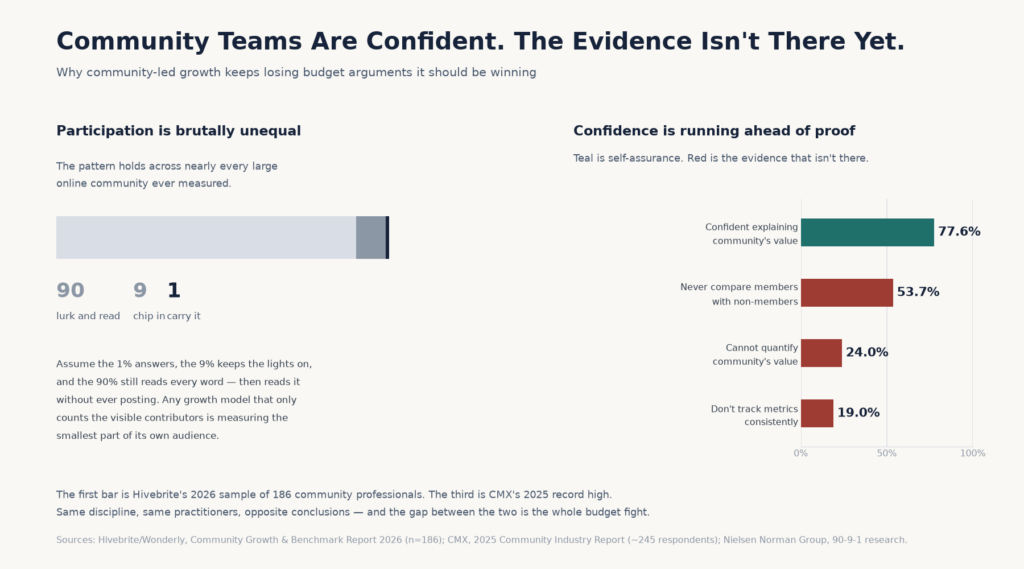
Participation inequality is the most reliable law in online communities. Nielsen Norman Group’s long-standing research puts the ratio at roughly 90–9–1: ninety percent lurk, nine percent chip in occasionally, one percent does nearly all the work. Wikipedia is more extreme still. This is not a problem to fix. It’s a structure to exploit.
Find your one percent. Give them status, early access, a title, a stage. They will out-produce your community team by a factor that makes hiring look inefficient. Hivebrite’s platform data hints at the target ratio for a healthy flywheel: about 3:1 member-generated to staff-generated content.
4. Measure like an operator, not a believer
Here’s the finding that should worry anyone running a community programme. Hivebrite asked 186 community professionals how they measure. 77.6% said they were confident explaining community’s value to leadership. At the same time, 53.7% never compare metrics between members and non-members, and 19% don’t track consistently at all.
That gap is the entire budget fight in one statistic. Confidence is running well ahead of evidence, and when the CFO asks the follow-up question, confidence doesn’t survive contact with a spreadsheet.
The fix is unglamorous. Build one table: retention, expansion, support cost, and referral rate for members versus non-members. That’s the CLG scorecard. CMX’s data suggests it pays off — teams whose community data is connected to the CRM rate their programmes as extremely successful at 24%, against 11.5% for those that aren’t. Correlation, not proof. Still worth noticing.
5. Wire community into product, support, and marketing
A community team sitting alone in a corner is a cost centre. A community team feeding product feedback, deflecting support tickets, and supplying marketing with real customer language is infrastructure. Hivebrite’s own platform trends show the direction of travel: roughly twice as many groups per community, 40% more member participation, twice as many users per administrator, and 30% of communities now using APIs to connect outward.
The uncomfortable part: most communities die
Let’s not pretend this is a happy story. Branded communities fail at a rate that should give everyone pause. The Deloitte and Beeline Labs study that shaped the conversation found over 60% of branded communities failed to gain traction by member count — and that was when participation was cheaper than it is now. Gartner’s widely quoted estimate was that around half of brand communities would be shut down.
Ask consumers why they leave and the answers are blunt. TINT’s data: not active enough (52%), not enough member value (50%), one-sided communication (41%). Every one of those is a resourcing failure, not a strategic one. Somebody stopped showing up.
An abandoned community is worse than no community. It’s a public notice that you don’t finish things, signed by the customers who trusted you most.
When community-led growth is the wrong answer
Some practitioners argue — and I think they’re substantially right — that CLG gets sold to companies who structurally cannot use it. The conditions where it genuinely works are narrow and identifiable:
- Your buyers are publicly identifiable with their tools. Developers, designers, analysts, ops people. They talk about their stack in the open because their craft is visible.
- Network effects exist. The product gets better as more of your peers use it. Without that, there’s little reason for a user to recruit another.
- There’s organic gravity already. You should be finding a community, not conjuring one. dbt’s Slack started because users were already emailing each other.
- You can absorb a long payback. If you’re at $1M ARR with a burn clock, an eighteen-month community build is a luxury you can’t fund.
Now the other side. If you sell territory-planning software to regional sales managers, or compliance tooling to HR directors, those buyers are in Zoom calls and email chains. They want peer references from people they already know, an ROI model that survives a budget meeting, and a case study from a company in their exact situation. None of that requires a forum. Building one anyway is how you end up in the 60%.
What dbt actually proves — and what it doesn’t
The dbt story is the best available evidence that this works, and it’s also the best available warning.
The mechanism: Handy set up a Slack for early users, and within a couple of years the community was doing marketing he never commissioned. People who ran data teams hosted meetups to convince other people to use dbt — so that they could hire dbt users. That’s not advocacy. That’s a labour market forming around your product.
The scale: from 100 users in 2017, growth held at roughly 10% month over month, then 3x year over year to about 1,000 companies by 2019. By early 2025 dbt had over 5,000 paying customers, more than $100M in ARR, and roughly 50,000 teams using it.
The warning: it still took $400M+ in venture funding and a $4.2B valuation to get there — and in 2026 dbt merged with Fivetran in an all-stock deal, combining to roughly $600M in revenue. Community built the category. It did not pay for the category. Anyone selling CLG as a way to avoid raising money or hiring a sales team is selling you something else.
Conclusion: the asset that gets cheaper
Paid channels get more expensive every year. That’s not a temporary condition; it’s the structure of an auction where more bidders keep arriving. Community does the opposite. Its marginal cost of growth falls as it matures, because the members start doing the work — answering, onboard — and the brand’s job shifts from producing engagement to protecting the conditions where it happens.
So here’s the honest version of the argument. B2B ignored community when it could afford to. It can afford to less and less. The brands that start now will spend the next three years building something that compounds while everyone else’s acquisition costs climb.
Start smaller than the pitch deck says. Fifty to two hundred of your best users, one owner, quarterly calls, a low-traffic Slack, and a members-versus-non-members table you can defend in a budget meeting. That’s not a growth engine yet. It’s the seed of one — and it’s the only version most companies can actually sustain long enough to find out.