Web3 Marketing Died; What Survived
I want to start with a sentence I have heard a hundred times in the last two years: the NFT thing was a bubble. Fine. Agreed. But that sentence is doing something sneaky. It lets everyone who missed the bubble feel like they dodged a lesson instead of a loss. And the lesson is still sitting there, unclaimed, like a coat left at a party nobody wants to admit they attended.
So let me be more precise than the obituary writers have been. Web3 marketing did not die because the technology failed. It died because most of what called itself Web3 marketing was never marketing at all. It was speculation wearing a marketing costume — a number-go-up mechanic dressed in brand language, with a Discord server standing in for a customer relationship.
Which raises the question that actually matters to anyone with a budget: if the costume is gone, what was underneath it?
More than you think. And less than the pitch decks promised. Let’s do this properly.
The Autopsy Nobody Wanted to Perform
Here is the part that gets skipped in the post-mortems. When you strip the speculation out of Web3 marketing, you are left with three mechanisms that were genuinely novel: ownership, portability, and verifiable access. None of those mechanisms required a token price to work. All of them got buried under one.
That distinction — mechanism versus narrative — is the whole ballgame. The narrative was that a token would align incentives, and alignment would produce loyalty, and loyalty would produce revenue. The mechanism was simpler and more boring: a customer could hold something the brand could not silently revoke, and a brand could prove who had shown up.
Guess which one survived.
What Actually Died
Let me bury the failures precisely, because vague autopsies produce vague lessons.
The airdrop as a growth engine
Handing out free tokens to bootstrap a community looked, for about eighteen months, like the cheapest customer acquisition channel ever invented. It was not. It was the most expensive way ever devised to rent a crowd.
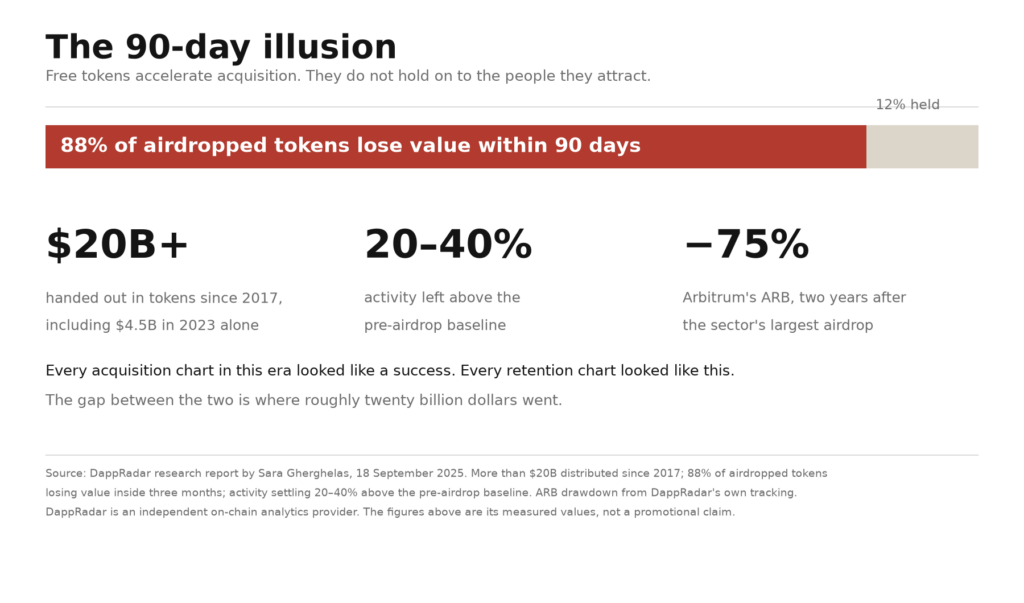
DappRadar’s research, published in September 2025, put numbers on what everyone suspected. Projects have distributed more than twenty billion dollars in tokens since 2017, including roughly 4.5 billion in 2023 alone. Within three months, 88% of those tokens had lost value. Activity settled at just 20–40% above the pre-airdrop baseline once the claim window closed. Arbitrum’s ARB, the largest airdrop in the sector’s history, was down more than 75% two years later.
You can build a spectacular growth chart out of that. You cannot build a business.
The metaverse land grab
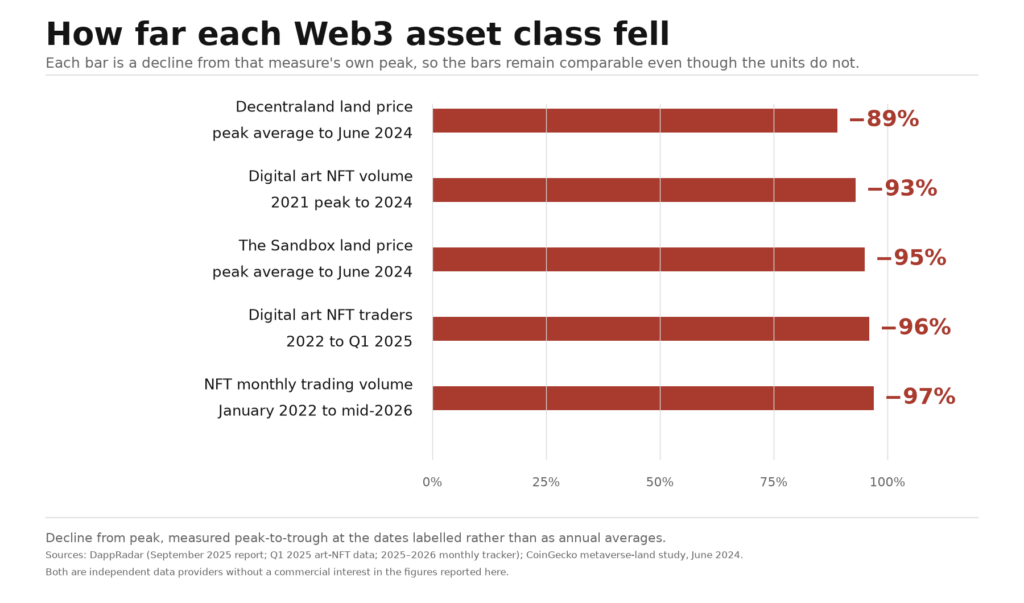
Brands bought virtual real estate as though foot traffic would arrive on schedule. It never did. A CoinGecko study found metaverse land prices already down 72% on average from their highs by June 2024 — The Sandbox off 95%, Decentraland off 89%, Otherdeed off 85%. The trophy deals aged worse. A nine-parcel Snoopverse estate next to Snoop Dogg’s virtual property sold for about $450,000 in December 2021; marked to current floor prices it screens at roughly $1,025. Metaverse Group paid about $2.4 million for 116 parcels in Decentraland’s Fashion District; the equivalent value today is under $9,000.
That is not a market correcting. That is a pricing model being deleted. Buyers had treated digital land as scarce real estate with brand tenants and resale scarcity. The market repriced most of it as illiquid optionality — a call option on a future that stopped being plausible.
The NFT drop as a stunt
Novel once. Then indistinguishable from a coupon. Then gone.
And here is the uncomfortable part for the brands that ran them: the drop was almost always measured by the only metric the mechanic could produce — secondary trading volume. Which meant the campaign’s success was, structurally, a function of how quickly your customers flipped the thing you just sold them. You built a loyalty program that paid people to leave.
The 90-Day Illusion, Stated Plainly
I keep coming back to the same number because it explains an entire era of marketing decisions. Ninety days. That is the average lifespan of enthusiasm purchased with a financial incentive.
Speculation-driven engagement has a shape. It spikes on announcement, peaks on claim, and decays to a new baseline within a quarter. This is not a Web3 quirk. It is a general rule: when the reward for engaging is the reward itself, engagement ends when the reward does.
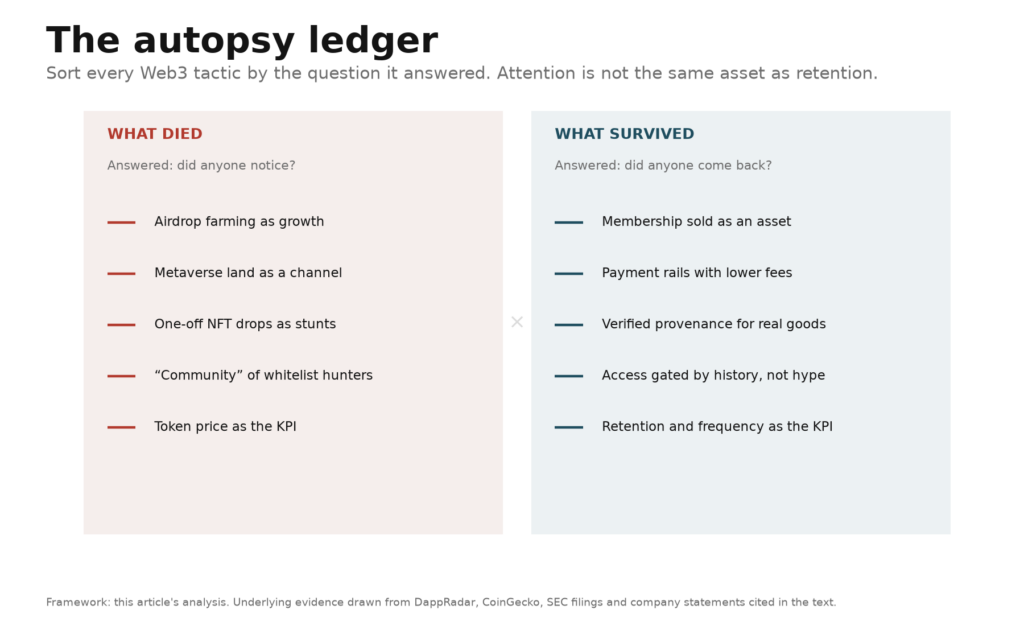
Which is precisely why the survivors are interesting. They all answer a different question. Not “did anyone notice?” but “did anyone come back?”
What Survived — and Why It Was Never Really Web3
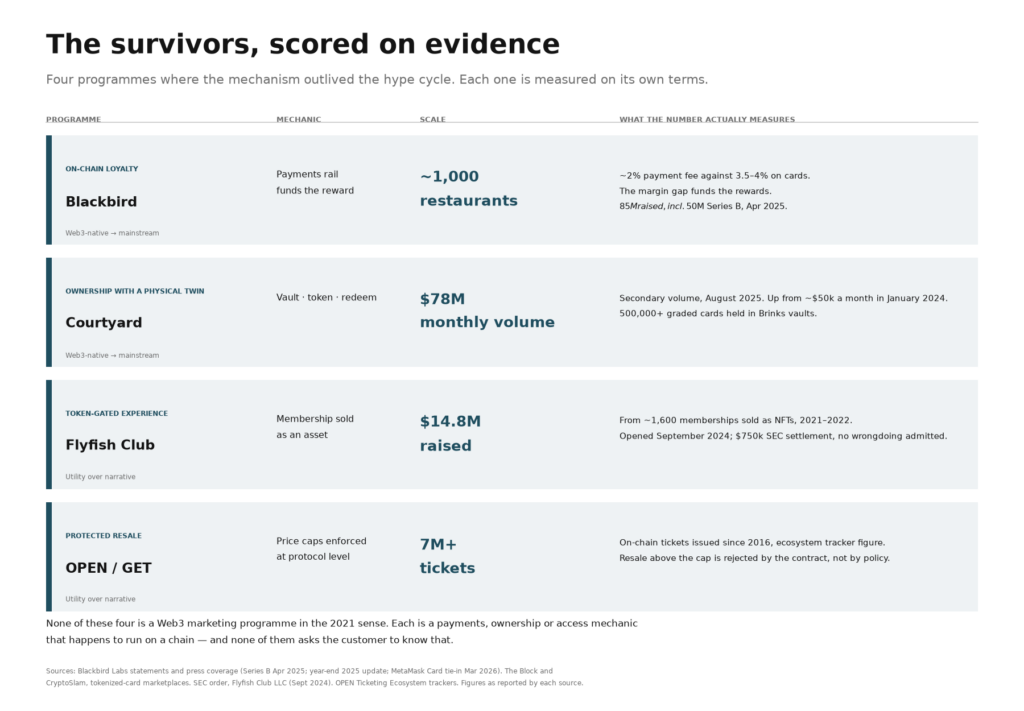
Four programmes are worth studying because each one is running a real experiment, at real scale, with real P&L consequences. None of them is a Web3 marketing programme in the 2021 sense. Each is a payments, ownership, or access mechanic that happens to run on a chain — and hides that fact from the customer.
Blackbird: the fee line funds the loyalty
Blackbird is the cleanest example of the post-hype playbook, and almost nobody frames it correctly. It is described as a crypto dining app. It is actually a payments company whose loyalty programme is funded by the margin it takes off card rails.
The mechanics: diners check in, pay through the app, and earn $FLY, which works across roughly a thousand restaurants in New York, San Francisco, Los Angeles, Denver, Charleston, and the Hamptons. Restaurants pay around 2% per transaction against the 3.5–4% that card processors typically take. That gap — roughly 1.5 points of margin on every check — is the budget from which the rewards are paid.
Read that again, because it inverts how most loyalty programmes are financed. Traditional programmes are a marketing expense queuing for a budget review. Blackbird’s is a share of a cost saving that already exists. It raised $85 million including a $50 million Series B in April 2025, and it has distributed more than 239 million $FLY across some 100,000 self-custodial wallets.
The lesson is not that blockchain is magic. The lesson is that a loyalty mechanic with its own funding source survives a downturn; a loyalty mechanic subsidised by a marketing line item does not.
Courtyard: ownership that has a physical twin
Tokenized trading cards should be the least credible idea in this article. Instead they are the most quietly successful.
Courtyard vaults graded Pokémon and sports cards with Brinks, mints a token that represents the physical item, and lets collectors trade the digital claim without shipping anything. Redeem the token and the card ships. In August 2025 the platform cleared roughly $78 million in secondary volume — about 5.5 times its January 2025 figure, and up from roughly $50,000 a month in January 2024. Across the tokenized card sector, quarterly revenue hit about $113 million in Q3 2026 against $37.6 million a year earlier.
Why did this work when digital art collapsed? Because the thing being owned was never the JPEG. It was a card in a vault, with a market price that exists independently of the token. Ownership was a liquidity wrapper around a real asset, not a bet on a picture.
Token-gated access, minus the casino
The third survivor is the least glamorous: access gated by history rather than hype.
Ticketing is the clearest case. Protocols like OPEN, formerly GET, have issued millions of tickets on-chain since 2016 while keeping resale price caps and organiser royalties enforced at the protocol level rather than by policy. The customer experiences a normal ticket wallet. The difference is that a resale above the cap is not discouraged — it is rejected by the contract.
That is a mechanism a marketing team can defend in a meeting, because it produces an outcome the CFO recognises: fraud down, resale margin retained, attendee history usable for the next on-sale.
The Four Brands That Ran the Experiment for Everyone
If you want the whole arc in four case studies, here it is. Two failures, one settlement, one survivor — and the difference between them is not technology.
Starbucks Odyssey: the honest failure
Odyssey launched in September 2022 with Polygon, married NFTs to Starbucks Rewards, and ended on 31 March 2024. At its close it had drawn a bit over 58,000 active users — a rounding error against the 35.6 million 90-day active members the core Rewards programme now reports. Of the 27 collections released, most traded below mint. Polygon reportedly paid $4 million for the partnership.
Note what Starbucks did next, because it is the most instructive part. It did not retreat from loyalty. It rebuilt the programme — a three-tier structure live since March 2026, a 60-star redemption that became its most-used reward, and a stated intention to make Rewards about recognition rather than discounting. Members now account for roughly 59% of US company-operated revenue.
The brand kept the loyalty engine and dropped the token wrapper. That is not a failure of loyalty. It is a correctly diagnosed failure of the wrapper.
Nike: the expensive lesson
Nike bought RTFKT in December 2021 at the top of the cycle. RTFKT wound down in January 2025. Nike sold it quietly in December 2025, and the .SWOOSH site retires on 5 May 2026, with future activations moving to SNKRS.
Then came the bill. In April 2025 a proposed class action was filed seeking at least $5 million, arguing the shutdown amounted to a rug pull and that the NFTs were unregistered securities. The filing draws the distinction that should worry every brand considering this path: when an artist stops producing, the work tends to appreciate. When a brand stops supporting the ecosystem its tokens depend on, holders are left with obsolete assets.
The lesson is about dependency, not crypto. If the value of what you sold depends on your continued promotional support, you have sold a liability with a marketing veneer.
Flyfish: the regulatory bill arrives
Flyfish Club sold roughly 1,600 memberships as NFTs between August 2021 and May 2022 at 2.5 ETH and 4.25 ETH, raising about $14.8 million to build a members-only restaurant in Manhattan. In September 2024 the SEC settled for $750,000, treating the memberships as unregistered securities, and Flyfish agreed to destroy its remaining NFTs and stop accepting royalties on secondary sales. The club opened that same month.
Two SEC commissioners dissented, arguing these were simply a different way to sell memberships. They may well be right about the principle. But the operator still paid, and floor prices had already fallen nearly 74% on the standard membership by the time the order landed.
The lesson here is narrower and harder: if you sell access as an asset, and you tell buyers the asset may appreciate, you have stopped selling access.
Blackbird, again — because the contrast is the point
Blackbird’s mechanism is the one that survives contact with a marketing budget review. It is a fee reduction that produces a reward, not a reward that requires a fee increase.
That is the entire difference between the four cases. Starbucks, Nike, and Flyfish each tried to import a financial instrument into a relationship. Blackbird imported a payments rail and let the relationship pay for itself.
What Web3 Got Right That Mainstream Marketing Still Misses
Here is where I part company with the smug post-mortems. Three of the underlying insights were correct, and mainstream marketing has not fully absorbed them.
Ownership changes the psychology
A subscriber has access. An owner has an asset. Those are different relationships, and they produce different behaviour. The research literature on psychological ownership is unambiguous that felt ownership increases care, advocacy, and willingness to defend the object — which is why brands have spent decades trying to manufacture the feeling through naming, customisation, and co-creation.
What Web3 contributed was not the psychology. It was the plumbing: a way to make the claim actually portable and actually provable. The psychology was always available. The mechanism was new. That is the piece worth keeping.
The superfan math is not a niche
The second insight is about concentration. MIDiA Research, working with SoundCloud, found that superfans contributing as little as ten cents a month made up just 1.9% of listeners but generated 42% of revenue under fan-powered royalties. Luminate’s data puts superfans spending about 80% more per month than the average music fan.
Web3 called this the community. Mainstream marketing calls it the top decile. Same insight, different vocabulary — and the vocabulary that survived is the one that came with a P&L.
Provenance is a product feature, not a certificate
The third is the least discussed and probably the most durable. Verifiable provenance turns out to be worth paying for when the underlying object has value: graded cards, memberships, tickets, limited editions. It is worth nothing when the object’s only value is that someone else might pay more for it later.
That is the test. Provenance attached to utility appreciates in usefulness. Provenance attached to scarcity alone is a rumour with a receipt.
The Post-Hype Playbook
If you are deciding what to do with this, here is how I would sort it.
Steal the mechanism, skip the narrative. Ownership, portability, and verifiable access are worth building. Token-price appreciation as a growth hypothesis is not a strategy; it is a bet on a greater fool, and the greater fool has left the building.
Fund the reward from a real cost. The single most reliable predictor of survival in the cases above is whether the incentive had a funding source other than the marketing budget. Blackbird’s fee gap, Courtyard’s vault-and-redeem spread, ticketing’s retained resale margin. If your loyalty mechanic cannot name the line item it is paid from, it is a discount with extra steps.
Measure return visits, not claims. Every failed programme in this article measured the moment of acquisition. Every survivor measures the third visit, the second season, the renewal. Pick the harder number.
Hide the machinery. Blackbird’s users do not think about wallets. Courtyard’s collectors do not think about minting. The brands that made customers learn crypto vocabulary were asking customers to do unpaid technical support.
Gate on history, not on hype. Access earned by prior behaviour — attendance, tenure, spend — is a loyalty mechanic. Access sold as an appreciating asset is a securities question in a trench coat.
Risks and Honest Caveats
A few things I would not paper over.
Do not misread the autopsy. Saying Web3 marketing died is not the same as saying nothing of value was there. Dismissing the whole space is the same intellectual error as over-hyping it, just with better hindsight.
The plumbing is still young. Wallets, onboarding, and custody remain real friction. Blackbird works because it hides them; most brands cannot. The principles are sound, the infrastructure is adolescent.
Regulation has not settled. MiCA prohibits paying interest on asset-referenced and e-money tokens, and treats holding-duration rewards as interest in some cases. The European System of Central Banks has argued for extending that ban to lending and staking arrangements; industry advocates pushed back during the consultation that closed on 30 September 2026 with more than 50,000 letters and 126,000 petition signatures. In the US, the Flyfish order and the Nike suit both turn on the same unresolved question. Anyone building here should assume the answer will be decided by a regulator, not by a whitepaper.
The word is contaminated. For a large share of consumers, Web3 signals speculation. Build the mechanic, brand it as membership or rewards, and skip the vocabulary. Starbucks did exactly this, and it worked.
The Takeaway
Web3 marketing, as hyped, is dead, and the obituary is fair. It measured attention and called it loyalty, priced access as an asset and called it community, and paid customers to leave while reporting the exit as engagement.
But the autopsy has a second finding, and it is the one worth carrying into next year’s plan. The durable part was never the token. It was three mechanisms — ownership you can prove, access you can verify, and value that moves with the customer instead of being trapped in a brand’s database.Those mechanisms are now the shared property of every loyalty programme that has quietly rebuilt itself around them — including the ones that would never put the word Web3 in a press release. Which means the honest verdict is not that the space failed. It is that the space succeeded at the only thing that ever mattered: it proved which parts were real, and then let the branding burn off.
The companies that lost money bought the narrative. The companies that are still here bought the mechanism, wrapped it in something a customer could understand, and let the speculation find another home.