Why Disclosure Rules Stopped Working: The Verification Gap Behind Influencer Compliance
The UK’s advertising regulator published two monitoring studies, four years apart, using the same question. In 2021 it found influencer ad disclosure inadequate. In May 2025, after scanning more than 50,000 posts from 390 influencers, it found 43% still non-compliant.
Four years. Two reports. One conclusion. And nobody was surprised.
That is the part worth sitting with. This is not a story about rules being unclear, because the rules are remarkably clear and have been for a decade. Germany’s Federal Court of Justice settled the principle in 2017: a commercial purpose must be apparent on first sight. The FTC has said “clear and conspicuous” since 1980. The ASA has published guidance, threatened, named names, and produced a diagram of exactly where “#ad” should sit.
So we have clear rules, twelve years of guidance, public enforcement, and a compliance rate that has barely moved. Why?
Because the disclosure gap is not an information problem. It is a verification-cost problem. And that distinction explains almost everything about how this market behaves.
The Asymmetry Nobody Prices
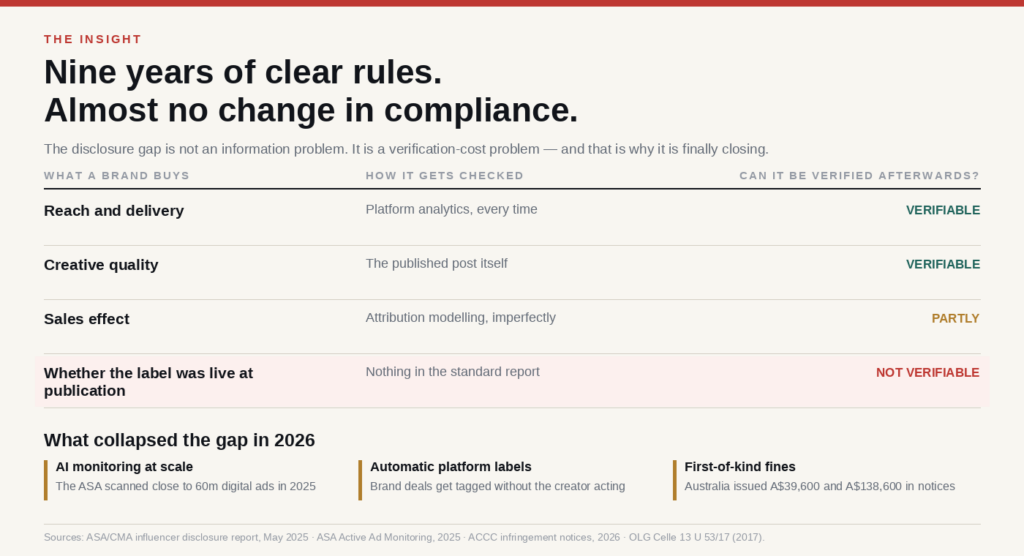
Think about what a brand is actually buying when it books an influencer. It buys reach, delivery, and creative quality — all of which arrive as platform analytics, in a dashboard, verified automatically, every single campaign. It also buys a sales effect, which gets modelled imperfectly but at least gets modelled.
Now consider the one thing that determines legal exposure: whether the label was live at the moment of publication.
Nothing in the standard reporting stack answers that question. There is no column for it. The creator’s screenshot arrives if you ask, and only if you ask. The platform’s declaration toggle is a black box you cannot audit from the outside — you can see that the creator used it, not whether the label survived an edit three days later.
That asymmetry has a predictable consequence. Firms invest where measurement is cheap and returns are visible. Disclosure, being neither, gets handled with a line in a contract and a line in a brief — which is to say, it gets delegated and then assumed. The brand’s conviction that its campaign is compliant is not evidence. It is an inference from the absence of complaints.
Why a Decade of Enforcement Changed Nothing
Conventional deterrence theory says penalties should close gaps like this. Raise the expected cost above the expected benefit, and rational actors adjust.
But deterrence requires the probability of detection to be legible. And detection in influencer marketing was, until very recently, closer to random sampling than to surveillance. The ASA can pursue a few hundred cases a year out of millions of posts. The FTC sends warning letters and negotiates consent orders that, while costly, arrive years after the campaign has been forgotten. Australia ran a sweep in 2023, found 81% of influencers posting content that raised concern, and imposed no penalties at all.
Read that sequence carefully. An 81% failure rate, discovered, published, and answered with nothing. That is not weak enforcement. That is enforcement teaching the market that disclosure is a reputational risk rather than a financial one.
Meanwhile the cost of compliance is real and immediate. A properly labelled post is less engaging — the label sits where the hook would be, and creators notice the engagement dip within days. So the market did what markets do with an unmeasured obligation carrying a real cost and a diffuse risk. It under-invested, quietly, at scale, and reported itself compliant.
What Actually Changed in 2026
Then three things landed in the same eighteen months, and each one attacked the verification problem directly rather than the penalty schedule.
Detection became cheap. The ASA’s Active Ad Monitoring system scanned close to 60 million digital ads in 2025, using AI to flag non-disclosure automatically. Non-compliance stopped being a needle in a haystack and became a machine-detectable event.
Verification moved to the platform. Automated brand-deal labelling now tags undisclosed partnerships without the creator acting, and accounts that hide them lose recommendation eligibility. The one fact brands could never audit is now asserted by a party with the data.
The penalties became administrative. The UK’s CMA can fine directly, without court, up to 10% of global turnover. Australia issued infringement notices — A$39,600 and A$138,600 — for exactly the conduct its 2023 sweep had found everywhere and punished nowhere.
Notice what these three have in common. None of them made the rule stricter. They made the rule cheaper to check. The law didn’t change in 2026. The cost of finding out whether you broke it collapsed — and behaviour followed.
The Lesson, Stated Plainly
The insight generalises well beyond influencer marketing. When a legal obligation is cheap to state and expensive to verify, compliance becomes theatre: contracts are signed, briefs are issued, everyone attests, and nothing is checked. Regulation that tightens language without shrinking the verification gap produces more paperwork, not more compliance.
The practical implication for brands is uncomfortable but simple. Your compliance risk was never really about knowing the rules. It was about the fact that nobody in your organisation could prove, on any given campaign, whether the label was live. Fix that, and the rest of the playbook gets a great deal easier.