INSIGHT — Why Good Translation Still Loses the Sale
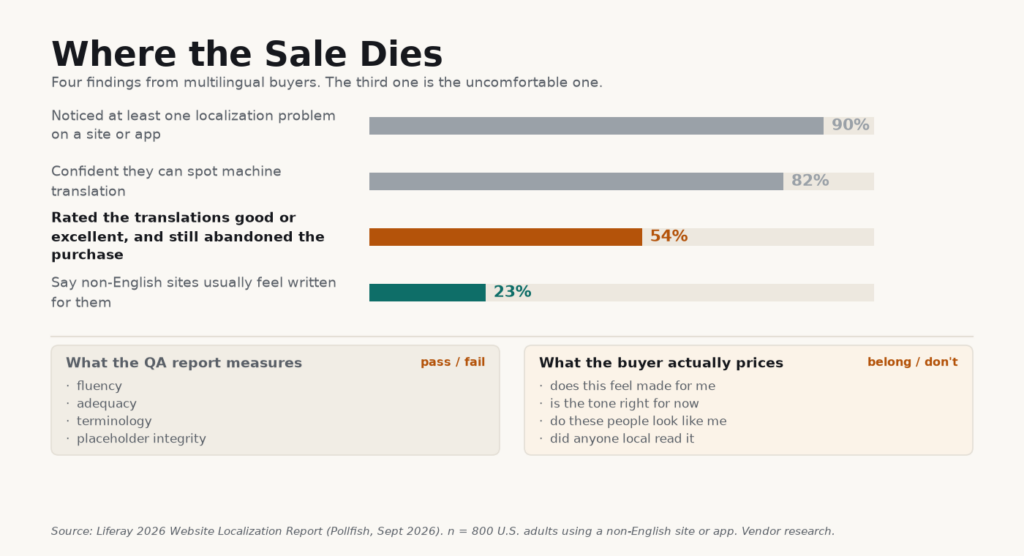
The number that should bother every localization lead is not 56. It is 54.
Liferay’s 2026 survey of 800 U.S. adults who had used a non-English site or app in the past year found that 56% had abandoned a purchase because the experience felt poorly adapted to their language. Expected. But among those who rated the brands’ translations good or excellent, 54% had still walked away. Almost the same number, drawn from the group that had already passed your QA.
Your translation scored well. Your buyer still left. That is not a quality failure. It is a measurement failure.
The Scorecard Problem
Translation QA asks whether a sentence is equivalent: fluency, adequacy, terminology, no broken placeholders, no corrupted tags. Binary, auditable, satisfiable. A vendor can hit 99% and hand you a report proving it.
None of that measures what the buyer is pricing. She is asking whether this feels made for someone like her. Whether the tone fits the moment. Whether these people look like her, whether the joke is hers. Nobody puts that in a bug tracker.
So you get the strangest outcome in marketing operations: two teams, two scorecards, both technically correct, and one of them describing a sale that never happened. The report says green. The funnel says red. Neither is lying.
What the Machine Fixed, and What That Revealed
When translation was slow and expensive, bad translation was invisible — it never shipped to small markets, because the cost of producing it was itself a form of triage. AI collapsed that cost. Every market got fully translated, and the volume of culturally wrong content expanded with it.
The ACL 2026 GEM workshop benchmark makes the boundary visible. The strongest multilingual models average roughly 2.1 out of 3 on full text, but fall to about 1.45 on puns and 1.65 on idioms — the exact material brand voice is built from. Grammar got solved. Voice got exposed.
That is why the problem feels new. Localization did not get worse. Translation got cheap enough to reveal how much of brand meaning was never in the words.
Why Buyers Notice, and Why They Do Not Forgive
The 82% figure is usually read as a warning about AI detection. The more interesting reading is what it implies about attention.
Fluent buyers have learned the texture of machine translation: a fluency slightly too even, no idiom that surprises, no rhythm that snags. They notice it the way you notice a fake smile — not through analysis, but through the small wrongness of it. Once noticed, it stops being a quality observation and becomes evidence about care. These people did not bother.
That judgment is about the brand, not the sentence. Which is why it survives a 99% pass rate.
Only 20% of Liferay’s respondents credit AI alone when localization feels strong; 43% credit human involvement. Buyers have worked out the division of labor. The industry is running behind them.
The Uncomfortable Part
The assembly line is fine. The inspection station is in the wrong place.
You are inspecting the artifact instead of the reaction to it. No amount of better translation closes that gap, because what got rejected was never the translation — it was the suspicion that nobody local had read it.
The fix is boring and expensive. Put a native reader between the QA gate and launch, and change the question. Not is this correct. Ask: does this sound like someone from here trying to sell me something? If she hesitates, you have found the 54%.