43% to 81%: The Compliance Gap Hiding in Every Global Influencer Campaign
In 2017, a German court examined an Instagram post and found the disclosure sitting in position two of six hashtags. Technically present. Practically invisible. The judges ruled it insufficient, and the reasoning was almost insulting in its simplicity: a label nobody sees is not a label.
Nine years later, that ruling still describes most of the internet.
Here is the uncomfortable truth about influencer marketing. The industry has spent a decade professionalising everything — rates, contracts, whitelisting, measurement — except the one sentence consumers actually need. And regulators across four continents have now run their own audits, independently, using different methods, and arrived at the same finding. Roughly half to four-fifths of the commercial content they checked either carried no disclosure or carried one too vague to count.
That is not a fringe compliance problem. That is the norm.
Why Disclosure Is the Whole Game
Strip away the regional quirks and there is one principle underneath all of it. Consumers must be able to tell, without effort, when content is paid for. Everything else — the hashtag, the platform toggle, the language, the placement — is machinery in service of that single idea.
Why does it matter so much? Because an undisclosed ad is not a labelling failure. It is a lie about the nature of a recommendation. When a creator you trust says a serum changed her skin, she is either telling you what she thinks or telling you what she was paid to think. The whole commercial value of influencer marketing rests on you not having to wonder.
Regulators Judge Perception, Not Intent
This is where most brands get caught. Your legal team knows the post was sponsored. Your agency knows. The creator obviously knows. None of that matters.
The test is what a rushed consumer scrolling on a bus perceives in the first second. The FTC’s Endorsement Guides make the point with a video example: a disclosure superimposed on screen for five seconds is easy to miss, and therefore not clear and conspicuous. The UK’s advertising code applies the same logic, requiring ads to be “obviously identifiable” before someone engages. Germany’s statute is almost brutally direct — the commercial purpose must be apparent “on first sight.”
On first sight. Not after a tap. Not after reading to the bottom. Not after hovering over a tiny “paid partnership” chip.
Where the Rules Actually Bite
United States: Clear and Conspicuous, and Now Expensive
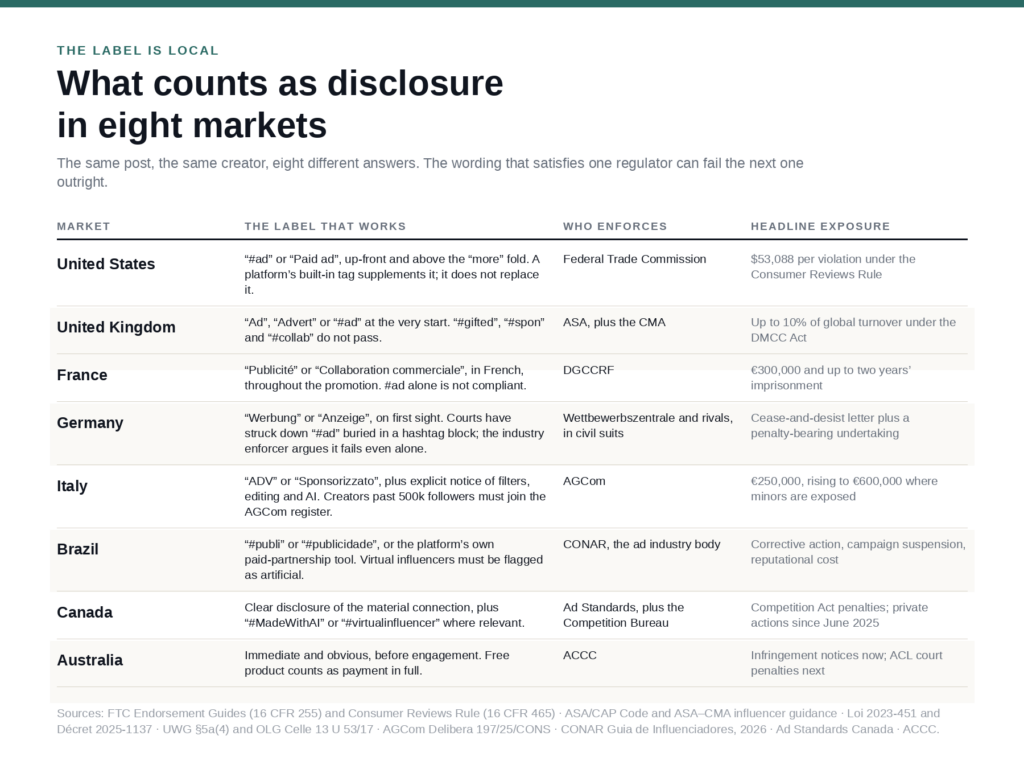
The FTC’s Endorsement Guides, revised in 2023, are the reference text. Disclosure must be clear and conspicuous: readily visible, easy to understand, and placed where consumers will actually encounter it. Not buried in a hashtag block. Not hidden behind a “more” button — a failure the FTC specifically flagged in warning letters to ten celebrities and influencers promoting a detox tea, whose disclosures only appeared after expanding the caption.
What changed the economics is the Consumer Reviews and Testimonials Rule, in force since October 2024. It converted a guidance regime into a penalty regime, with civil penalties of $53,088 per violation for knowing breaches. Pair that with the FTC’s 2021 notice of penalty offences sent to hundreds of companies, and the “we didn’t know” defence starts looking expensive.
United Kingdom: Obviously Identifiable, and Now Directly Enforceable
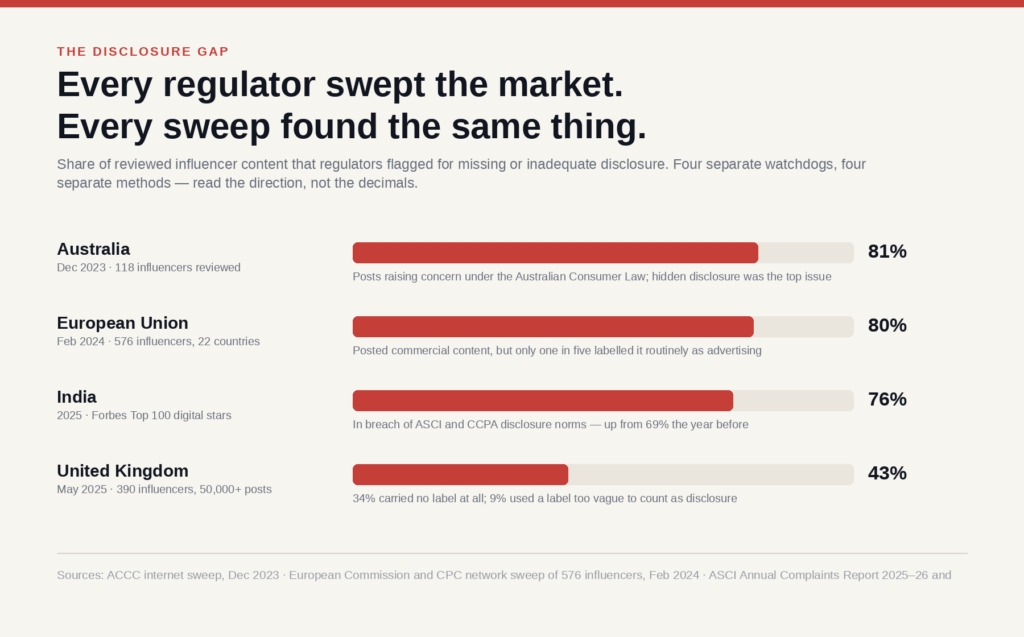
The ASA and CMA published a joint monitoring report in May 2025, drawing on more than 50,000 posts from 509 UK accounts and 390 individual influencers, screened with AI-assisted monitoring. Fifty-seven per cent disclosed adequately. Forty-three per cent did not — 34% with no disclosure at all, and 9% with a label too vague to do the job.
Vague means “#gifted,” “#spon,” “#collab,” “PR trip,” “affiliate.” The regulators have said repeatedly that these do not communicate commercial intent. Put “Ad” first, they advise. “Ad – Gifted” works. “Gifted” alone does not.
Underneath the self-regulatory layer sits something sharper. Since April 2025, the CMA can enforce consumer law directly under the Digital Markets, Competition and Consumers Act, with fines reaching 10% of global turnover — no court required. The ASA can name you publicly; the CMA can invoice you.
European Union: The Sweep That Embarrassed a Continent
In February 2024, the European Commission and national consumer authorities from 22 member states, plus Norway and Iceland, published the results of a coordinated sweep of 576 influencers. Ninety-seven per cent were posting commercial content. Only one in five disclosed it systematically. Eighty per cent failed.
That gap between 97% and 20% is the single most damning statistic in this field, and it is why Brussels kept legislating. The Digital Services Act added platform transparency duties. Then came the AI Act, whose Article 50 transparency obligations went live on 2 August 2026, requiring synthetic content and deepfakes to be labelled — and Article 99 sets penalties at up to €15 million or 3% of worldwide turnover.
France and Germany: The Label Must Speak the Local Language
Here is a distinction that catches global teams flat-footed. In France and Germany, English “#ad” is not a disclosure. It is a decoration.
France’s 2023 influencer law requires “publicité” or “collaboration commerciale,” clearly legible throughout the promotion. It also demands “images retouchées” for retouched images and “images virtuelles” for AI-generated faces or bodies. Miss the commercial disclosure and you face two years and €300,000. Miss the image label and it is one year and €4,500. Since January 2026, a written contract is mandatory once a single advertiser’s annual spend with a creator reaches €1,000 before tax, with joint liability across influencer, agent and advertiser.
Germany enforces through private litigation, which turns out to be just as bracing. Courts have rejected “#ad” tucked into a hashtag block. The industry-funded Wettbewerbszentrale has argued that “#ad” alone fails in the German market, and it has been suing to prove it — including against a racing driver promoting Swiss watches. Its revised 2024 guidance treats non-cash benefits as payment. A press trip is advertising. Loaned equipment is advertising. A March 2026 appellate ruling reinforced exactly that.
Italy: A Register With Teeth
Italy went further than anyone. AGCom’s Delibera 197/25/CONS created both a code of conduct and a public register of “relevant” influencers — anyone past 500,000 followers or a million average monthly views. Roughly 2,000 creators were expected to sign up. The register is not a professional licence; it is a transparency instrument that makes enforcement easy.
Penalties reach €250,000 for failures such as undisclosed advertising, rising to €600,000 where minors are exposed. AGCom can also suspend an account for up to six months. And the code requires creators to flag filters, editing and AI-generated imagery explicitly — a disclosure obligation most global briefs still don’t mention.
The Rest of the Map, Briefly
Canada’s Ad Standards Code now addresses AI-generated influencers directly, recommending “#MadeWithAI” or “#virtualinfluencer” labels; the Competition Bureau can act independently, and private enforcement has been available since June 2025.
Brazil’s CONAR updated its influencer guide in May 2026, consolidating “#publi” and “#publicidade” conventions and requiring virtual influencers to be flagged as artificial.
Australia is the one to watch. The ACCC’s sweep of 118 influencers found 81% posting content that raised concern — 96% among fashion creators. Until 2026 the consequences were reputational. Then PhotobookShop paid A$39,600 in infringement notices for orchestrating undisclosed gifted endorsements, and Hismile paid A$138,600 across seven notices. Individuals can face A$2.5 million; companies A$50 million.
India combines a self-regulatory code with a statutory overlay. ASCI processed 1,609 influencer ads in its 2025–26 year and required modification of 97.3% of them — though that figure measures all corrective action, not disclosure alone, and more than half involved categories where advertising is restricted or banned. Separately, 76% of Forbes India’s Top 100 digital stars were found in breach of disclosure norms, up from 69%.
What Non-Disclosure Now Costs
It is tempting to treat these as theoretical maxima. Mostly they are. But look at the shape of the exposure rather than the top line.
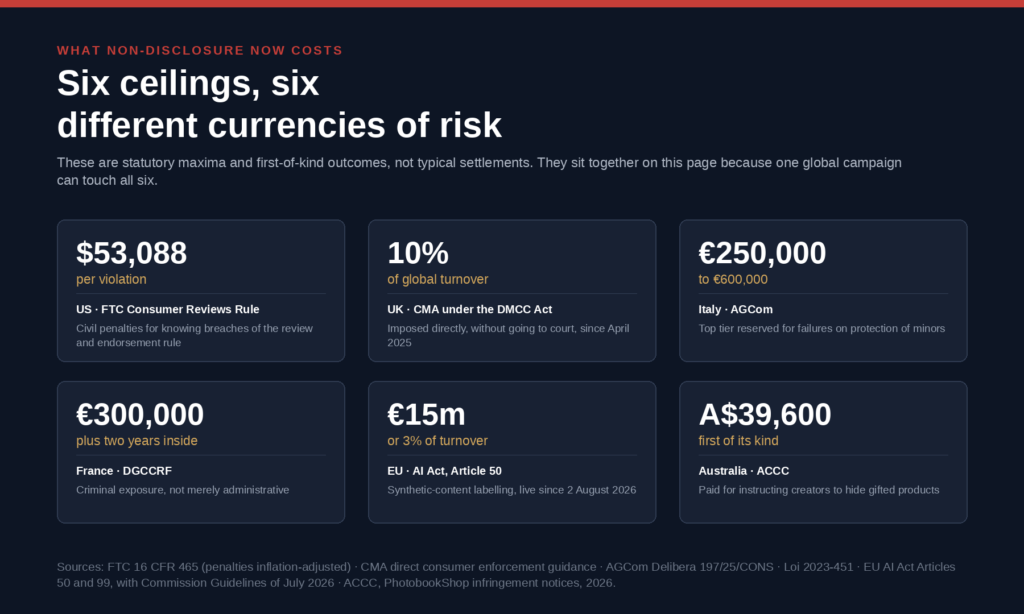
The important shift is that penalties are no longer exclusively administrative and slow. The UK can fine directly. Australia issued infringement notices without going to court. The FTC can seek civil penalties per violation rather than negotiate a single consent order. If you run one campaign across five markets and skip disclosure in three, you have not made one mistake. You have made three, in three jurisdictions, with three different enforcement clocks running.
The AI Wrinkle
Virtual Influencers Broke the Assumption
Every disclosure regime was written on the premise that a human being was recommending something. A synthetic persona recommending a product has no experience to report and no preference to share. There is nothing underneath.
Regulators moved quickly. The FTC’s guidance now addresses AI-generated spokespeople. France requires “images virtuelles.” Italy requires notice of AI and filters. Canada names virtual influencers in its code. The EU AI Act adds a separate labelling layer for synthetic content that stacks on top of the advertising disclosure — meaning a virtual influencer ad in Europe may need two labels, not one.
The Material Connection Got Wider
The other quiet expansion is what counts as payment. Cash was always obvious. Free product, gifts, trips, event invitations, affiliate links, employee relationships — all of these now trigger disclosure duties in most major markets. Germany’s enforcer has been explicit that a press trip is consideration. Australia said plainly that free products and tickets count.
The practical consequence: a gifting programme is an advertising programme. If your seeding strategy ships product to 500 creators with no contract and no brief, you have 500 undisclosed ads waiting to happen.
Platforms Became a Second Regulator
Then there is the layer nobody budgets for. Platforms now label brand deals themselves when creators don’t, and they demote accounts that hide them. Automated detection has made non-disclosure a machine-detectable event rather than a needle in a haystack.
This is helpful and dangerous at once. Helpful because it catches what you missed. Dangerous because a platform label is a platform’s judgement, not a legal safe harbour. Every regulator examined here treats the native toggle as a supplement. None treats it as a substitute.
The Playbook That Survives Jurisdictions
You cannot harmonise eight legal systems. You can harmonise your process. Here is the version that holds up.
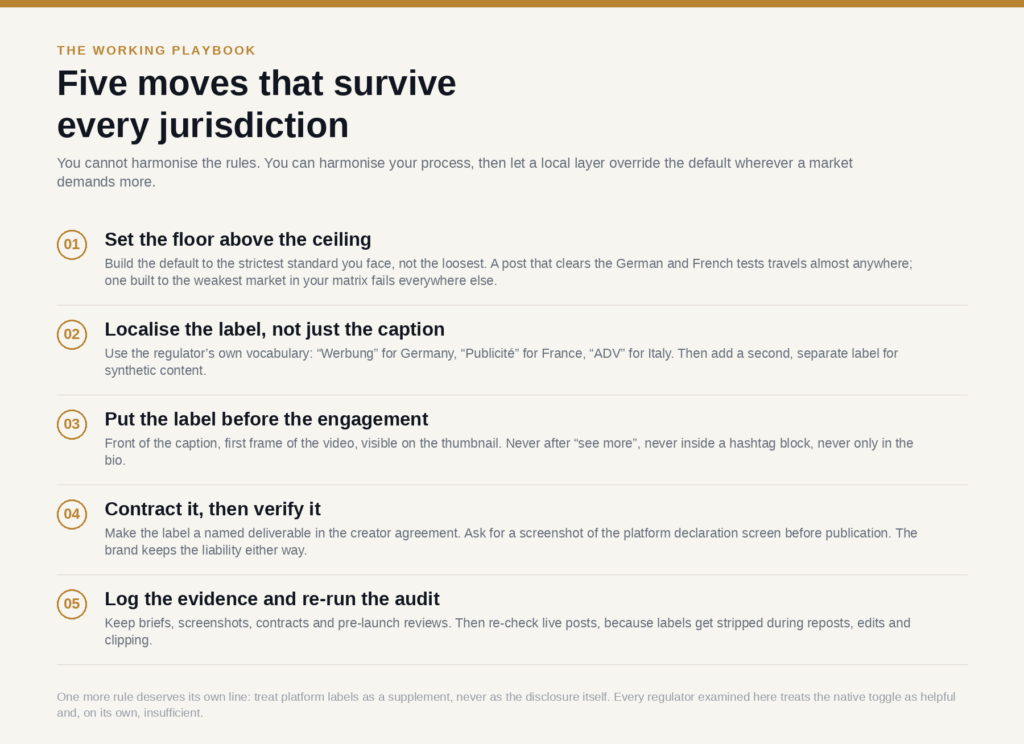
Set the floor above the ceiling. Build your default to the strictest standard you face, not the loosest. A post that clears the German and French tests travels almost anywhere. A post built to the weakest market in your matrix fails everywhere else. Most teams do the opposite — they build to the median and patch the exceptions — which is precisely how compliance debt accumulates.
Localise the label, not just the caption. Translating “Gifted” into German does not make it a disclosure. You need the regulator’s own vocabulary: “Werbung” or “Anzeige,” “Publicité” or “Collaboration commerciale,” “ADV” or “Sponsorizzato.” And you need a second, separate label for synthetic content wherever AI imagery appears.
Put the label before the engagement. Front of the caption. First frame of the video. Visible on the thumbnail. Never after “see more,” never inside a hashtag block, never only in the bio. If your creative treatment fights this requirement, change the creative treatment.
Contract it, then verify it. Make the disclosure a named deliverable in the creator agreement, with the exact wording, language and placement specified. Then ask for a screenshot of the platform’s declaration screen before publication. Yes, that is friction. Yes, it is cheaper than an infringement notice.
Log the evidence and re-run the audit. Keep briefs, contracts, screenshots and pre-launch reviews. Then check the live posts, because labels get stripped during reposts, edits and clipping — and because the version you approved is not always the version that published.
Risks and Honest Caveats
The brand pays. This is the part that still surprises marketing directors. Regulators hold the advertiser liable for the creator’s non-disclosure. “The creator did it” is not a defence anybody has successfully run. In France, liability is explicitly joint across influencer, agent and advertiser. If you briefed the campaign, you own the outcome.
Rules are moving targets. The ASA moved to AI-driven monitoring and batched enforcement waves. Germany’s case law keeps sharpening. The EU added an entire AI transparency layer in August 2026. A compliance policy reviewed once a year is a policy that is wrong for eleven months.
Over-correction is its own tax. There is a real cost to clumsy disclosure — the triple-stacked “SPONSORED AD SPONSORED” caption that reads like a warning label and performs accordingly. The goal is not maximal disclosure. It is unmistakable disclosure, delivered without wrecking the content. Those are different things, and the second one is a creative problem, not a legal one.
The patchwork is genuinely burdensome. There is no global standard, no mutual recognition, no shortcut. A regional matrix is not bureaucracy for its own sake. It is the only honest way to operate.
What to Do Monday Morning
If you take one thing from all of this, take the arithmetic. Four independent regulators swept their markets and found failure rates between 43% and 81%. Your campaign is statistically more likely to be non-compliant than compliant, and the enforcement climate has shifted from reputational to financial in every major market within roughly eighteen months.
So start where the risk is cheapest to fix. Write the disclosure line into your creative template, in every language you publish in. Add the synthetic-content label to your AI production workflow before the next campaign, not after. Put the verification screenshot into your launch checklist. And keep a record, because the first question any regulator asks is not “what did you do” but “can you prove it.”
Influencer marketing runs on trust. Disclosure is not a tax on that trust — it is the mechanism that makes it defensible. The creators who label clearly are not less persuasive. They are the only ones who can still be believed.