The Ban Arrived. The Rulebook Didn’t.
The rulebook was cancelled. The ban was not. What marketers actually have to prove now — and why silence has become the more expensive strategy.
On 27 September 2026, “eco-friendly” became a banned phrase in European consumer marketing. Not discouraged. Not “subject to guidance.” Banned — written into the blacklist of the Unfair Commercial Practices Directive, prohibited in all circumstances, with no case-by-case assessment required and no reprieve for stock already sitting on shelves.
If you have spent the last decade writing that phrase, approving it, or defending it in a brand review, sit with that for a second. The adjective you reached for when you had nothing specific to say is now the one you cannot print.
But here is the part almost nobody outside a legal team has noticed, and it is the reason this story is stranger than the headlines suggest. The law that would have told you how to prove a green claim — the verification standard, the lifecycle methodology, the accredited auditor, the EU-wide certificate — was withdrawn. Announced dead on 4 November 2026, six weeks after the ban on vague language took effect.
So Europe now enforces a prohibition with no prescribed method of proof. It knows what it will not tolerate. It has declined to say what it will accept. And every marketer working inside that gap has to decide, alone, what “substantiated” means.
That is the real 2026 story. Not “regulators cracked down.” Regulators half cracked down, and the half they left standing is the half that lands on your job.
Why vague green language finally got expensive
The case for action was never really about bad intentions. It was about arithmetic so lopsided that regulators eventually had to move.
The European Commission’s own market study found that 53% of environmental claims across products sold in Europe were vague, misleading or unfounded. Forty percent had no supporting evidence at all — not weak evidence, not contested evidence, none. And the labels meant to guarantee all this? More than 230 sustainability labels were circulating in the EU, roughly half of them with weak or non-existent verification.
Think about what that market looks like from the inside. A shopper stands in an aisle holding two packages, both printed with a green leaf, both claiming to be the better choice, neither claim meaning anything in particular. She has no method of adjudication. The honest brand has no way to distinguish itself. The dishonest brand has no reason to stop.
That is a market failure with a specific shape: the cheap signal drives out the expensive one. A vague claim costs nothing to make and works nearly as well as a real one. So why would anyone pay for a lifecycle assessment?
The International Consumer Protection and Enforcement Network ran a coordinated sweep of websites and analysed roughly 500 in detail. Around four in ten were using environmental language in a way a regulator could reasonably call misleading. Not four in ten of the worst sites. Four in ten of the sample.
Once you have that number, the regulatory question stops being whether and becomes how fast.
Two laws were drafted as partners. Only one showed up
Here is the structure most coverage gets wrong.
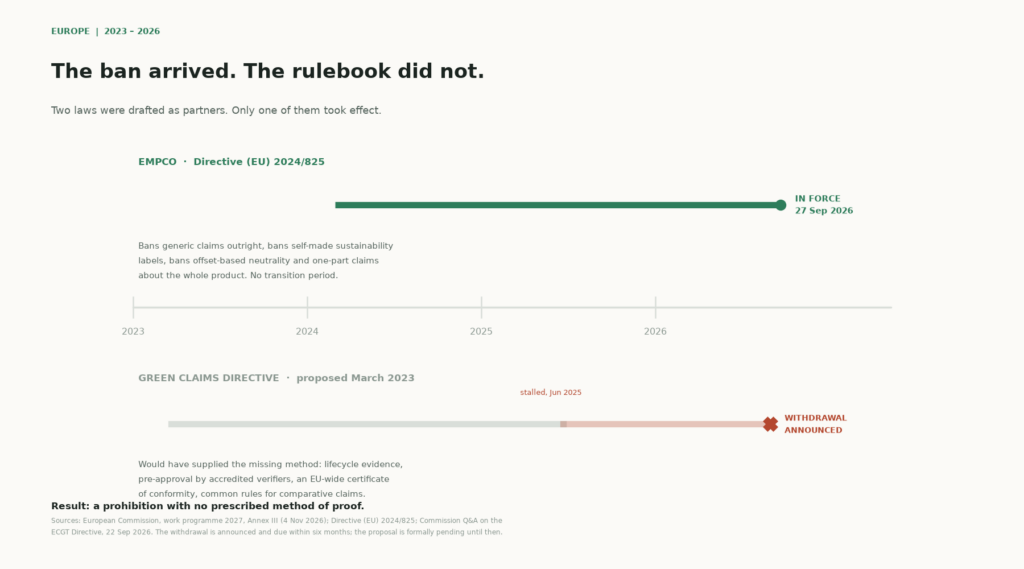
The Empowering Consumers for the Green Transition Directive — Directive (EU) 2024/825, universally shortened to EmpCo — was adopted in February 2024, had to be transposed by 27 March 2026, and has applied since 27 September 2026. It is a maximum-harmonisation instrument. Member states cannot water it down, and cannot gold-plate it either. It works by amending the Unfair Commercial Practices Directive, which means it inherits an enforcement machine that already exists and already has teeth.
The Green Claims Directive was its companion piece. Proposed in March 2023, it was supposed to supply everything EmpCo deliberately left out: the requirement that explicit claims rest on recognised scientific evidence and a lifecycle perspective, pre-approval by an independent accredited verifier before the claim went public, a certificate of conformity recognised across the single market, and dedicated rules for comparative claims.
It never got there. The Council failed to agree a negotiating mandate in June 2024. A decisive trilogue was cancelled in June 2025 after the European People’s Party — the Parliament’s largest group — asked the Commission to withdraw the proposal as overly burdensome. The Commission then spent more than a year saying it intended to withdraw without actually doing so. On 4 November 2026, its 2027 work programme placed the directive in Annex III: the list of pending proposals to be pulled within six months. The stated reason was procedural and slightly brutal — the file had been stuck with the co-legislators for over three years and was unlikely to find Council support in any reasonable timeframe.
One technical note worth keeping: the withdrawal is announced, not yet completed. The proposal remains formally pending until the Commission finishes the procedure. If you are writing a compliance memo, that distinction matters. If you are writing marketing copy, it changes nothing — you are governed by EmpCo either way.
What is actually banned, in plain terms
Let me get concrete, because this is where most brand teams are still exposed.
Generic environmental claims are out, unless you can demonstrate recognised excellent environmental performance relevant to that specific claim — the EU Ecolabel, an officially recognised EN ISO 14024 scheme, or top-tier performance under other EU law such as an A energy rating. The Commission’s illustrative list is a roll-call of a decade of copywriting: “environmentally friendly,” “eco-friendly,” “green,” “nature’s friend,” “ecological,” “climate friendly,” “gentle on the environment,” “carbon friendly,” “biodegradable,” “biobased.”
Notice the escape hatch, though, because it is generous. A claim stops being generic the moment the specification appears in clear and prominent terms on the same medium. “Climate-friendly packaging” is generic. “100% of the energy used to produce this packaging comes from renewable sources” is specific, and it walks straight past the ban. The regulation is not asking you to stop talking. It is asking you to stop being vague while you do it.
Self-made sustainability labels are out unless they rest on a certification scheme with independent third-party monitoring, or are established by a public authority. Your in-house green seal, the one your design agency drew in 2021, is not a label under this rule. It is a liability.
One-part claims about the whole product are out. If the recycled content applies to the bottle and not the cap, you cannot present the bottle as recycled. This is where the beverage industry got caught.
Offset-based neutrality is out — and this one deserves its own section, because it deleted an entire vocabulary overnight.
Presenting legal compliance as a distinctive benefit is out. “Contains no banned substances” is not a marketing claim. It is the law.
Irrelevant benefits are out. The Commission’s own example is gluten-free bottled water, which I include mainly because it is a perfect miniature of an industry’s worst instincts.
The offsetting ban deleted a language, not just a claim
“Climate neutral.” “CO₂ neutral certified.” “Carbon positive.” “Climate net zero.” All of these are now prohibited where the neutrality rests on offsetting — in all circumstances, however well documented the offsets are, however reputable the project.
You may still talk about investing in carbon credit projects. You may not buy your way to the word “neutral.”
You can see the retreat in brand architecture already. Lufthansa renamed its “Green Fare” to “Impact Fare,” explaining that the new name “places even stronger emphasis on customers’ contribution to greater sustainability in aviation and thus reflects new regulatory requirements for environmental communication.” Read that sentence twice. It is a masterclass in saying nothing while complying with everything.
And future-facing promises now come with a filing cabinet attached. A claim about performance in 2050 — “net zero by 2040” — is misleading unless it rests on clear, objective, publicly available and verifiable commitments, set out in a detailed and realistic implementation plan with measurable time-bound targets and allocated resources, regularly verified by an independent third-party expert whose findings are made available to consumers.
That is not an aspiration anymore. That is a costed project plan with an auditor marking your homework in public.
The audience already moved, and they moved away
Here is where the compliance story and the commercial story collide.
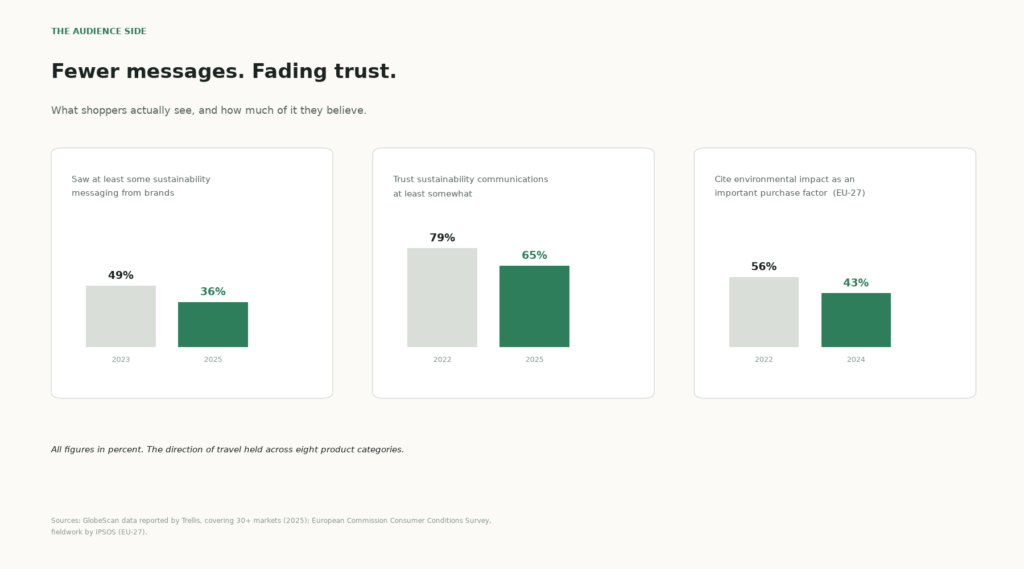
GlobeScan data across more than thirty markets shows that in 2025 only 36% of consumers reported seeing at least some sustainability messaging from brands, down from 49% in 2023. Trust fell in parallel: 79% expressed at least some trust in 2022, 65% by 2025. Both declines held across eight product categories — cars, cleaning products, clothing, electronics, financial services, home furnishings, packaged food, personal care. That consistency is the tell. This is not a category problem. It is a category-independent problem.
The European Commission’s Consumer Conditions Scoreboard, fielded by Ipsos across the EU-27 plus Iceland and Norway, adds the sharper number: the share of EU consumers saying environmental impact influenced a recent purchase fell 13 percentage points between 2022 and 2024, to 43%. The decline showed up in 23 of the 27 member states. And the reasons consumers give are not apathy — 67% say sustainable products simply cost too much, 62% say they are confused about which products are genuinely green, and 62% say they do not trust environmental claims.
And then there is the gap that ought to make every CMO uneasy. BCG’s 2026 survey of more than 20,000 consumers across 11 European countries finds willingness to pay a green premium holding at 17% — roughly one in six. Meanwhile 53% say they are worried about their day-to-day finances, up from 40% in 2024, 63% buy only on promotion or actively hunt discounts, and 62% would switch brands for a better price.
Seventeen percent will pay more for sustainability. Sixty-two percent will leave you for a discount. Both numbers are true, and the second one is larger.
Britain took the teeth the EU left on the table
While Brussels was losing its verification standard, London was quietly building something more operationally aggressive — and if you sell into the UK, this is the regime that should worry you most.
The Competition and Markets Authority published its Green Claims Code in September 2021, built on six principles: claims must be truthful and accurate, clear and unambiguous, must not omit or hide important relevant information, must be substantiated, must consider the full life cycle, and must be fair and meaningful in context. Guidance without penalties, for years.
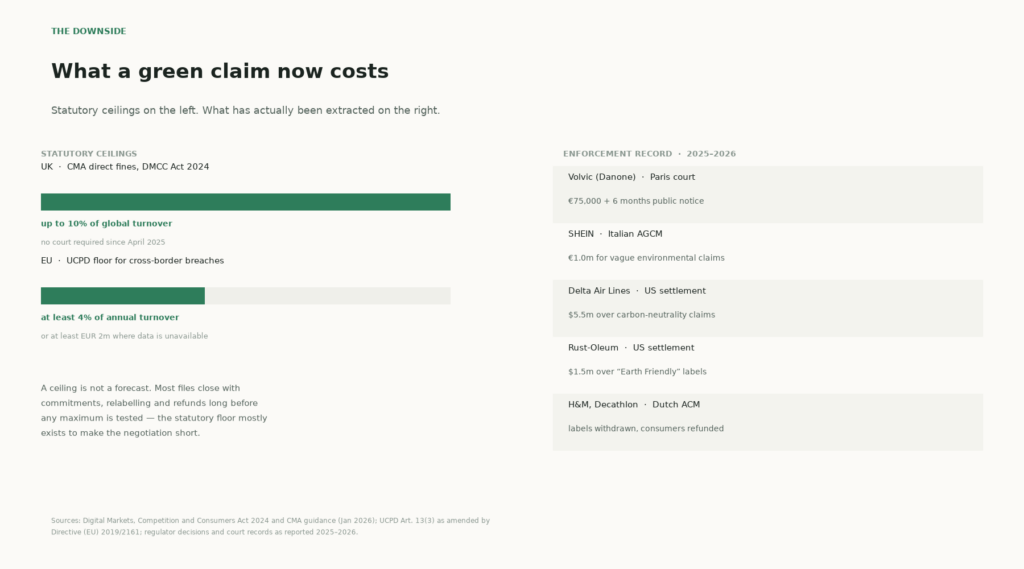
Then the Digital Markets, Competition and Consumers Act 2024 changed the arithmetic. Since April 2025 the CMA can fine directly, without going through a court, up to 10% of an organisation’s global turnover for misleading commercial practices. Compare that with the EU floor of 4% for cross-border breaches and the UK ceiling is, on paper, more than twice as severe — and reachable by an administrative process rather than litigation.
In January 2026 the CMA extended the logic across the supply chain, with guidance titled “Making green claims: getting it right, across the supply chain.” Its central move is to redefine who is making a claim. Every business that makes, relays or relies on an environmental claim is expected to ensure it is accurate. Retailers are told explicitly not to assume an upstream supplier’s claim is compliant, but to hold evidence and contractual rights to reassess it. The CMA says it will pursue whichever party originated the misleading claim or is best placed to correct it.
The Advertising Standards Authority has been running its own track in parallel, and February 2026 produced a pair of rulings that read like a syllabus. On 4 February, acting on complaints brought by Procter & Gamble, the ASA upheld challenges against Kit & Kin and The Cheeky Panda over claims including “sustainable,” “eco,” “biodegradable,” and “kinder to the planet.”
Read the reasoning carefully, because it defines the modern standard. Without qualification, the ASA treated “sustainable” and “eco” as absolute claims — meaning the product causes no environmental harm across its entire life cycle — and therefore demanded full-lifecycle evidence. Kit & Kin offered a B Corp certification, FSC-certified paper, carbon-neutral manufacturing and a rainforest partnership. The ASA acknowledged all of it and pointed out that none of it appeared in the ads, and none of it proved the absence of harm. The nappies still contained plastic-based Velcro tabs and leg cuffs.
On “biodegradable,” the evidence showed the viscose component broke down in home composting at 28°C, in soil, and in marine environments. It did not show that the wipe as a whole would biodegrade under real-world conditions. The claim was misleading.
And on “kinder to the planet,” the ASA held that a comparative claim requires its basis to be clear in the advertising itself — not in a methodology document nobody opens.
America is a patchwork, and the patchwork is the risk
The US picture is genuinely confusing, and the confusion is the point.
The FTC’s Green Guides remain the reference standard for how the agency reads Section 5 of the FTC Act on environmental claims. They are guidance, not law — but they shape enforcement and are cited constantly in private litigation, including by courts that treat them as informative rather than binding. They have not been meaningfully updated, and Congress has begun describing them, in legislative language, as outdated.
Federal legislation is moving on recycling and labelling instead. The Recycled Materials Attribution Act would set national standards for recycled-content claims, create a third-party certification system, explicitly recognise mass balance accounting as a valid substantiation method, and direct the FTC to revise the Green Guides accordingly. The PACK Act would create federal standards for “recyclable,” “compostable” and “reusable” labels on packaging, verified by accredited certifiers. Both advanced through committee in 2026.
Meanwhile California’s SB 343, the law much of this federal activity is modelled on, is itself under a preliminary injunction after a federal district court found challengers likely to succeed on vagueness and First Amendment grounds.
So: no federal statute, guidance everyone calls outdated, a state patchwork, and the flagship state law temporarily blocked. If you are a national brand, that is not a safe harbour. It is four different exposures wearing one label.
Private plaintiffs do not wait for regulators. In Bush v. Rust-Oleum, a case filed in 2020 over Krud Kutter products labelled “Non-Toxic” and “Earth Friendly,” a California federal court refused to dismiss and later refused summary judgment. Two holdings from that litigation matter more than the money. First, the court declined to treat the Green Guides as dispositive, leaving the reasonable-consumer question to a jury. Second, it rejected the puffery defence outright, reasoning that “Earth Friendly” is not so general that a consumer could not rely on it, and that a small-print back-label disclaimer may not cure a prominent front-label claim — the defendant’s own surveys showed most consumers never read the back. Final approval came on 2 October 2025: $1.5 million, plus permanent removal of “Non-Toxic” and qualifying language added to “Earth Friendly.”
The Delta Air Lines litigation is the more instructive case, precisely because it has not settled. Filed in 2023 over Delta’s “world’s first carbon-neutral airline” claim, it survived a motion to dismiss and, as of mid-2026, a California federal judge narrowed the proposed class and denied injunctive relief while refusing to toss the California law claims — leaving a damages case alive on whether the offset-dependent neutrality claim was false. The exposure is not a fine. It is years of discovery, a public record of your sustainability file, and a ruling that defines what your claim meant.
The PFAS wave has pulled in outdoor brands, apparel makers and fast-food chains — in most of those cases not because anyone claimed “PFAS-free,” but because broad language like “natural,” “safe,” or “eco-friendly” was read as implying the absence of things the plaintiff then found present. In January 2026 a California federal court certified a class in Jeruchim v. J.M. Smucker, holding that a product need not be labelled “PFAS-free” for a reasonable consumer to assume it, where the rest of the packaging asserts health benefits.
The paradox: everyone went quiet, and it cost them
Now the part that should reframe how you think about this entire subject.
Faced with real legal exposure, what did companies do? They stopped talking.
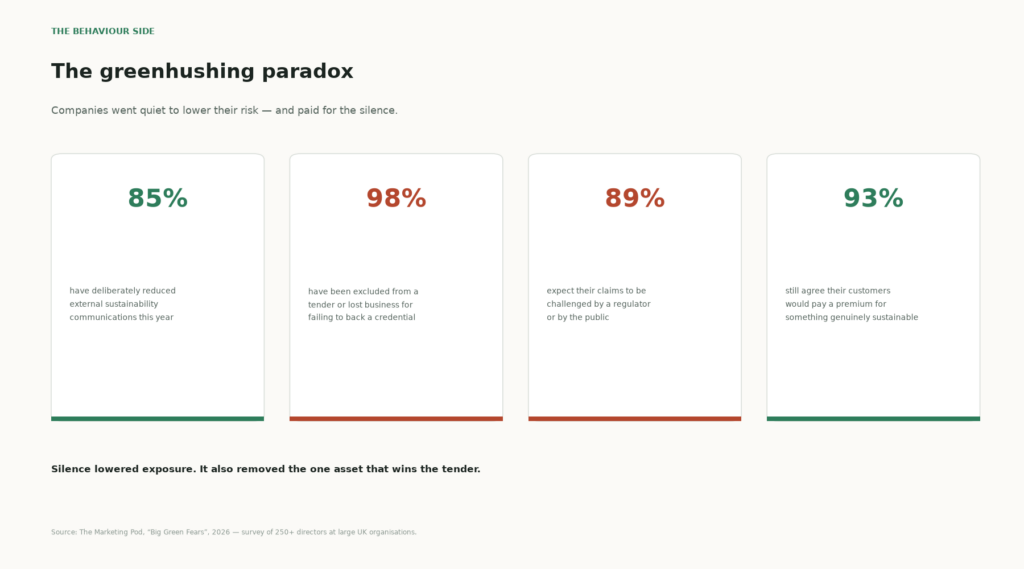
The Marketing Pod’s Big Green Fears research, surveying more than 250 directors at large UK organisations in 2026, found that 85% had deliberately reduced external sustainability communications over the past year — while continuing to celebrate the same progress internally. Eighty-nine percent expected their claims to be challenged by a regulator or by the public. Twenty-nine percent named keeping up with regulation as their single biggest green fear for the year.
Then the punchline. Ninety-eight percent said they had been excluded from a new contract opportunity, or had lost business, because they could not back up their sustainability credentials.
Read those two numbers together. Companies reduced disclosure to reduce risk, and the reduction itself became the commercial risk. Utilities were the extreme case: every decision-maker surveyed in that sector had lost business over a sustainability gap. Finance sat at 80%. Manufacturing reached 91% once you include those who sometimes lose out.
The mechanism is not mysterious. Procurement teams are asking for evidence — partly because their own legal departments read the CMA’s January guidance and told them to. A supplier who has gone quiet in response to enforcement pressure has no file to hand over. Silence that was meant to look prudent reads, from the other side of the table, as nothing to show.
The strategic contradiction is stark, and the report says it out loud: firms are trading long-term growth for short-term safety. Ninety-eight percent acknowledged customers would pay a premium for a genuinely sustainable product, yet only 16% planned proactive sustainability investment over the following 18 months. That is not caution. That is a budget decision dressed as a compliance decision.
What “substantiated” now requires, in five tests
Since nobody handed you a methodology, here is the one that survives contact with every regime currently operating. It is not EU-specific; it is what a regulator, an advertising body and a class-action plaintiff will each independently look for.
1. Specificity. Replace the adjective with a quantity, a percentage, a measurement, or a named standard. “Made from 60% post-consumer recycled PET” clears the bar. “Eco-friendly” fails it. The Commission’s drafting makes this the pivot point of the whole regime: specificity is not a virtue, it is the exemption.
2. Evidence, held before publication. Not evidence you could assemble if challenged. Evidence already in a file, dated, attributable, and specific to the product as sold — not to a materially similar predecessor. Both February ASA rulings turned precisely on this: lifecycle analysis existed, but on a different product (toilet tissue rather than nappies; face wipes rather than baby wipes), and was not transferable.
3. Scope discipline. State what the claim covers and, where it matters commercially, what it does not. “This bottle is 100% recycled, excluding cap and label” is compliant. “100% recycled bottle” is not, even if the bottle body genuinely is. The distinction cost three major beverage companies a multi-year negotiation with European regulators.
4. No misleading implication. A claim can be literally true and still deceive. “Compostable” that only degrades in an industrial facility at high temperature is the canonical example, and it is exactly the reasoning the ASA used against “biodegradable” wipes where only the viscose component broke down under test conditions.
5. Defensible comparability. “Greener than,” “kinder to the planet,” “better for the world” all require a like-for-like basis disclosed in the ad itself. The ASA has been explicit: the basis must be clear in the advertising, not buried in a methodology document.
The playbook: what actually works in 2026
Lead with numbers, not adjectives. The most compliant sentence is usually also the most persuasive one, because it is the only one a sceptical reader cannot dissolve on contact. “38% less water per wash than our 2019 formula” beats “kinder to the planet” on every dimension that matters — credibility, defensibility, memorability.
Build the evidence file before the campaign, not after the complaint. One file per claim, dated, with the underlying data and the name of whoever signed it off. Review it on a cycle. When a retailer asks under their supplier terms — and after January 2026 they will — you either have the file or you have a problem.
Put legal in the copy review, not the compliance audit. The regulatory bar is now specific enough that legal review has to happen at draft stage, on the actual words, in the actual layout. A claim that survives in a footnote does not survive on a pack shot.
Disclose limits on purpose. Naming what your claim excludes is counterintuitive and it works. It removes the plaintiff’s best argument — that you implied more than you said — and it reads as confidence rather than caution. The beverage settlements were not lost by companies that named the cap and label. They were lost by companies that did not.
Audit the imagery, not just the words. The Commission’s guidance treats a green leaf or a water drop, particularly combined with a logo, as capable of being read as a voluntary trust mark. Decorative green is a claim. Your design system is now a regulated surface.
Treat the supply chain as your claim. If your supplier’s assertion is wrong, it is your claim that misleads. Contract for evidence, audit rights and notification of change. The CMA has been explicit that it will pursue whichever party is best placed to fix the problem, and “my supplier told me” is not a defence — it is an admission that you never checked.
Stop confusing greenhushing with prudence. The safest communication position in 2026 is not silence. It is narrow, evidenced, specific speech. Silence forfeits tenders, cedes the category narrative to whoever is willing to be precise, and does nothing to reduce legal exposure — because the claim you never substantiated is still printed on the packaging.
The reframe nobody expected
The obvious reading of the last three years is that sustainability marketing got harder. The more accurate reading is that it got sorted.
Vague claims are now illegal in Europe and litigable almost everywhere else. That is bad news for exactly one kind of marketer: the one whose sustainability story was a tone of voice rather than a set of facts. For everyone else — for the brands with actual lifecycle data, actual certifications, actual reductions to point at — the crackdown removed their competition. The cheap signal that used to drown them out is now a legal hazard for anyone who tries it.
And the demand did not evaporate. McKinsey and NielsenIQ’s five-year analysis of US retail scan data — 600,000 SKUs, roughly $400 billion in annual revenue, 44,000 brands — found products carrying ESG-related claims grew 28% cumulatively from 2017 to 2022, against 20% for products making no such claims, and accounted for 56% of category growth. That is behavioural data: it measures what people bought, not what they told a survey. The authors are careful to call it correlational, and they should be — it does not control for marketing spend or distribution.
One finding from that study deserves more attention than it gets. Products making the least common claims grew 8.5% faster than peers making none, while the most prevalent claims — “environmentally sustainable” — delivered only about a 2% differential. Rarity was the differentiator. Which is precisely what a ban on generic language does: it makes specificity scarce, and scarcity is where the premium lives.
So the strategic conclusion is not “retreat.” It is narrower and more demanding: the premium is still there, but it now only pays for claims that can survive an auditor, a competitor’s complaint, and a class-action subpoena. That is a higher bar. It is also, finally, a bar that rewards the truth.
The takeaway
Europe kept the ban and dropped the rulebook. Britain kept the rulebook and added 10% of global turnover. America kept neither, and handed the job to state attorneys general and plaintiffs’ lawyers. Three different regimes, one identical requirement underneath all of them: say something specific, and be able to prove it.
The phrase “eco-friendly” is not a style choice you lost. It was a placeholder for a claim you had not yet done the work to make. In 2026, the placeholder is gone, and the work is the marketing.