Why Zero-Party Data Got Easier to Collect and Harder to Trust
Two Salesforce trends move in opposite directions. The gap between them is the most useful diagnostic in personalisation right now.
I’ve been running preference capture for a while now, and the thing that keeps surprising me isn’t the opt-in rate. It’s what happens after the answer lands. So let me start with a diagnostic that explains why.
Two numbers that shouldn’t be possible together
Salesforce’s State of the AI Connected Customer tracks two opinions that, on paper, ought to move in the same direction.
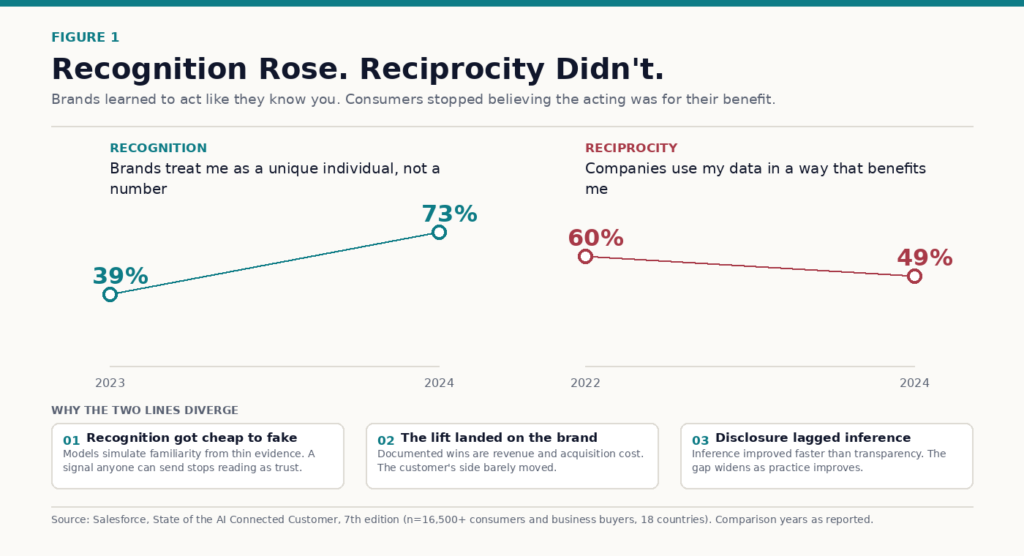
In 2023, 39% of customers said brands treated them as a unique individual rather than a number. By 2024, that was 73%.
In 2022, 60% said companies used their data in a way that benefited them. By 2024, that was 49%.
Recognition nearly doubled. Perceived reciprocity fell by eleven points. Same customers, same period, same survey instrument.
Everything in the industry’s story says these should be correlated. If a brand understands you better, presumably it serves you better, and you notice. That’s the pitch. And yet, across 16,500 consumers and business buyers in eighteen countries, the two lines peeled apart.
The plain reading, which is wrong
The obvious interpretation is that brands got worse at handling data. More breaches, more creepy ads, more regulators.
But that reading doesn’t survive contact with the practice. Zero-party collection has been the genuinely consumer-friendly corner of the discipline: you ask, they answer, you use it. The brands doing this well are not the ones generating distrust. If anything, they’ve made sharing easier — one question in a size guide instead of a wall of checkboxes.
So something else is happening. Three mechanisms, and they compound.
Mechanism one: recognition became cheap to fake
When the 39% figure was recorded, simulated familiarity was expensive. Remembering that you browsed trail shoes in March required an identity, a cookie, a device graph — infrastructure with real cost, and a browser ecosystem increasingly hostile to it.
Generative models collapsed that cost. A language model can produce a paragraph of apparent familiarity from almost no evidence. It can sound like it remembers you. And it will sound like it remembers you whether or not it knows anything at all.
That’s the mechanism: when everyone can perform recognition, the performance stops functioning as proof of care. A signal that used to be scarce and costly became abundant and free. Customers read it as a technique, not an attention.
This is also why recognition scores can rise while trust falls. The metric measures whether people receive the impression of being understood. Roughly a third of that improvement is real capability. The rest is a cheaper ability to seem capable — and customers update on both.
Mechanism two: the lift landed on the brand’s ledger
Here is the part practitioners rarely say out loud. The documented returns from personalisation are almost entirely brand-side.
McKinsey’s long-running work puts the upside at a 10% to 15% revenue lift and 10% to 20% lower acquisition costs. Those are real, and they’re excellent — for the operator. But notice what the customer receives in that transaction: the same product, the same price, the same inbox volume, slightly better targeted.
The benefit is unevenly distributed by construction. Personalisation today mostly converts a better experience into margin captured upstream, not value handed back.
So the question “does the brand use my data in a way that benefits me?” gets answered honestly — and the answer is “not proportionally”. Customers aren’t wrong about the imbalance. They’re describing it.
Mechanism three: disclosure lagged inference
Inference capability advanced. Disclosure practice didn’t.
Deloitte’s 2025 survey found only 20% of consumers say tech providers are “very clear” about what data they collect or how it’s used. Twenty per cent. That number has not moved much while the inference side has industrialised.
The asymmetry is structural rather than conspiratorial. Even a brand that improves its data practice year over year will see perceived reciprocity fall, because the customer can observe the capability rising while the visibility of use stays flat. Practice improving and perception falling are not contradictory here. They’re the same event seen from two ends.
What this looks like in practice
Field note, from a preference-centre rebuild I worked on.
We captured a stated intent — buying a gift, November, under a hundred, for a sibling — and the model produced a genuinely good recommendation. The customer clicked it. Then followed nine days of the same retargeting creative from a campaign built in September, plus a “we miss you” email, plus a discount prompt.
We had done the hard part well and broken it in the last mile. The stated intent never reached the systems that spend money. When I traced it, the preference lived in one platform and the ad decision ran in another, connected by an overnight batch job that dropped fields it didn’t recognise.
That is the pattern behind the 49%: the answer gets collected, then leaks. Each leak teaches the customer that answering was decorative. Do that three times and the opt-in rate falls — not because asking is unwelcome, but because answering now costs credibility.
Which mechanism you should fix first
If your recognition is high and your reciprocity is low, the diagnosis depends on where the leak is.
Ask one question: of the preferences captured last quarter, what share actually changed something the customer could see within thirty days? If that number is healthy, your issue is mechanism three — publish what you collect and how it’s used, in plain language, at the point of collection. If it’s low, mechanism two is your problem, and no amount of messaging will fix it.
Mechanism one is the environment. You can’t reverse it. What you can do is stop relying on the performance of knowing someone and make the actual knowledge do visible work. Recognition is now table stakes. Reciprocity is the differentiator, and it’s measurable.