Why Purpose Marketing Stalled — And It Wasn’t the Consumers
The standard explanation for purpose fatigue is a consumer story: audiences got cynical, caught the washing, stopped believing. It’s a good story. It’s also, I think, mostly wrong — or at least it mistakes the symptom for the cause.
Here’s the number that reframes it. In Capgemini’s survey of 2,146 senior executives across 716 organisations, 92% said they were holding firm on their net-zero timelines. Only 21% had a detailed transition plan with interim targets and capital allocation. That’s a 71-point gap between the sentence and the spreadsheet.
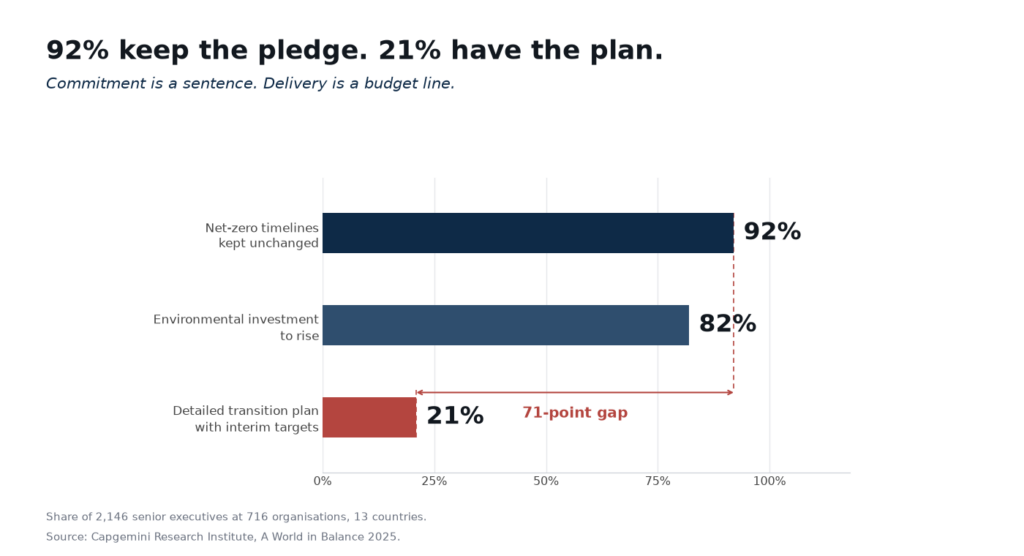
A 71-point gap isn’t confusion. Organisations that size don’t accidentally fail to write a plan. It’s a choice, and choices have prices. So what does each side cost?
Announcing is cheap and instant. A net-zero pledge costs a press release and a paragraph in the annual report. It’s legible on the day it’s made. It moves a sustainability rating. It satisfies an investor question in a Tuesday call. The return arrives within the quarter.
Delivering is expensive and slow. A real transition plan means interim targets that constrain next year’s capex, capital reallocated away from growth projects, supply contracts renegotiated with suppliers who will push back, and a number in the board pack that can go the wrong way for three years before it goes right. The return arrives in a decade, if at all, and it’s invisible on most scorecards.
Put those two side by side and the behaviour stops looking like a failure of will. It looks like arbitrage. Purchase the cheap signal, defer the costly one, and book the credit now.
This is why the fatigue arrived from the inside, not the outside. Capgemini found just 1% of organisations qualified as sustainability front-runners in 2025, down from 7% the year before, and its maturity index fell 12 points — the first decline after three years of gains. Meanwhile 65% of executives blamed geopolitical conditions for slowing progress. Notice what that explanation does: it names an external force while describing an internal budget decision. Both things are true. Geopolitical tension didn’t stop the announcement; it stopped the plan.
Consumers, watching from outside, saw the pattern before the industry named it. They watched brands buy the cheap signal, year after year, and learned that a pledge is a marketing artefact rather than a management commitment. The 62% greenwashing figure isn’t consumer cynicism arriving from nowhere. It’s an inference — a correct one — drawn from evidence they could see.
Which flips the strategic lesson. The fix isn’t better messaging, and it certainly isn’t a purpose perception KPI. It’s changing what gets rewarded inside the building. If the pledge is what earns the rating, the promotion, and the favourable coverage, you will get pledges. If the interim target that costs someone a capex line is what earns them, you’ll get plans. Purpose doesn’t need defending from critics. It needs to stop being the cheapest thing a company can do.