Both, In the Right Proportion: What the 2026 Budget Rebalance Actually Requires
For ten years, marketing budgets moved in one direction. Money flowed toward the measurable — the search campaign, the retargeting pool, the discount code that could be traced to a specific sale. Brand building, the slow, expensive, maddeningly imprecise work of making people feel something about a company, got the leftovers.
That was not a mistake made by fools. It was the rational answer to a reasonable question: if you can only defend a number in a budget meeting, why fund the number you cannot defend?
Something has changed. Not a sudden conversion to the romance of brand. Something more pedestrian and more durable: the evidence for over-investing in performance has become impossible to ignore, and the cost of ignoring it has started arriving in the one place executives notice — the acquisition line.
Here is what the data actually says, what the swing really looks like, and where the argument gets weak.
The decade that made everything measurable and nothing durable
The last ten years were not stupid. Performance marketing earned its dominance by offering something brand work could never convincingly provide: attribution. As cookies, pixels and multi-touch models matured, budget followed the trail of clicks. A CMO presenting a dashboard with a 6x ROAS had a defensible story. A CMO presenting a brand tracking study had a story that answered a different question than the one the CFO asked.
The pressure worked exactly as designed. The CMO Survey from Duke University’s Fuqua School of Business, Deloitte and the American Marketing Association — now in its 35th edition — found that marketing budgets had fallen to 9.0% of company revenue in early 2026, the lowest share since 2021, with total spending growth of just 1.7%, the weakest since the same year. In that environment, measurability is not a preference. It is a survival requirement.
WARC’s own analysis describes the result with unusual bluntness: roughly 70% of marketing budgets now go to short-term performance activity, and the share rose sharply year on year even as most marketers said the ideal split would be closer to 50:50.
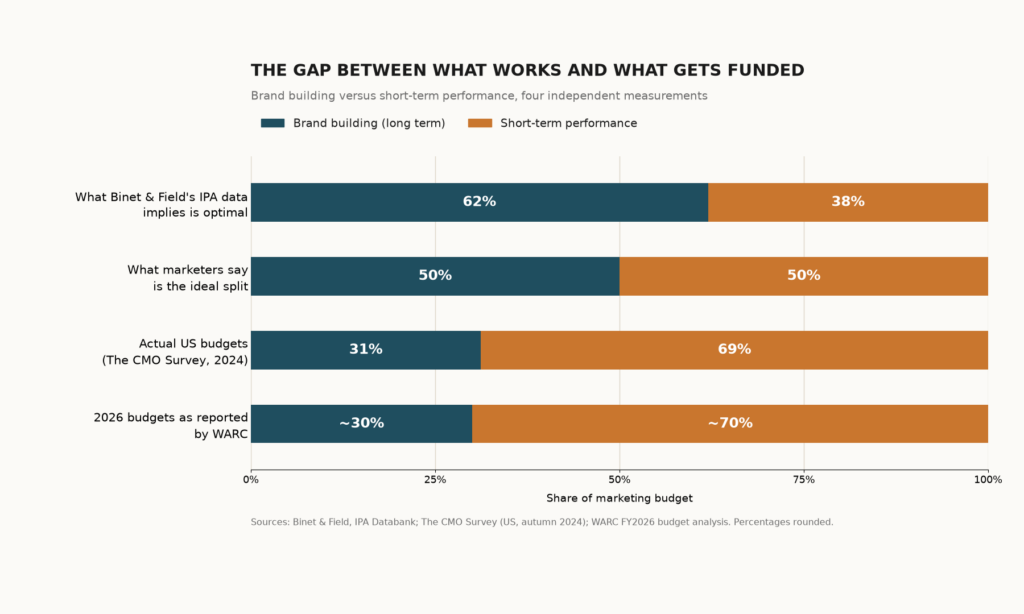
Notice the shape of that sentence. The gap is not a failure of belief. It is a failure of permission.
The hidden cost nobody expensed
Brand building is a stock. Performance is a flow.
That distinction sounds like economist’s decoration, but it explains almost everything about the last decade. A flow stops when you stop paying for it. A stock keeps working. Cut performance spend and revenue falls this quarter, visibly, attributable to the cut. Cut brand spend and nothing happens this quarter. Something happens two to four years later, and it arrives disguised as a different problem: pricing power that has thinned, loyalty that has frayed, and acquisition costs that will not respond to optimization no matter how many levers you pull.
That lag is why the mistake was easy to make. Every quarter, the cut looked free.
The four forces pushing the pendulum back
If the decade was driven by measurability, the reversal is driven by the slow failure of that same advantage. Four forces are doing the work.
1. The measurement that justified performance has degraded
The justification for performance spending was never the channel. It was the confidence. Cookies, pixels and clean attribution gave marketers a level of certainty brand work could not match. That certainty has eroded faster than most budget documents have updated their assumptions.
The story is often told wrong, so it is worth getting straight. Google abandoned its plan to deprecate third-party cookies in Chrome in July 2024, confirmed in April 2025 that it would not show users a separate choice prompt, and then — the part most teams missed — retired most of the Privacy Sandbox on 17 October 2025. Topics, Protected Audience and Attribution Reporting were all shut down. Only CHIPS, FedCM and Private State Tokens survived, and none of those is a way to count sales.
Read that sequence carefully. The cookie stayed, so the crisis was called off. But the browser-level replacement for counting conversions was cancelled, which means the responsibility for measurement moved from Google’s infrastructure back into your own stack. Meanwhile Safari and Firefox had already blocked third-party cookies by default, and Apple’s App Tracking Transparency kept gating the mobile identifier.
The net effect is subtler than “tracking is dead” and more consequential than “nothing happened.” It is this: a meaningful share of conversions is now unobservable, modeled, or double-counted across platforms. When performance’s edge over brand rested on measurement confidence, and measurement confidence is now probabilistic, that edge narrows. It does not vanish. It narrows.
2. Performance has become structurally more expensive
The second force is arithmetic, and it is the one that finally got the CFO’s attention.
Performance channels run on auctions, and auctions respond to competition. When two waves of well-capitalized bidders entered — mega-retailers buying users at scale, and a generation of venture-funded AI-native startups — they repriced inventory for everyone already bidding. Add creative saturation, rising CPMs and conversion rates that slipped even as click-through rates improved, and you get a squeeze that feels worse than any single metric suggests.
The direction is consistent across independent benchmark sources. Meta CPMs up roughly 18–20% year over year. Google CPCs up roughly 13%. Median CPA rising across most tracked verticals, while conversion rates fell in the large majority of them. One aggregate DTC benchmark put full-stack customer acquisition cost inflation since 2021 at well over 40% for fashion brands.
The important thing is not the exact figure. Defensible published CAC estimates vary widely by vertical and methodology, and anyone quoting a single precise number is overselling. The important thing is the structural logic: if the marginal dollar of performance spend buys fewer customers each year, the efficiency advantage that justified starving brand is being eaten by the very channel that claimed it.
3. The brand bill came due
Third force: the compounding cost of under-investment is now legible.
This is the part that marketing has historically struggled to make vivid, because it happens on a delay and arrives as symptoms rather than as a line item. The pattern is consistent: brands that stopped investing in distinctiveness end up competing on the things that are comparable — price, promotion, delivery speed — and each individual promotion looks like it works while the aggregate teaches customers to wait for the next one.
Kantar’s BrandZ valuation work offers the clearest long-horizon reading available, and it makes three claims that have held across two downturns: strong brands deliver superior shareholder returns, they are more resilient when the market falls, and they recover faster. During the 2020 collapse, BrandZ’s strongest portfolios added returns at a far higher rate than the index in the period that followed. The precise magnitude depends on the window and portfolio definition, so it is a directional argument rather than a number to quote in a deck. The direction, though, has not wavered.
There is a useful accounting metaphor here, and it is more than a metaphor. Underspending on brand is borrowing. The loan is invisible because the repayment schedule is not in any dashboard. It comes due in pricing power you no longer have.
4. The evidence finally became impossible to dismiss
The fourth force is the least dramatic and probably the most decisive: the research stopped being contestable.
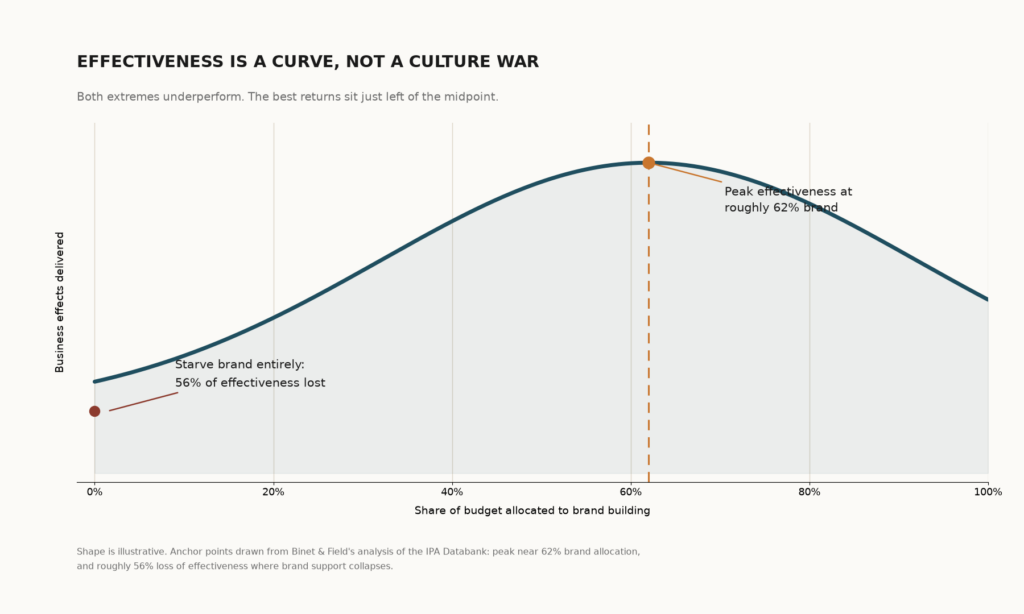
Les Binet and Peter Field’s work on the IPA Databank — roughly 996 effectiveness cases covering some 700 brands across 80-plus categories — established the “60:40 rule”: the most effective campaigns allocate around 60% of budget to brand building and 40% to sales activation. Their later analysis moved the peak closer to 62%. The optimal ratio shifts by category, from roughly 46:54 in B2B to 80:20 in some high-penetration consumer contexts, but the order of magnitude has survived more than 25 years of data.
Two findings from that body of work matter more than the headline ratio.
First, the effectiveness curve is not a line that rises forever as you spend more on brand. It is a curve with a peak. Starve brand and you lose a large share of total effectiveness; over-rotate into brand and you lose the activation that converts existing demand. The evidence points to a middle that is slightly left of center, not to an extreme.
Second, and this is the finding that dismantles the “brand is a delayed reward” objection: long does not mean slow. System1’s analysis of 27,000 UK ads found that five-star brand-building advertising also produces stronger short-term sales impact. The relationship runs one way. Long drives short. Short does not drive long. Brand work is not a deferred payment; it is simply work with a longer half-life.
Where the money is actually moving
Here is where the story gets more interesting, and where a lot of commentary gets it wrong. The rebalance is real, but it is not uniform, and it is not primarily happening in the places people assume.
CMOs have reprioritized brand. Dentsu’s CMO Navigator research, covering close to 2,000 marketing leaders across 14 markets, found that brand investment overtook demand investment for the first time, at roughly 60% brand to 40% demand, up from an inverted split the year before. Media allocation shifted in the same direction, toward brand-side activity at about 60:40.
And yet, in the same period, the share of budgets actually spent on short-term performance rose to around 70%, and the CMO Survey recorded more than 70% of marketers prioritizing immediate results over long-term gains, with 84% of CMOs now naming ROI as their primary metric for allocating budget.
Both things are true at once. This is the central paradox of 2026, and it deserves to be stated plainly:
Brand is winning the priority list and losing the budget meeting.
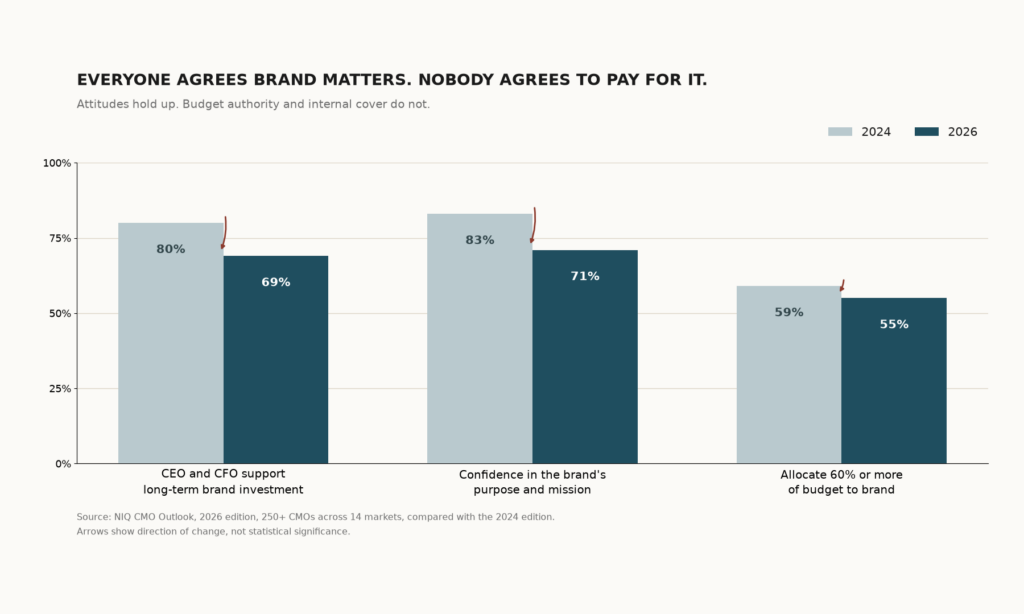
NIQ’s CMO Outlook captures the mechanism better than any think piece. Confidence in brand as a commercial asset held at 83%. But belief that the CEO and CFO support long-term brand investment fell from 80% to 69% in a year, confidence in brand purpose dropped from 83% to 71%, and the proportion of CMOs allocating 60% or more to long-term brand building slipped from 59% to 55%.
So the constraint is not conviction. It is permission. Marketers are not being persuaded that brand matters; they are being denied the institutional cover to fund it.
What a real rebalance looks like in the budget line
If the swing is genuine, it should show up in specific, checkable operating decisions rather than in sentiment surveys. It does — in a small number of companies, and unevenly.
Crocs is the cleanest public example. Its CFO, Patraic Reagan, told a Baird conference in June 2026 that the company had pulled back substantially on performance marketing, describing it as “an expensive way to drive revenue,” and had repositioned that spend into product and brand storytelling. The financial logic showed up in the same quarter’s results: direct-to-consumer revenue rose 8% while performance marketing spend fell, and the company explicitly attributed the higher profitability to that combination. That is a rare thing in public reporting — a company naming the trade-off and showing the margin.
Levi Strauss took the opposite route, and it is instructive for that reason. It planned higher advertising spend in fiscal 2026 behind a global brand campaign, absorbing the cost in SG&A during a period of tariff pressure. Whether that pays back is not yet knowable; brand investment never is, at the point of outlay.
Under Armour is the cautionary version. It has cut roughly 25% of its SKUs and is concentrating on “fewer, bigger stories,” with its CEO arguing that a shirt without a story is just a shirt. But marketing is landing at the low end of its 10–11% of revenue range, not above it. Consolidating the message and funding the message are different decisions, and Under Armour illustrates how easily the first gets mistaken for the second.
Those are not proofs of a macro trend. They are proofs that the trade-off is being made explicitly, in public, by companies with quarterly earnings obligations — which is the only place a budget philosophy can actually be tested.
The split is a starting point, not a target
There is a temptation to treat 60:40 as a rule to be hit precisely. Resist it.
Binet and Field’s own framing is that the ratio is a guide derived from award-entered campaigns — correlations among successful cases, not results from a controlled experiment. That makes it excellent for diagnosing whether you are roughly off-target, and poor for dictating an exact allocation.
What the number is genuinely useful for is a different job: telling you when your activation share has drifted so far that you are buying the same small pool of in-market buyers at an ever-rising price. If your CPMs are climbing year on year while conversion rates sit flat, that is not a bidding problem. It is a mental availability problem, and it is the clearest available signal that the brand share is too low.
Brand is finally getting measurement it can survive
The other operational change is quieter and, in the long run, more important than the ratio.
For years, brand was defended with the weakest vocabulary in the building: awareness, sentiment, “brand love.” That vocabulary lost every budget argument it entered. What has changed is that brand contribution is now estimable with methods that do not require individual tracking.
Marketing mix modeling — including open frameworks such as Meta’s Robyn and Google’s Meridian — estimates contribution from aggregate spend and sales data, which makes it structurally immune to cookie loss. Incrementality testing, geo-holdouts and conversion lift studies answer a genuinely causal question that attribution never could: would this sale have happened anyway? And brand-lift studies connect exposure to attitudinal shift.
None of these is precise. All of them are more honest than a last-click dashboard that reports clean numbers without disclosing how much of the journey it actually saw. Nielsen’s analysis has repeatedly found that creative quality accounts for a far larger share of sales lift — around 47% in its five-keys work — than targeting does, which is a useful corrective to the performance instinct of optimizing the wrong variable.
The honest caveats
A rebalancing argument that presents only its own evidence is propaganda, not analysis. Four counterweights deserve to be stated plainly.
The pendulum can over-swing. The same mistake is available in both directions. A naive rush back to brand that treats measurement as a distraction would repeat the decade’s error with the polarity reversed. The evidence supports a balance, not a reversal — and it specifically warns against the “double-duty” instinct of forcing brand and performance into the same execution, which underperforms distinct long and short work.
The permission problem is not solved by better data. This is the caveat most brand advocates skip. Measurement improvements make brand more defensible in principle. They do not automatically change who holds budget authority, or how a CFO under quarterly pressure behaves. NIQ’s numbers show support from the top falling, not rising, in the same period that measurement got better. Better evidence does not by itself win the argument.
Some businesses genuinely cannot afford the lag. A company with under twelve months of runway, declining revenue or imminent debt obligations should not reallocate toward channels with six-to-nine-month payback. Brand investment requires a balance sheet that can absorb a short-term activation dip. For everyone else, “we can’t afford brand right now” is usually a statement about quarterly incentives rather than about cash.
Treating brand as performance would destroy it. The subtlest risk is not abandoning brand measurement but over-applying it. If brand work is judged on the same short conversion window as activation, it will be optimized into something that is no longer brand work. The point of a longer measurement horizon is not to subject brand to the same test. It is to use a test appropriate to what brand actually does.
The three clocks, and why “balance” is the wrong metaphor
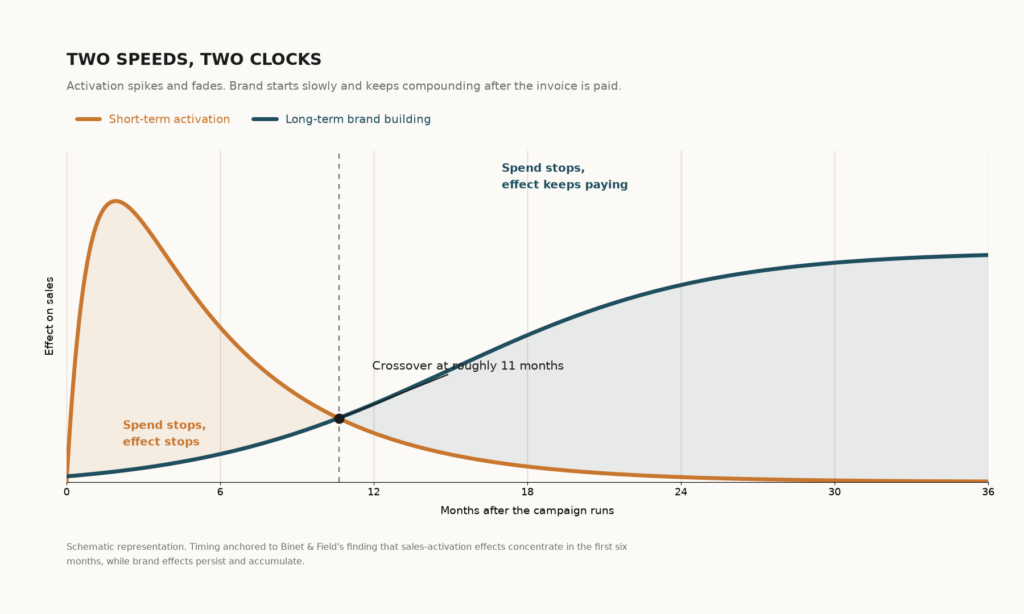
The most useful way to hold all of this together is not a pendulum at all. It is a set of clocks running at different speeds.
Activation works in weeks. Consideration builds across months. Brand compounds over years. All three are real, and each one decays on its own schedule. The decade of performance obsession was not a failure to understand this. It was a systematic over-weighting of the fastest clock, because the fastest clock is the one that shows up in this quarter’s report.
The rebalance, properly understood, is not a correction from one side to the other. It is a re-recognition that growth requires all three running, and that starving the slowest clock does not save money — it converts a compounding asset into a recurring expense. You end up renting, every quarter, the demand you could have owned.
That is why the pendulum framing, while useful for describing the mood, is slightly misleading as a strategy. A pendulum implies you should aim for the opposite extreme next. The evidence says something less dramatic and harder to sell internally: the most efficient marketing is both, in a proportion your category can defend.
What to do on Monday
Three moves that follow from the evidence, in order of difficulty.
Audit the split before you defend it. Most teams do not know their real activation share once you include branded search, retargeting, affiliate and promotion. Compute it honestly. Then compare it with the ratio your category’s purchase frequency implies, not with a number from someone else’s study.
Build the counterfactual, then move in steps. Do not reallocate on conviction alone. Run a geo-holdout or incrementality test on your most saturated channel, and use the result to justify the shift. Move 10–15 percentage points per quarter rather than executing a philosophical conversion, and measure on a 90-day cadence with a longer modeling lookback. Brand effects take time to appear in revenue; teams that judge them at 30 days will conclude they failed and revert.
Change what the budget meeting asks. The deepest constraint is not the split. It is that the room only rewards short-horizon proof. Adding one durable metric — share of search, a nested mix model, a brand-lift series — changes what can be defended, and therefore what can be funded. That is slower than reallocating a budget line, and it is the only version of this change that survives a CFO transition.
The decade of performance obsession succeeded at making everything measurable and failed at building much that lasted. The correction now underway is not a rejection of that discipline. It is the discovery that discipline applied only to the fast clock eventually produces a very expensive way to stand still.