Brand-Purpose Fatigue: When Authenticity Became a KPI
Something strange happened in a brand strategy review I sat through last spring. The deck had thirty-one slides. One of them was titled “Purpose Perception Score: Q1 vs Q4.” There was a green arrow pointing up and a number, 68, in a circle. Everyone nodded. Nobody asked what 68 meant, or who had measured it, or whether a person who saw the campaign would have recognized the thing being measured.
That slide is the whole story. Not the campaign. The slide.
Brand purpose was supposed to be the antidote to cynicism — the thing you did instead of shouting at people. A decade later it has become one more line item on a dashboard, complete with a target, an owner, and a quarterly review. And consumers, who are not stupid, noticed.
The trap was built with good intentions
Let’s be fair to the people who started this. Purpose marketing didn’t begin as a grift. It began with a real observation: people say they prefer brands that stand for something. That observation was correct, and it still is.
The trouble started when a preference became a requirement. Once purpose showed up in every pitch deck, every agency RFP, every new-business credentials pack, it stopped being a choice a brand made and became a box a brand checked. The moment something is mandatory, it is no longer expressive. It’s compliance.
You can date the shift pretty precisely. Simon Sinek’s “Start With Why” made purpose feel strategically delicious. Jim Stengel’s Grow appeared to supply the proof — purpose-led brands growing dramatically faster than the S&P 500. That “proof” was built by picking fifty high-performing brands, noticing they all described themselves as having higher ideals, and concluding the ideals caused the performance. It’s the analytical equivalent of observing that all winning racehorses are tall, and then buying tall horses.
None of this means purpose is fake. It means the case for purpose was oversold by people who wanted it to be true. And oversold ideas attract the wrong kind of believer.
Then someone put it on a scorecard
Here’s the paradox nobody in the industry ever resolved. Authenticity is, by definition, the quality of not performing for an audience. The instant you measure it, you have created an incentive to perform it. And an incentive to perform authenticity produces exactly one output: better performance.
The evidence that brands now treat purpose as a KPI is not anecdotal. Industry tracking has found roughly half of brands claiming sustainability as a formal KPI — a claim that raises an obvious question, since nobody has offered a credible method for measuring it. Meanwhile the vast majority of marketers say brands have a responsibility to help people live more sustainably, and most say they are investing more time in defining brand purpose. When everyone is defining purpose and nobody can measure it, you don’t get purpose. You get purpose-shaped language.
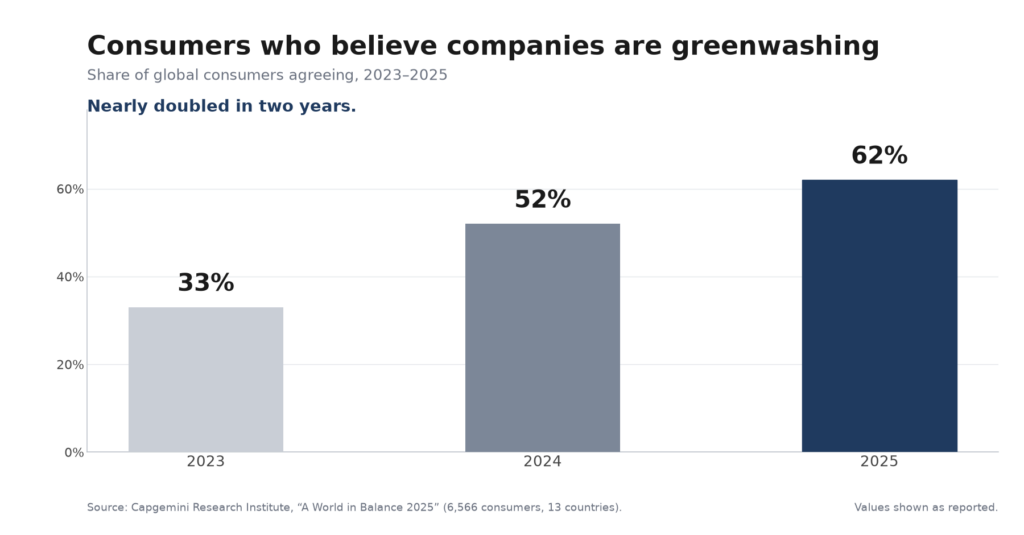
That chart is the receipt. In 2023, a third of consumers thought companies were greenwashing. Two years later, 62% did — across 6,566 consumers in 13 countries. The number nearly doubled while the industry was spending more on purpose than ever. Effort went up. Credibility went down. That is not a messaging problem. That is a structural one.
The four ways it broke
Rainbow in June, silence in July. Brands adopted causes for a month and abandoned them for eleven. Consumers noticed the rhythm and learned to read it as scheduling, not conviction.
The relevance stretch. A snack brand takes on structural inequality. A telecom brand champions ocean plastics. The intention may be sincere; the connection is legible as arbitrary. And arbitrariness reads as opportunism, because it usually is.
Tone-deaf timing. A purpose campaign launched into a genuine crisis — a war, a disaster, a layoff round — stops being a statement of values and becomes a statement about the brand’s willingness to use other people’s pain as a backdrop.
Volume. This is the one people underestimate. Signal value depends on scarcity. When every brand in a category has a purpose platform, having one communicates nothing. The ten-thousandth “we believe in you” spot isn’t inspiring. It’s weather.
Stack those four together and you get a defense mechanism. Consumers didn’t decide to distrust brand purpose. They were trained into it, one badly-timed campaign at a time.
What the fatigue looks like when you measure it
Here’s where the argument gets interesting, because the fatigue is not uniform. It’s selective, and it’s moving.
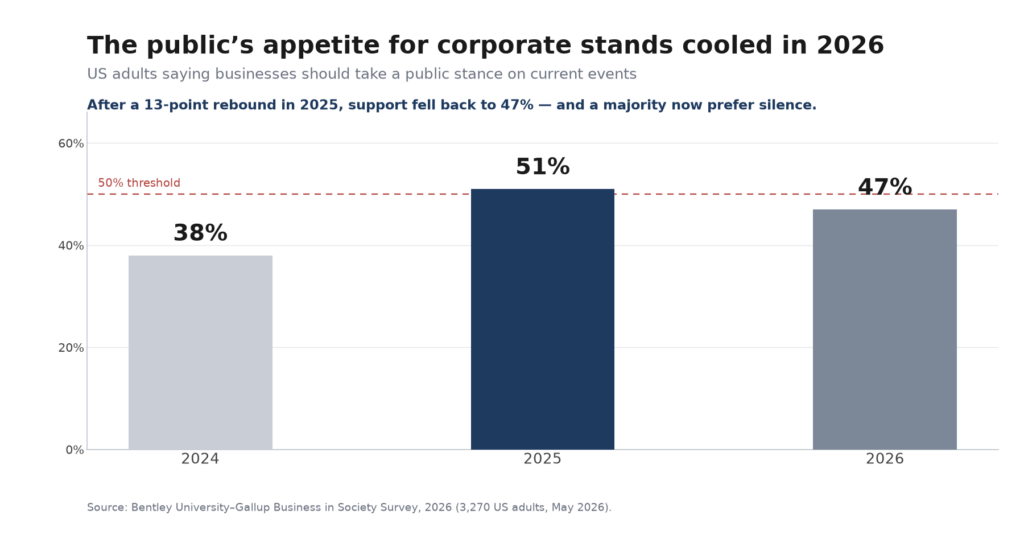
Support for corporate stands jumped thirteen points in 2025, to 51%, then fell back to 47% in 2026 — leaving a 53% majority who’d rather companies stayed out of it. That whipsaw is the tell. A public that swings that fast on a question that fundamental isn’t expressing a stable philosophy. It’s reacting to the noise level.
But look at which issues still command majorities. Free speech, 58%. Climate change, 58%. Diversity and inclusion, 57%. Mental health, 56%. Healthcare, 54%. Now look at the bottom: abortion, 22%. Religion, 16%. Endorsing candidates, 23%.
That pattern is not “consumers hate values.” It’s a map of where the public grants a brand standing. People are perfectly willing to hear from a company on climate — because a company has factories and supply chains and a measurable footprint. They are not willing to hear from it on religion, because it has no standing there. Standing is earned by proximity to the thing being discussed.
The most expensive mistake in modern marketing
If you want the single clearest demonstration of what happens when a brand takes a stand it hasn’t earned, you don’t need a study. You need a beer brand.
Bud Light’s 2023 partnership with a transgender influencer cost its parent company roughly $400 million in revenue within a quarter and eventually the title of America’s best-selling beer. What makes the case instructive isn’t the politics — it’s the mechanical failure. Bud Light’s audience was broad, culturally conservative, and bought the brand for sports and cheap refreshment. It had built zero credibility with the constituency it was suddenly speaking to. So it alienated one side and gained nothing on the other. You cannot trade one audience for another if you never acquired the second.
Target’s version was messier and, oddly, more instructive. It took a Pride-era backlash, then rolled back its DEI commitments, and managed to alienate both camps — a two-front self-inflicted wound. Its sales have since recovered, but only after a leadership change and direct engagement with the people boycotting it. Recovery took a year and a CEO.
And the underlying trend is hardening. Stanford research finds that roughly two-thirds of Americans have now reduced or stopped buying a product because they disagreed with a company’s stance — about double the 2018 figure. Meanwhile the share of Americans who think CEOs should speak out at all has dropped from 65% in 2018 to about 55%. More people are willing to punish. Fewer people want to listen. That is a terrible ratio for a channel built on being heard.
The category error underneath all of this
Here’s the thing everyone keeps getting wrong. Consumers never stopped valuing values. They stopped believing declarations.
Look at what actually predicts trust in 2026. Edelman’s research across 15 markets and nearly 18,000 respondents found that 88% call trusting a brand an important or critical purchase criterion — statistically level with quality at 89% and value at 88%. Trust isn’t a soft metric. It’s a purchase gate.
But when those same respondents were asked what most shapes their willingness to trust, 41% named what people the brand doesn’t pay say about it. Only 20% named what the brand says about itself. Two to one, in favor of everyone except the brand.
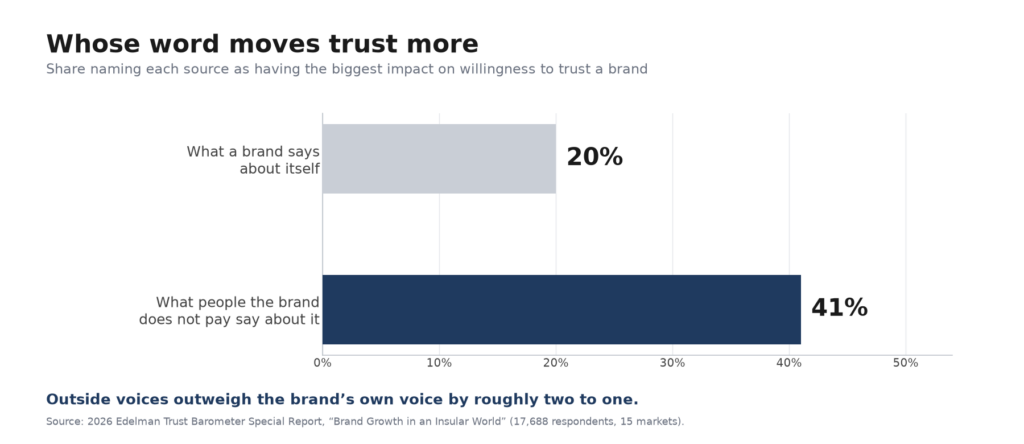
So the whole apparatus of purpose marketing — the films, the manifestos, the founding-story videos — is optimizing the channel that carries half the weight of the channel it can’t control. You cannot out-communicate your own operations. The audience already knows to check the second thing.
Why well-made purpose still works (and this is the inconvenient part)
I’d be lying if I told you purpose is dead. It isn’t. It’s just wildly uneven, and the unevenness is the story.
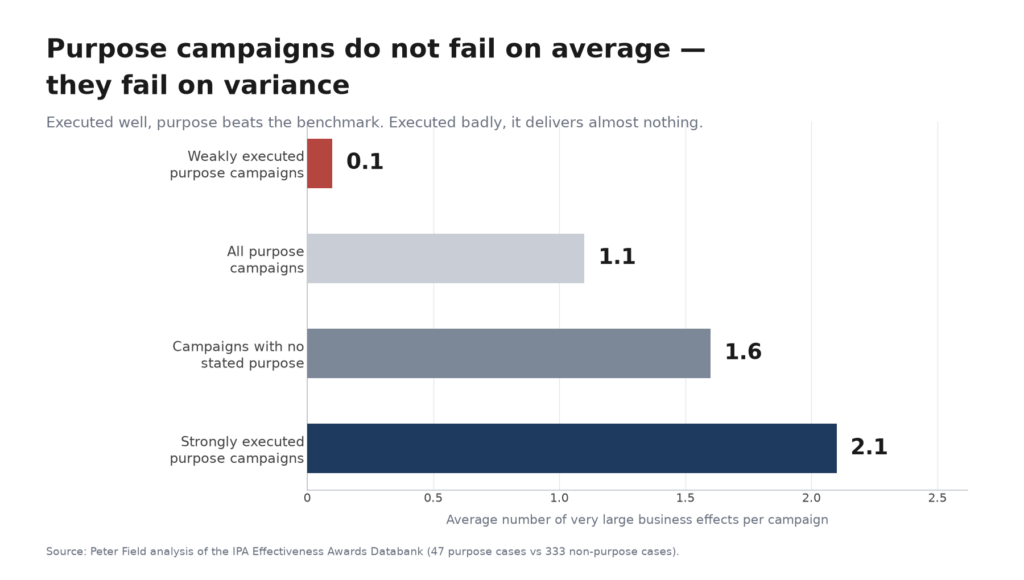
Peter Field’s analysis of the IPA Effectiveness Awards Databank compared 47 purpose campaigns against 333 non-purpose campaigns. Across the whole category, purpose underperformed: 1.1 very large business effects versus 1.6. That top-line number is what the skeptics quote, and they’re right to.
But inside those 47 cases, the spread is enormous. Strongly executed purpose campaigns averaged 2.1 very large business effects — better than the non-purpose benchmark. Weakly executed ones averaged 0.1. Not “worse.” Effectively zero.
That means the distribution, not the average, is the finding. Purpose isn’t a strategy that works or fails. It’s a multiplier on execution quality whose downside is total. Half the category lands near zero and the other half beats conventional advertising. And the mechanism separating them isn’t the quality of the film. Field’s strong cases shared four traits: purpose tied to product truth, purpose tied to a category entry point, purpose tied to issues the target market actually cares about, and distribution built around it.
I should flag the fair criticism here, because it matters: comparing the top half of purpose campaigns to all non-purpose campaigns is a slightly circular move, and Richard Shotton has made that point sharply. Field’s own response is the honest one — purpose performs worse in general, and the useful question is why the good ones work. Both things are true at once. Holding both is what rigorous thinking looks like.
What survives the fatigue
Five rules. They’re not novel. They’re just rarely followed.
1. Prove it, don’t say it. The purpose is your hiring, your sourcing, your pricing, your product. The campaign is only the evidence label. Patagonia is the standard because the structure changed, not the messaging: since restructuring in 2022, it has directed $180 million into its climate nonprofit, and up to 98% of profits can flow there after reinvestment — against the $10–15 million a year its earlier 1%-of-sales pledge generated. A company that once ran a Black Friday ad telling people not to buy its jacket and then saw sales rise didn’t achieve that with copywriting. It achieved it with forty years of prior behavior that made the copy believable.
2. Relevance or silence. If the cause has no organic connection to how the business makes money, you’re renting someone else’s credibility at retail price. The Gallup issue rankings are, functionally, a standing map. Use them.
3. Silence is a legitimate strategy. The most underrated move available to a CMO in 2026 is declining to comment. Fifty-three percent of Americans would prefer you did. Not every issue requires your voice, and pretending otherwise doesn’t read as courage — it reads as a brand that can’t tell the difference between conviction and calendar.
4. Substance over signal. A quiet supplier change that removes a real emissions source beats a loud campaign about caring. Nobody puts the supplier change in the sizzle reel. That’s precisely why it builds trust and the sizzle reel doesn’t.
5. Consistency over campaign. Purpose that appears daily in decisions compounds. Purpose that appears annually in September depreciates. Consumers are pattern-matchers, and they’re very good at spotting a twelve-month gap between statements.
The measurement trap, restated
If you take one operational thing from this piece, take this: stop measuring purpose perception, and start measuring whether your purpose is legible in behavior.
Concretely, that means replacing the “purpose score” with things you can actually audit. Do your supply-chain disclosures survive a hostile read? Can a customer verify your claim in under five minutes? Has your stated priority changed the way a real decision went in the last two quarters? Did you say no to revenue because of it? That last question is the only real test, and it’s the one no dashboard column can hold.
The reason is simple. Every metric you attach to authenticity teaches your organization to produce the metric. If the metric is “purpose perception,” you will get purpose perception — through media weight, through sentiment-friendly creative, through survey design. You will not get purpose.
The takeaway
Brand purpose didn’t fail because purpose is wrong. It failed because an industry took something that can only be demonstrated and turned it into something that could be reported.
The correction is already underway, and it’s not a retreat from values — it’s a retreat from narration. Consumers have simply raised the evidentiary bar: show me the hiring, the sourcing, the price you paid for your position. Then we’ll talk.
Which leaves brands with an uncomfortable but clarifying choice. You can keep buying the dashboard. Or you can go do the thing the dashboard was supposed to be measuring, and let other people describe it for you — which, at 41% versus 20%, is the only channel that ever really worked.