Zero-Party Data: What Consumers Will Actually Share
The cookie survived. The trust did not. Here is what people will tell you about themselves — and the four ways brands keep wasting the invitation.
The form nobody finishes
Open a checkout on almost any direct-to-consumer site and count the boxes. The average US checkout asks for 11.3 form fields when eight would do, which means most stores could cut 20% to 60% of what they display without losing anything they actually use.
Now look at what those fields ask for. Thirty-nine per cent of benchmarked sites require a phone number without explaining why, and 14% of shoppers will abandon an order when the phone field is simply marked required. Ask for a date of birth the same way and 35% say they would seriously consider buying elsewhere.
Now consider the opposite: a two-question quiz that asks how your skin behaves in winter, then recommends three products. Same customer, same brand. One is an interrogation. The other is a conversation. The difference isn’t the number of questions. It’s whether the person can see what they get back.
That distinction has a name, and it has been sitting in plain sight since 2018.
The layer that had no name
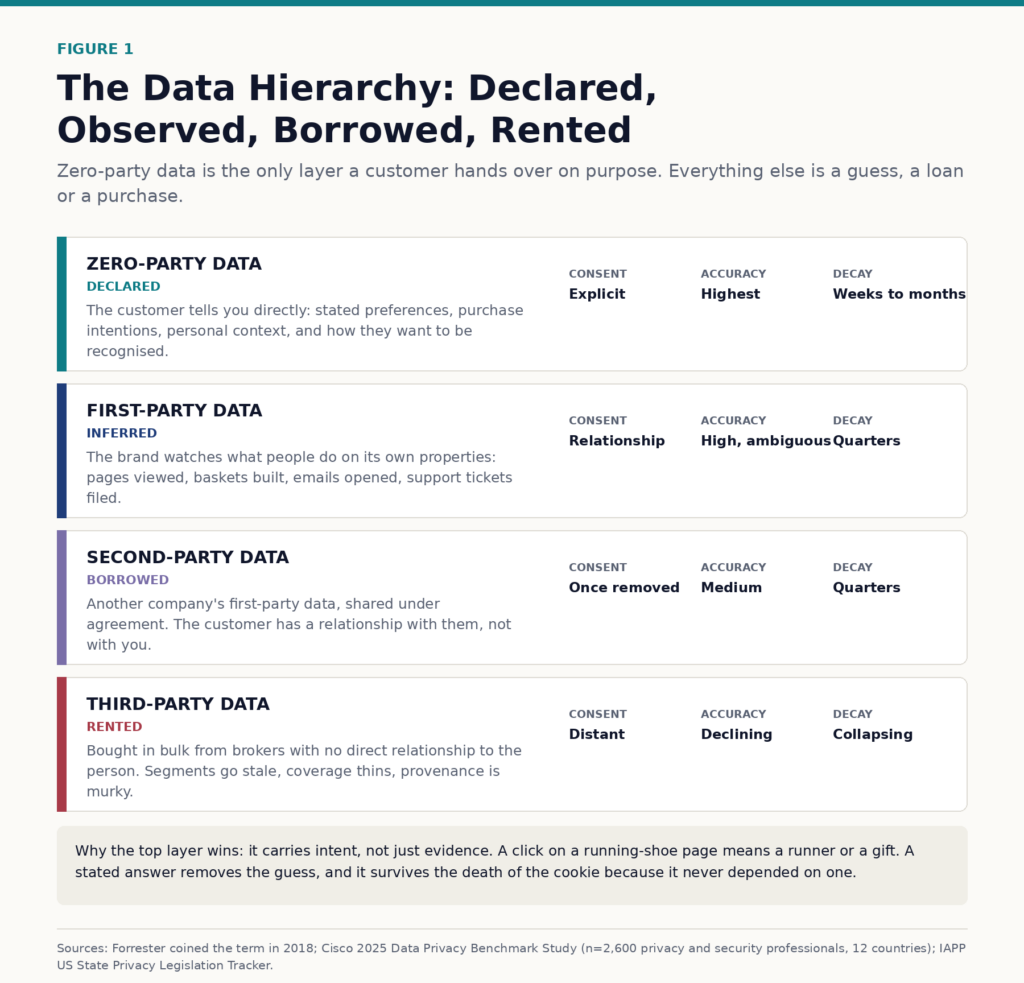
Forrester coined “zero-party data” to describe something marketers kept filing under first-party by mistake: information a customer intentionally and proactively shares with a brand. Stated preferences, purchase intentions, personal context, and how they want to be recognised.
The confusion is forgivable, because both types come from a relationship the brand already owns. But they answer different questions.
Purchase history tells you what someone did. A quiz answer tells you why, and what they want next. One is a record. The other is a brief.
Declared beats inferred
Picture a shopper who spends nine minutes on a running-shoe category page, opens three tabs, and leaves. What do you know? That they are interested in running shoes. What you don’t know is whether they run, whether this is a gift, whether they need a wide fit, or whether they are replacing a pair that died at 300 kilometres.
Behaviour gives you evidence. A question gives you intent.
Which is why stated preference outperforms inference on three counts at once. It is more accurate, because nobody is guessing. It is more actionable, because “medium width, trail, under $150, buying for a half-marathon in March” can drive a recommendation today. And it is more durable, because it does not depend on a cookie, a device graph, or a broker’s coverage map.
Then comes the awkward part.
The cookie reprieve was not a rescue
In April 2025 Google said it would keep its existing approach to third-party cookie choice in Chrome rather than rolling out a standalone prompt. Five months later, on 17 October, it retired most of the Privacy Sandbox APIs it had spent six years building — Attribution Reporting, Topics, Protected Audience, IP Protection and more — citing low adoption.
Read quickly, that looks like the cookiepocalypse being called off. It wasn’t.
One browser changed its roadmap. It didn’t change the regulatory direction, and it didn’t change what Safari and Firefox have done by default since 2020. As of 1 January 2026, nineteen US states have comprehensive consumer privacy laws in force — twenty if Florida’s narrower statute counts — after Indiana, Kentucky and Rhode Island came online that morning.
So the honest framing is this: third-party data is no longer dying on a schedule. It is decaying on one. Segments go stale, coverage thins, and provenance gets harder to defend every quarter a regulator asks where a data point came from.
Zero-party data is the one layer that never depended on any of it. A quiz answer doesn’t need a cookie. It needs a reason to answer.
What people will actually hand over
Here is where most playbooks go vague and say “consumers want personalisation”. True, and useless. The sharper question is which specific facts people will trade, and at what price.
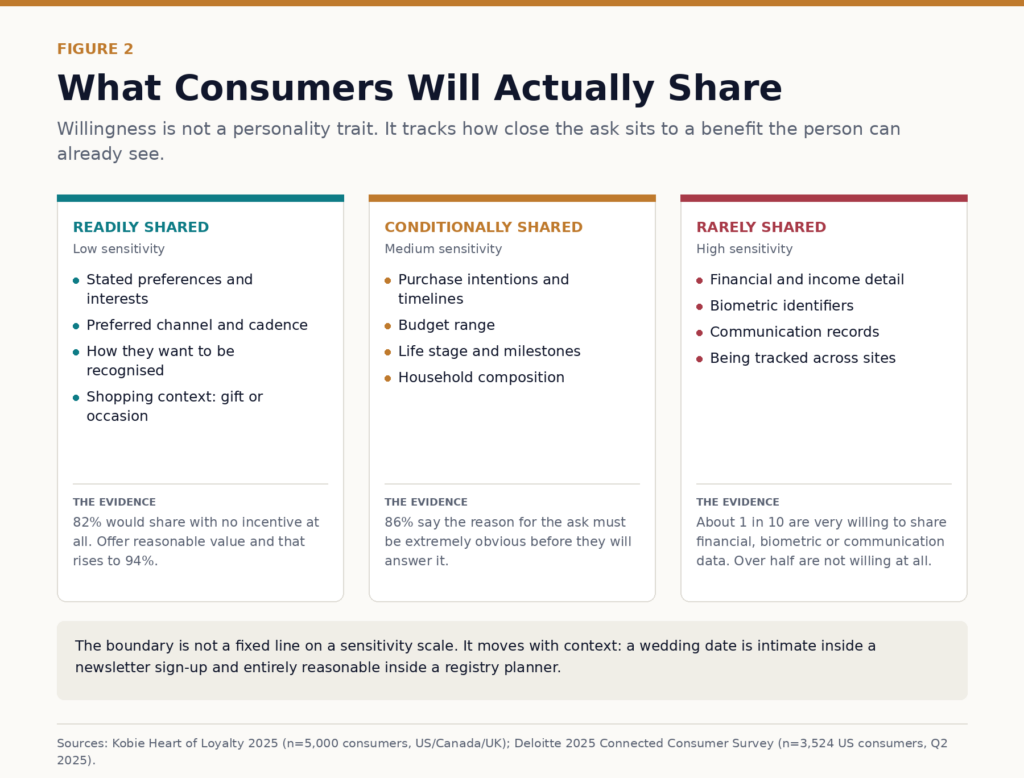
The pattern holds across every credible study: willingness tracks sensitivity, and sensitivity tracks how far the ask drifts from the benefit in front of the person.
Low-sensitivity preferences come easily. Stated interests, preferred channel and cadence, how they want to be recognised, whether a purchase is for themselves or a gift. Kobie’s 2025 Heart of Loyalty research, covering 5,000 consumers across the US, Canada and the UK, found 82% would share information with a brand without any incentive at all — and that figure climbs to 94% once reasonable value is offered in return.
Middle-sensitivity context is conditional. Purchase intentions, budget range, life stage, household composition. These get shared when the trade is legible and withheld when it isn’t. The same study found 86% of consumers say the reason for the ask must be extremely obvious before they will answer.
High-sensitivity data is another conversation. Deloitte’s 2025 Connected Consumer survey of 3,524 US adults found only about one in ten are very willing to share financial, communication or biometric information — and more than half are not willing at all, even in exchange for a better digital experience.
There is a broader signal here worth sitting with. Forrester’s Q1 2025 research for Adobe found just 8% of consumers are always fine with sharing their personal information, while 57% would prefer to remain anonymous across all interactions. Willingness isn’t a personality type. It’s a price, and it moves with context.
The lesson is not “ask for less”. It is “ask for what the moment justifies”. A wedding date is intrusive inside a newsletter sign-up and entirely reasonable inside a registry planner.
Willing to share, badly asked
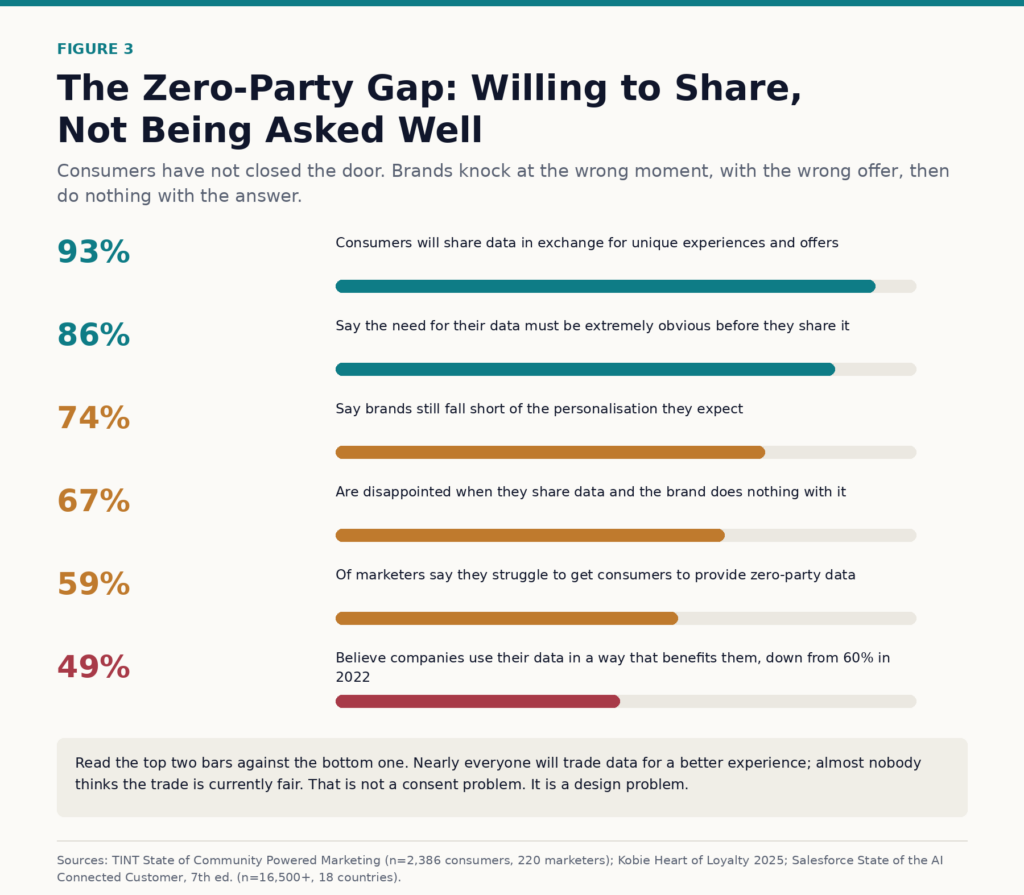
Put the numbers side by side and a strange picture appears. Consumers haven’t closed the door. Brands are knocking at the wrong moment, with the wrong offer, and then doing nothing with the answer.
TINT’s survey of 2,386 consumers and 220 marketers found 93% will share data in exchange for unique experiences and offers. It also found 59% of marketers say they struggle to get consumers to provide zero-party data. Both are true at once, which means the bottleneck isn’t permission. It’s execution.
Then the failure compounds. The same research found 74% of consumers say brands fall short of providing the personalisation they expect, and 67% are disappointed when they share something and see nothing happen.
Salesforce’s State of the AI Connected Customer study — more than 16,500 consumers and business buyers across 18 countries — adds the trust dimension, and it is stark. Seventy-three per cent now feel brands treat them as unique individuals, up from 39% in 2023. But only 49% believe companies use their data in a way that benefits them, down from 60% in 2022.
Read those two together. Personalisation got dramatically better at recognising people. It got worse at convincing them the recognition was for their benefit.
The shelf life problem
Stated preference decays. This is the part most programmes ignore, and it is where good intentions turn into stale segments.
Kobie draws a useful line between two buckets. Long-term preferences — favourite sport, hobby, brand affinity, reading genre — stay actionable for years and matter most at the start of a relationship or after a period of disengagement. Short-term intent — the film someone wants to see this winter, the trip they’re planning, the gift they’re shopping for — is good for months and then quietly wrong.
The blast radius is bigger than it looks. Forrester research commissioned by Zeta Global, surveying 310 loyalty and marketing professionals, found 38% of brands don’t use loyalty programmes to collect zero-party data at all, and 23% have minimal or no integration between loyalty data and other customer systems. Meanwhile SAP’s 2026 Global Engagement Index, spanning 10,000 consumers and 4,800 decision-makers, found 60% of customer data sits unused as dark data and 54% of enterprises can’t access and use real-time data.
Collecting rich preference data and leaving it in a table is worse than never asking. The customer paid for nothing.
Four ways brands waste the invitation
Asking at the wrong moment. The interruptive modal on arrival asks a stranger for commitment before establishing any reason to care. Ask during preference set-up, inside the size guide, at the recommendation moment — when answering is obviously in the person’s interest.
Asking for more than the moment justifies. Baymard’s checkout research keeps returning the same verdict: most sites could cut form elements by 20% to 60% without losing anything they use. The phone field is the canonical case, and the date-of-birth field is worse — 35% of shoppers would seriously consider going elsewhere when it’s compulsory.
Asking without saying why. Only 20% of consumers say tech providers are very clear about what data they collect or how it’s used, and only 27% have high confidence it is kept secure. Deloitte also recorded the wider mood shift: 70% now worry about privacy and security when using digital services, up from 60% a year earlier, and just 48% say the benefits of online services outweigh their concerns — the lowest reading since the survey began in 2019.
Collecting and then ignoring. This is the one that does lasting damage. A stated preference that never changes a recommendation teaches the customer that sharing was pointless, and two thirds already feel that way.
Five moves that earn the answer
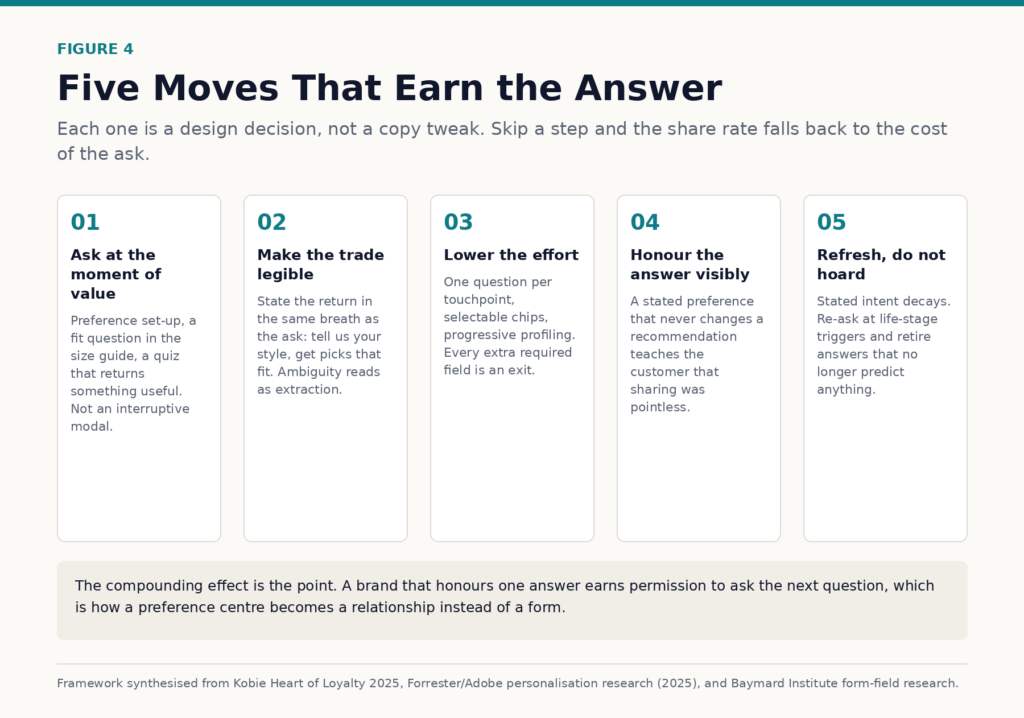
1. Ask at the moment of value. Preference set-up, a fit question in the size guide, a quiz that returns something the person couldn’t have worked out alone. Interact’s 2026 benchmark, drawn from more than 100 million leads generated on its platform across 1.3 billion quiz views, puts average start-to-lead conversion at 40.1% and completion at 65%. Treat it as a vendor benchmark, not a promise — but it’s a useful planning reference for what happens when the ask delivers a payoff.
2. Make the trade legible. Say the return in the same sentence as the request. “Tell us your style, get picks that fit.” Ambiguity reads as extraction, and 86% are explicit that they need the reason to be obvious.
3. Lower the effort. One question per touchpoint, selectable chips instead of dropdowns, progressive profiling that remembers what it already knows. Every extra required field is an exit ramp.
4. Honour the answer visibly. The biggest trust driver is action. If someone tells you they’re shopping for a gift in November, stop showing them the retargeting ad you built in July. Make the preference change the output in the same session where you can.
5. Refresh, don’t hoard. Re-ask at life-stage triggers — move, new baby, job change, season — and retire answers that no longer predict anything. A preference centre that never updates is a form with better branding.
What to measure, and what to ignore
Most programmes get measured on collection volume, the least informative number available. Track four things instead.
Share rate at the moment of ask. Not total records — the percentage of eligible people who answered where the ask appeared. This separates design from audience.
Completion. A quiz that starts and stalls tells you the questions are wrong, not the offer.
Activation rate. Of the preferences captured, what share changed a recommendation, an email, an offer or a service response within 30 days? This is the metric that distinguishes a data asset from a database.
Refresh rate. How much stored intent is under a year old and still predictive? Everything else is inventory you’re paying to store.
The caveats nobody puts on the slide
Share fatigue is real. Consumers are already asked for input after every purchase, delivery, support call and app session. Over-asking breeds resentment faster than under-asking breeds ignorance. Budget your asks like media spend.
Value-exchange asymmetry is the default failure. Brands routinely overestimate what a small benefit buys. If the reward is a 5% discount, the reasonable ask is a size preference — not a household income band.
Accuracy isn’t guaranteed. A Forrester study commissioned by SheerID found 36% of marketers worry that customer answers aren’t accurate. People misstate preferences, sometimes to reach the reward, sometimes because they’re guessing. Verification, cross-checks against behaviour, and a willingness to let behaviour override a stale answer all matter.
There’s now a regulatory floor. The FTC’s $2.5 billion settlement with Amazon in September 2025 — including a $1 billion civil penalty, the largest ever in a rule-violation case, and $1.5 billion in refunds for an estimated 35 million consumers — reframed interface design as consumer protection rather than a UX debate. California’s new CCPA regulations took effect on 1 January 2026, adding risk-assessment, cybersecurity-audit and automated-decision-making duties. Consent theatre has become expensive.
And the asking is increasingly done by software. Deloitte reports 53% of US consumers now use or experiment with generative AI, up from 38% in 2024. Salesforce finds 72% want to know when they are talking to an AI agent. When an assistant asks your customer a preference question on your behalf, the value exchange has to be legible to two parties, not one.
The bottom line
Zero-party data is the most valuable and most honest asset a brand can hold, precisely because it cannot be taken. It has to be earned, question by question, at moments that make sense to the person answering.
The appetite is there: 93% will trade data for a better experience, and 94% will share once the value is concrete. The patience is thin: fewer than half believe the trade benefits them, and two thirds have already lived through the specific disappointment of sharing something and watching nothing happen.
So the strategic question isn’t whether to collect zero-party data. It’s whether your organisation can be trusted with an answer. That gets decided in the same session, usually within seconds, by whether the next thing the customer sees reflects what they just told you.