Insight — Why Every Measurement Method Fails at Almost Exactly the Same Rate
Attribution, incrementality testing, and media mix modelling are sold as rival philosophies. Their users report the same disappointment to within five points.
The number that should not exist
Here is a result that ought to be impossible.
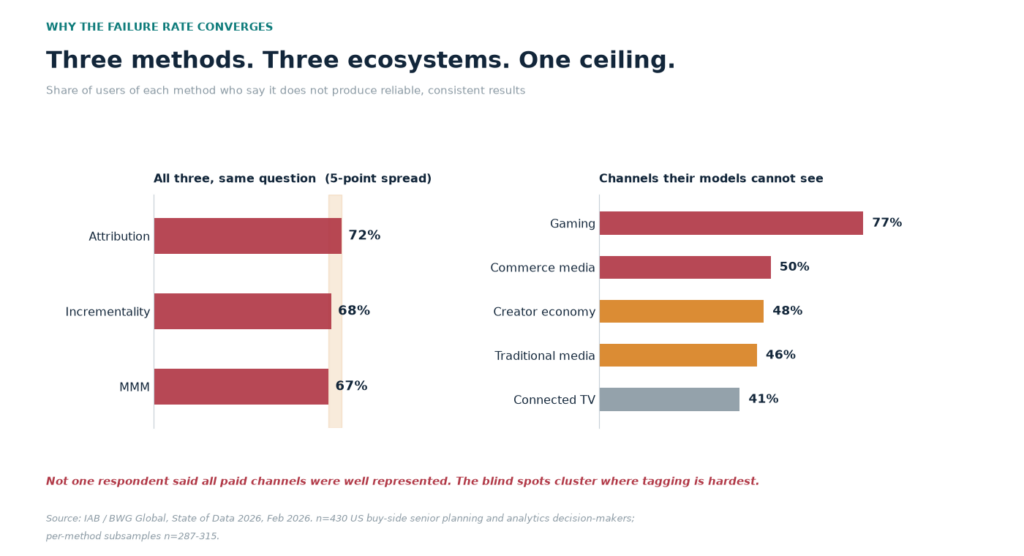
Ask attribution users whether their method produces reliable, consistent results and 72% say no. Ask regular incrementality testers the same question and 68% say no. Ask media mix modelling users — the people running the statistical approach the industry has spent three years repositioning as the mature alternative — and 67% say no.
Three methods. Three different mathematical foundations. Three separate vendor ecosystems with every commercial incentive to differentiate. And a five-point spread between the worst and the best.
That is not a competitive market. That is a ceiling.
If these methods were genuinely different tools, their failure profiles should diverge sharply. Attribution breaks when identity fragments. Incrementality breaks when sample sizes fall short. MMM breaks when the historical window is too thin or the channel mix shifts. The failure conditions are anatomically distinct. So why do the satisfaction numbers land in a heap?
Because they are all drawing from the same well
The answer is in what the three methods share, not what separates them.
All three are downstream processes. Attribution consumes touchpoint logs. Incrementality consumes observable conversions in treated and untreated groups. MMM consumes aggregate spend and outcome series. Every one of them is a factory, and every one is fed by the same shrinking pipe: data you actually own, collected with consent, retained long enough to be useful.
That pipe has been narrowing for reasons that have nothing to do with which model you chose. GA4 keeps user-level data for two months by default, fourteen at most. Safari, Firefox, and iOS have blocked or restricted third-party cookies for years regardless of what Chrome does. Meta removed its 7-day and 28-day view-through windows in January 2026, then reclassified social engagement into a one-day bucket in March. Google retired four attribution models in 2023 and replaced them with one whose weights it does not publish.
None of that is a modelling problem. It is a supply problem, and it hits every model on the same input.
Run the arithmetic in reverse and the convergence stops being mysterious. Three methods reporting the same failure rate is exactly what you would expect if the binding constraint sits upstream of all of them.
The blind spots confirm it
The channel data settles the argument. Not one respondent in the IAB study said all paid channels were well represented in their MMM. Gaming was flagged by 77%, commerce media by 50%, the creator economy by 48%, connected TV by 41%.
Now notice which channels those are. Gaming, creator content, retail media, and streaming television are precisely the environments where individual-level tagging is hardest and walled-garden reporting is thinnest. These are not random omissions. They are the same supply failure, showing up as a coverage gap.
And missing channels do not politely disappear from the output. Their sales get redistributed onto the channels the model can see, which quietly inflates the apparent return of everything measurable. The blind spot becomes an overstatement somewhere else.
What this means if you are buying
Stop shopping for a better method. You are already running 3.8 of them on average, and the largest advertisers run 4.2. The marginal method is not the constraint.
The constraint is upstream, and it is unglamorous: first-party collection, consent architecture, server-side event quality, deduplication hygiene, and long-term retention in a warehouse you control rather than a platform that deletes on a schedule you did not set.
Teams that fix the input discover something uncomfortable and liberating at once. The models stop being the problem. They start being roughly as good as the data underneath them, which is the most any of them was ever going to be.