The $210 Hour: Why Livestream Shopping Can’t Scale in the West
TikTok Shop sells more in a livestream than any Western platform ever has. It still can’t make the format pay — and the reason isn’t technology, trust, or taste. It’s wage arithmetic.
Every explanation for why livestream shopping never took off in the West has the same flaw. It credits the wrong scarce resource.
The standard accounts are about infrastructure and culture. Payment rails are fragmented. Returns are expensive. Americans don’t like being sold to on camera. Chinese consumers grew up buying inside apps and Westerners didn’t. All of that is true, and none of it is the binding constraint.
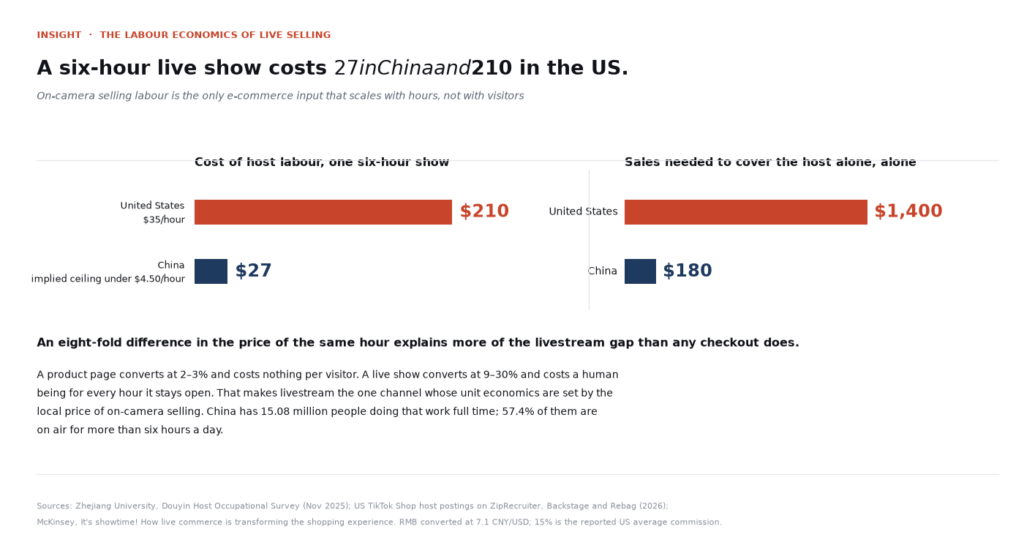
Here’s the number that actually binds. A six-hour live show requires six hours of a human being. In the United States, on-camera selling talent is advertised at $20 to $75 an hour — TikTok Shop host roles in Los Angeles run $30 to $40 with commission, jewelry brands post $20 to $30, prestige resale lists $40 rising to $50 after 9pm, one Los Angeles studio advertises $50 to $200 for experienced talent. Call it $35 as a working midpoint.
Six hours at $35 is $210. At the 15% commission rate reported as the US average for TikTok Shop affiliate sales, a brand needs $1,400 in sales from that single show just to pay the host, before product cost, fulfilment, or the platform’s fee.
Now the same show in China. The Zhejiang University occupational survey of Douyin hosts found that of 15.08 million people doing this work full time, 66.9% earn between ¥2,000 and ¥10,000 a month, and 57.4% are on air more than six hours a day. Someone working 26 days at six hours is committing about 156 hours. Even at the top of that modal band, ten thousand yuan, the implied rate is under ¥65 an hour. At the more typical four to five thousand, it’s below ¥35 — roughly $5.
Which means the identical six-hour show costs about $27 in China.
Why this is the only input that matters
Almost everything in e-commerce gets cheaper as it scales. A product page costs the same whether ten people or ten thousand visit it. A paid ad is priced per impression and amortised across volume. A warehouse has fixed costs and declining marginal ones. The unit economics of conventional retail all improve with throughput.
Livestream inverts that. It converts dramatically better — 9% to 30% against 2% to 3% for a standard product page, per McKinsey’s analysis — but its cost is per hour, not per visitor. A stream with forty viewers and a stream with forty thousand viewers both consume one host, one shift, one studio slot.
This is why the format is so spectacular in a market with cheap on-camera labour and so stubborn in one without it. The conversion advantage is real everywhere. The cost structure is only favourable in one place.
And it explains a pattern that otherwise looks like cultural preference. Pop Mart derives roughly 85% of its TikTok Shop revenue from livestreams; goPure ran 483 hours of live shows to clear a million dollars. Both are brands that can afford — or can amortise — a hosted schedule. For a two-person Shopify store, the same format is a part-time job that doesn’t reliably pay for itself. The operators who succeed treat live selling as a staffing decision, not a marketing tactic.
China then solved the labour problem twice over. First by having a vast, young, low-cost supply of hosts — 15.08 million full-timers, 81% of them aged 21 to 30, with 56.5% working part-time alongside other income. Then by replacing them. AI digital-human hosts reached more than 60% penetration in Chinese e-commerce livestreaming overall and above 70% in standardized categories like 3C and household goods; among small merchants, adoption climbed from 12–15% in 2024 to 40–45% in 2026. JD.com made digital-human livestreaming free to all merchants in December 2025, and reported that digital hosts handle roughly 90% of standardized product explanation at a fraction of human cost, with conversion up around 30% on idle-hour slots.
That’s the tell. A market doesn’t industrialise a labour input with AI unless that input is the constraint. Nobody is automating the product page.
What this predicts that the other theories don’t
If labour cost is the binding constraint, three things follow, and each is testable.
Livestream will concentrate in high-ticket, high-margin categories. Beauty, collectibles, jewelry, prestige resale — exactly where the posted US rates cluster. A $30 average order value cannot carry a $35-an-hour host at 15% commission. A $300 one can.
The storefront will keep winning the volume. This is precisely what the channel data showed earlier: 51.4% of TikTok Shop’s US GMV closes on the shelf, 8.2% in livestream. The shelf has no hourly cost. It is the only surface in the stack with conventional scaling economics, so it absorbs the volume.
Recorded video will beat live for most brands. A shoppable product video captures the demonstration benefit — the reason live converts at 9–30% — without a per-hour cost, and it runs permanently rather than during a scheduled window. For any brand that can’t justify a host’s hourly rate, this is not a compromise. It’s the better unit economic.
The uncomfortable implication
Western brands have spent three years treating livestream as a capability gap to be closed with studios, creator programs, and platform partnerships. The gap isn’t capability. It’s the price of an hour of enthusiastic, product-literate, camera-ready selling — and that price is set by the local labour market, not by anything a brand can buy its way out of.
Until AI avatars get good enough to host in English without embarrassing a premium brand, Western livestream commerce will stay a premium-category format with celebrity and niche exceptions. The brands that understand this stop building studios and start building shelves — and they stop budgeting for a channel that was never going to scale the way the Chinese headline numbers implied.
The format didn’t stall because Americans don’t like watching. It stalled because the maths only works when an hour of a person is cheap.