Why Retail Media’s Second Wave Never Arrived
The economics behind why forty-two networks produced no new number two.
Retail media has been the industry’s favorite growth story for six years. Over that stretch the number of major networks went from roughly 15 to 42 — forty-two ad platforms, most of them selling the same three products to the same few thousand brands.
And Amazon still takes just under 80% of US spending. Walmart takes 8%. Everyone else divides the remaining 12%.
That is the paradox worth sitting with. A market that more than tripled in size, welcomed twenty-seven new competitors, and rearranged its share by almost nothing.
The usual explanation is a measurement story. Smaller networks lack incrementality tools, their reporting is opaque, buyers consolidate on the platforms they can verify. All true, and all beside the point. If measurement were the binding constraint, the networks that fixed it would have gained share. They didn’t — because the constraint sits upstream of media entirely.
Ad inventory is manufactured from assortment
Sponsored search, the format carrying more than 60% of US retail media spending, cannot exist without search results. Search results cannot exist without product listings. Product listings cannot exist without sellers willing to list.
Follow that chain and the mechanism becomes obvious: every incremental seller is simultaneously new ad inventory and a new advertiser. A marketplace is therefore not a distribution feature a retailer bolts onto its media business — it is the factory that produces the media business. More sellers means more pages, more slots, more bidders, and a lower cost per click for everyone, which in turn attracts more sellers.
That loop is why Amazon compounds. Roughly 62% of its units are fulfilled by third-party sellers, and its marketplace is close to 69% of its e-commerce base. Walmart’s marketplace sits near 10%. Small brands make up 58% of Amazon’s assortment against 46% at Walmart’s, and far less at most others.
A regional grocer with 12,000 SKUs sourced from 300 national brands has a fixed, modest pool of both inventory and advertisers. It can buy the ad server. It cannot conjure the sellers.
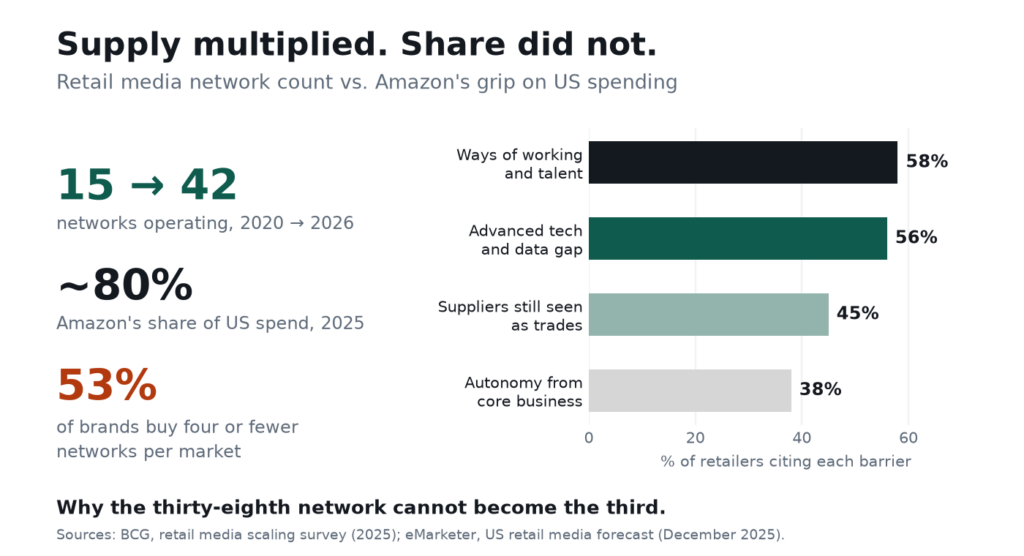
Which reframes the barriers everyone reports. 58% of retailers say ways of working and talent block their scale-up; 56% lack advanced tech and data capability. Fixing both would make a network better run. Neither would make it bigger, because neither addresses the supply of sellers.
The upside nobody prices
The same logic predicts where growth actually hides. Advertisers spending under $100,000 a year on retail media account for 17% of organic sales but only 5% of retail media spending. That long tail is the largest untapped pool in the channel — and the networks positioned to capture it are the ones with marketplace assortments, since Amazon and Walmart already carry the highest small-brand penetration.
There is a sting in the tail, though. At less advanced retailers, as little as 20% of retail media revenue is genuinely incremental; leading retailers report 95%. For most of the forty-two, the ad business is quietly repricing trade spend rather than creating new budget — which is precisely why grocery retailers, earning about 2.1% net margin in 2025, keep launching them anyway.
The test before building one is not whether you can staff a media team. It is whether you have ten thousand sellers who want to reach your shoppers. If the answer is no, you are not launching a network. You are launching a tax.