Why Your Pricing Page Gets Read and Rejected
Open a browser and type “X pricing” against a hundred B2B vendors. Then ask an AI engine the same question. Two different worlds appear.
On the page, you get tiers, bundles, “starting at,” and a button that says talk to sales. In the answer, you get a number, a scope, and a caveat — frequently a number the vendor never published. In the Cloud 100 study run by Growth Unhinged and Profound, across 7,675 AI responses and six engines, a company’s own pricing page appeared somewhere in 46% of answers about its pricing. It was the first cited source in just 12%.
Sit with the shape of that gap for a second. It is not a visibility problem. The page was found. It is not a crawlability problem either — 57 of the 77 companies with public pricing pages had pages fully readable to crawlers. The page was located, read, and then set aside in favor of somebody else.
Why?
The Page Answers a Different Question
Pricing pages are written for a buyer who has arrived with context. They assume you know what the product does, roughly what tier you belong in, and what your procurement cycle looks like. So the page says: Starter $29 per seat. Professional — let’s talk. Enterprise — let’s really talk.
An answer engine has no context. It has a prompt — often a crude, comparative one — and it needs to return something another model can check. “Evaluate Company X on pricing” does not want a negotiation posture. It wants a unit.
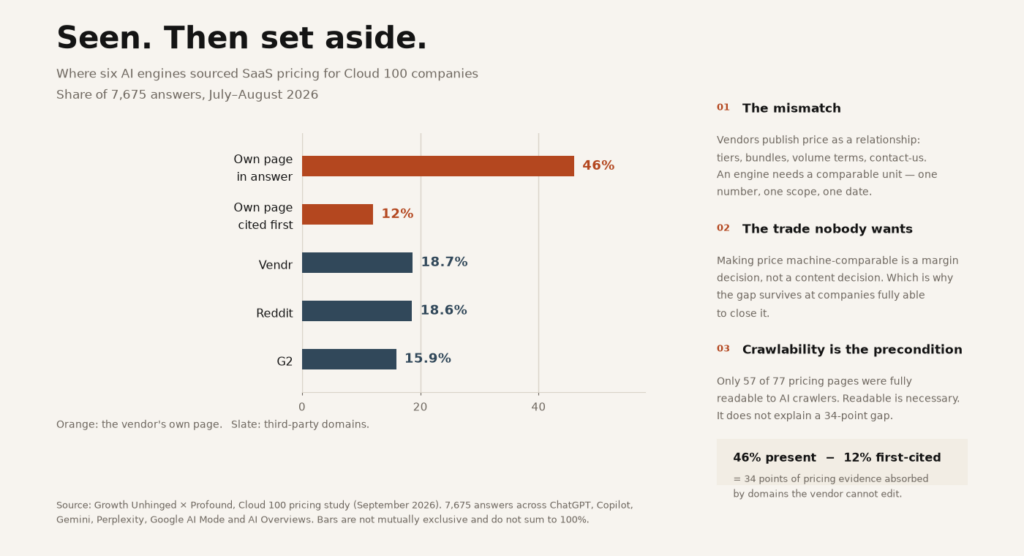
That mismatch is the whole mechanism. Vendors publish price as a relationship artifact: volume terms, discount floors, multi-year structures, the things you only say in a room. The engine needs a comparison artifact: one number, one scope, one date, one qualifier. Those are not the same document, and one cannot be rewritten into the other without giving something up.
What Is Actually Being Traded Away
Here is where the content team usually gets blamed for something that was never theirs to decide.
Making price machine-comparable is a margin decision wearing a content costume. To become quotable you must publish a unit that a competitor can be measured against on the same line — and once that line exists, every discount conversation starts from it. That is a real cost, and it is usually a sales-ops and finance cost, not a marketing one.
Which explains the pattern. The companies with the largest gap are not the ones with the worst content. They are often the ones with the most negotiated pricing, because their pricing page is doing exactly what it was designed to do: withhold the comparable number while establishing that a comparable number exists.
The study’s strongest performers were not the most transparent. Several ranked above median while showing plans without price points. What separated them was coverage of the logic — billable events, minimums, overage behavior, cancellation, regional variation, a concrete entry point. They published the arithmetic without publishing the rate card.
That is the escape hatch most teams miss. Quotability does not require publishing your price. It requires publishing the rule that generates your price.
The Absorption Zone
When the first-party page declines to be quotable, the answer is not left blank. It gets filled.
Vendr absorbed 18.7% of answers. Reddit 18.6%. G2 15.9%. Two of those three you cannot edit at all. And the third-party data is not neutral — it is a snapshot of a deal someone else closed, for a different scope, sometimes two years ago.
The extreme case from the study makes the failure mode concrete: one company published no prices whatsoever, and the six engines answered anyway, quoting the same seat from roughly $100 to $2,400 a month. Silence did not protect the margin. It handed the number to whoever guessed.
There is a perverse incentive buried here. If you do not publish the arithmetic, the absorption zone publishes a worse arithmetic — usually the highest price anyone ever paid, because that is the price people talk about. Withholding precision does not withhold the number. It just selects for the least favorable version of it.
What This Actually Changes
The instinct is to treat this as a formatting task: add a table, add a number, done. But the 46-versus-12 gap is not formatting. It is a governance question that has been misrouted to whoever owns the website.
If pricing cannot move, the answer is not to publish a fake number. It is to publish the decision logic in a form a model can quote: what triggers a tier change, what a seat actually includes, what makes a bill spike, what the floor looks like. That content is quotable without being negotiable.
The vendors winning these answers are not the ones who disclosed most. They are the ones who made the shape of their pricing legible while keeping the terms in the room. Which, on reflection, is what good pricing pages were supposed to do all along.