Winning AI Answers in Every Language Your Buyers Speak
Most GEO strategies are written in one language and quietly assumed to work in all of them. That assumption now has a price tag, and it isn’t paid in translation fees.
The bet you placed without knowing it
Somewhere in your GEO plan sits an unstated assumption: the work that got you cited in English will carry over into every market you sell into.
It won’t. And the distance between believing that and knowing it is where the budget disappears.
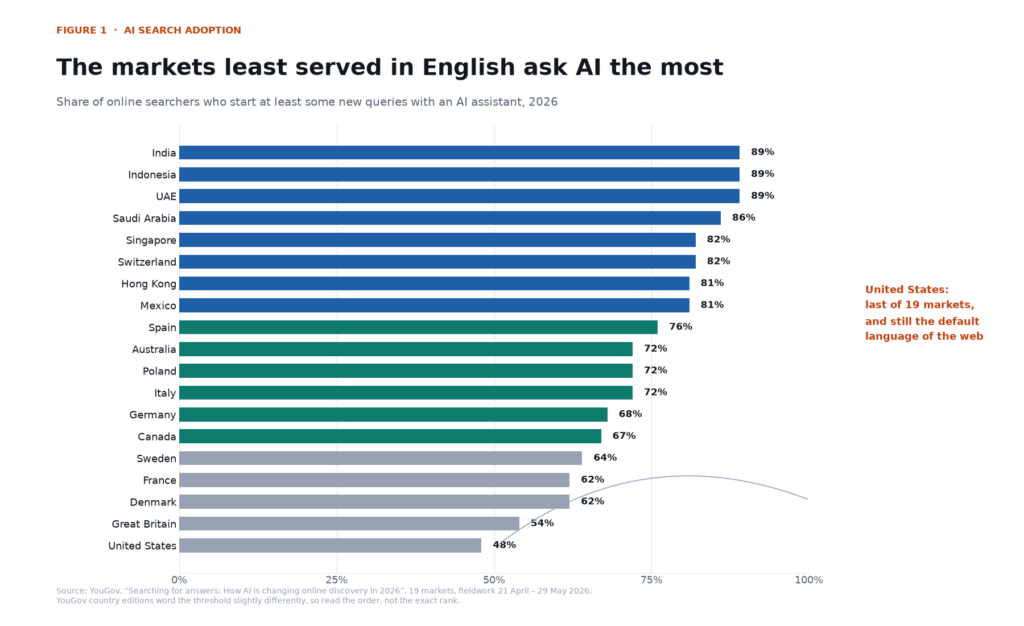
Start with the awkward fact. The country that built ChatGPT, Gemini and Perplexity is the slowest adopter of AI search among the nineteen markets YouGov surveyed in spring 2026. Just 48% of American online searchers start any new query with an AI assistant. Britain sits at 54%. India, Indonesia and the UAE sit at 89%. Mexico 81%. Spain 76%. Germany 68%.
Read that again. The market most brands optimise for uses the product least, and the markets using it most are the ones an English-only strategy structurally cannot reach.
What your audience actually looks like
OpenAI ended the argument in June 2026. On its individual consumer plans — Free, Go, Plus, Pro — more than half of active users now predominantly use a language other than English. Spanish, Portuguese and Arabic lead the non-English group, and growth is fastest in Africa and Asia.
That’s a base that flipped, not a rounding error. Note the scope honestly: those figures cover individual plans and exclude Enterprise, Codex and education products, where English still dominates. But if your buyers are consumers, creators, sole traders or professionals acting on their own, most of them are not typing in English.
Why the Spanish answer cites Spanish pages
Here’s the mechanism, and it’s the part that turns a demographic footnote into a budget line.
When someone asks an assistant a question, the assistant doesn’t simply answer. It retrieves. And when it retrieves, it reaches for sources in the language of the question far more aggressively than most marketers expect.
The cleanest proof isn’t a vendor blog. It’s a controlled probe published in August 2026: 234 runs against ChatGPT, four exit countries, six query languages, six identical runs per cell. Its central finding is blunt — query language, not user location, decides whether local suppliers appear at all. Where language matched country, a global brand won 1 of 24 runs. Asked in English over the same connections, local brands took 0 of 6 runs in both Estonia and Türkiye.
Two conclusions follow, and they pull against each other:
- Your English pages won’t get you cited in Spanish, Japanese or German answers. Separate the language from the page and you’re absent from that market’s candidate pool.
- Your local pages won’t rescue you in English answers either. Estonian pages didn’t surface when the question was in English. Same connection. Different language. Different market.
The second point is the one brands get wrong. English isn’t a neutral lingua franca the retrieval layer politely translates through. It’s a filter.
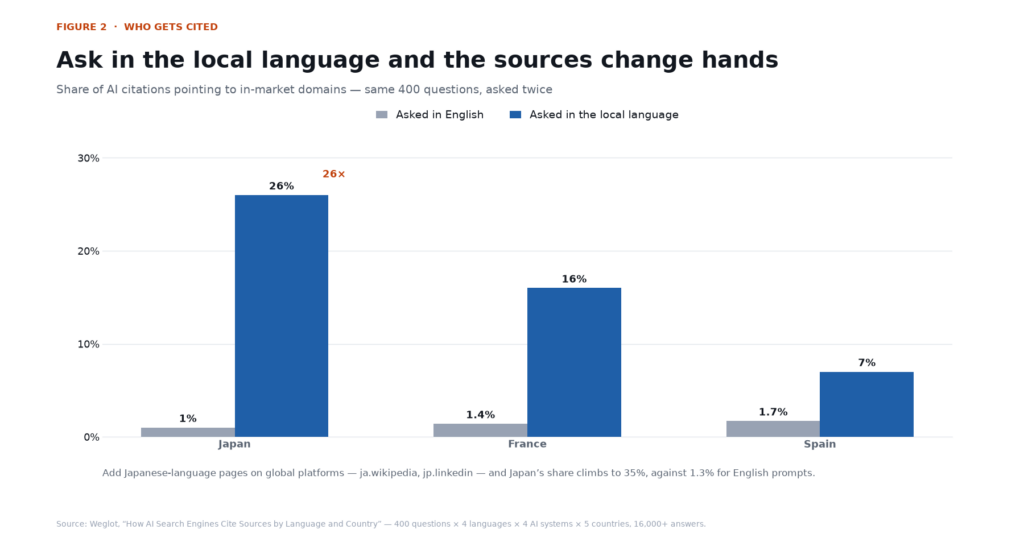
Stare at the numbers for a moment. Weglot put 400 questions in four languages to four AI systems across five countries — over 16,000 answers — and logged every source. In Japan, Japanese-language questions sent 26% of citations to .jp domains. The same questions in English sent about 1%. Count Japanese-language pages on global platforms too — ja.wikipedia, jp.linkedin — and the share climbs to 35%, against 1.3% in English. France obeyed the same law at lower volume: 16% to .fr domains in French, 1.4% in English. Spain: 7% to .es, or 26% to Spanish-language sources counting global platforms, against 1.7%.
The sources don’t get more local. They get different. That’s a different problem with a different fix.
The query is not your English query in a different coat
Second layer, and this is where machine translation quietly fails.
A question asked in Japanese is not the English question wearing a kimono. Intent, phrasing, expected answer format and the signals that make a reply feel trustworthy all shift. German shoppers search compound nouns and expect specification-dense answers. Japanese queries skew longer and more formal, and the same concept may arrive in kanji, katakana or romaji on any given day. Translate “best CRM” literally into Japanese and you have not found what an operations lead types at 11pm.
Then there’s the retrieval layer’s own behaviour, which is stranger than most people realise.
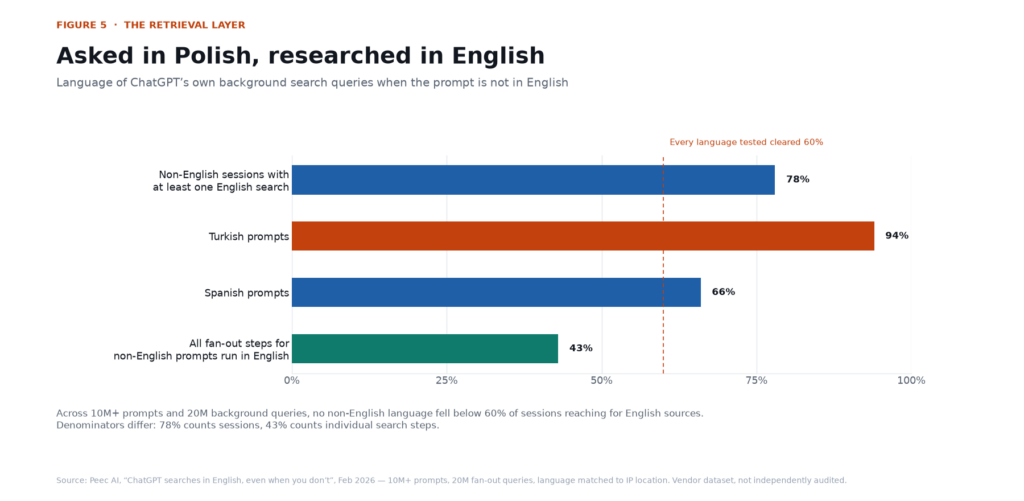
Peec AI analysed more than 10 million ChatGPT prompts and 20 million background search queries — fan-outs — filtered so that location matched language. 78% of non-English sessions included at least one English-language search. By individual step, 43% of all fan-out queries triggered by non-English prompts ran in English. Turkish prompts did it 94% of the time. Spanish, the least affected language tested, still did it 66%. No language came in under 60%.
The anecdotes beat the statistics. Asked in Polish from a Polish IP address which auction portals were best, ChatGPT omitted or buried Allegro — Poland’s dominant marketplace — in favour of eBay. Asked in German about German software companies, the reply named none.
One caution on denominators: 78% counts sessions, 43% counts individual steps, so don’t add them. Peec is a vendor publishing its own platform data, so read the magnitude as directional.
The platforms disagree, and that rewrites the plan
If you take one operational idea from this piece, take this: Google’s AI and OpenAI’s AI pull your multilingual site in opposite directions.
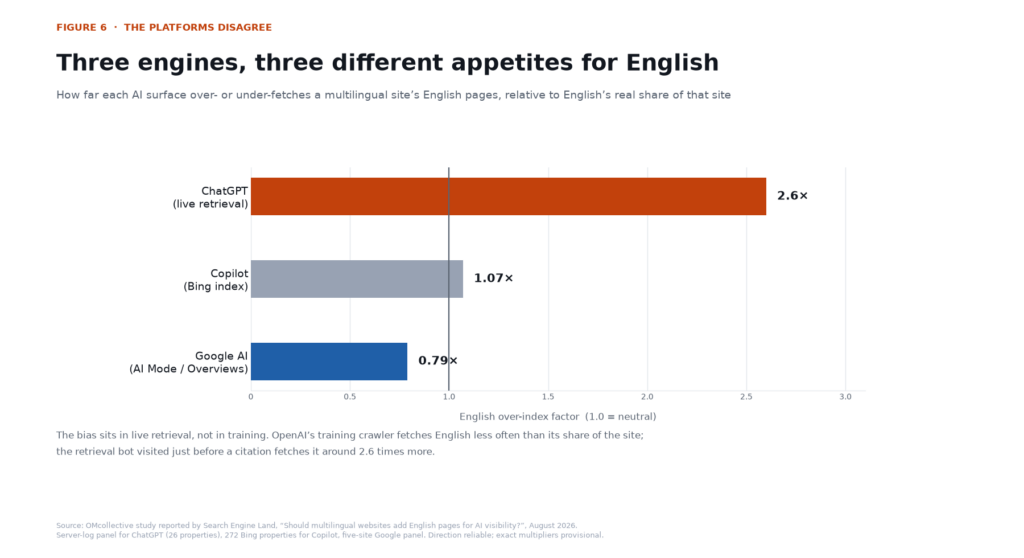
OMcollective, publishing through Search Engine Land in August 2026, measured how often each AI surface fetches a site’s English pages relative to English’s genuine share of that site. An index of 1.0 is neutral.
- ChatGPT: 2.6 (median; range 1.9 to 6.5). It fetched English pages 65–79% of the time.
- Copilot: 1.07. Effectively neutral.
- Google AI (AI Mode, AI Overviews): 0.79. Slightly under-fetches English.
And the bias isn’t where you’d guess. GPTBot, OpenAI’s training crawler, touches English less than its share of the site. The over-fetch lives in ChatGPT-User, the bot that arrives moments before a citation. The preference enters at answer time, not in the weights. That matters enormously: retrieval is plumbing, and plumbing gets replaced.
So the right move depends on the engine. On Google’s surfaces, your local pages are the asset. On ChatGPT, your English pages are. “Translate everything” and “translate nothing” are both wrong, and only “translate everything and keep the original current” survives all three engines.
Who actually gains from the home-language question
Now the question that decides where you spend first.
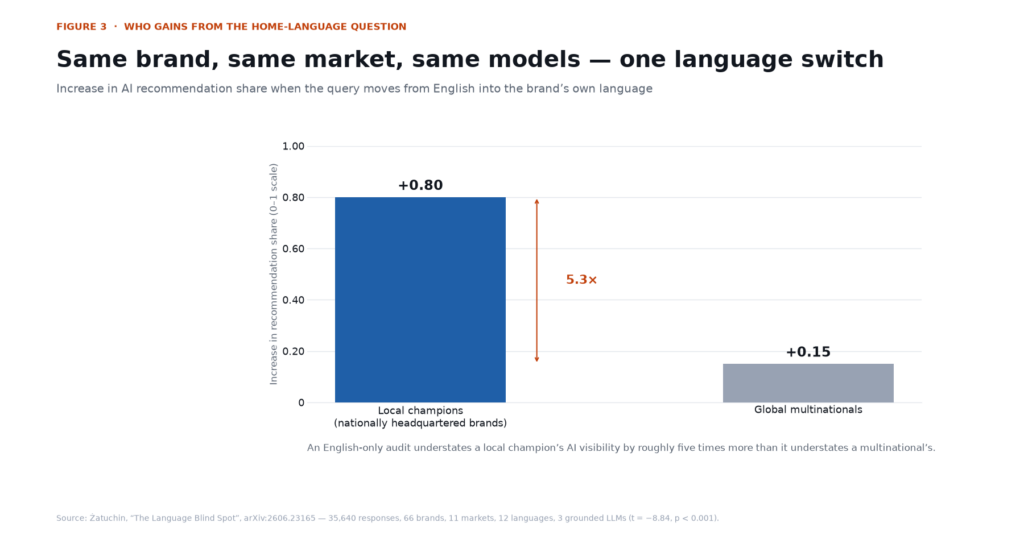
A study covering 35,640 responses — 66 brands, 11 markets, 12 languages, three grounded models — measured what happens when an identical question moves from English into the brand’s home language.
Average recommendation share rose by 0.80 for local champions and 0.15 for global multinationals (t = −8.84, p < 0.001).
A five-fold difference in benefit. Which means the standard English-only visibility audit isn’t equally misleading for everyone: it’s mildly misleading for Coca-Cola and badly misleading for the nationally headquartered challenger that actually needs the visibility. If you’re the local champion, your English dashboard isn’t optimistic. It’s fiction.
There’s a subtler finding in the same dataset. AI-constructed reputation is language-bound: mean cross-language similarity was 0.825, and sentiment varied measurably by language, with Germanic languages — English included — the most critical and Uralic and Baltic languages the most positive. Query language shifts who gets recommended far more than how they’re described.
Same product, different shortlist
And the variance isn’t only about how much you appear. It’s about which competitor stands beside you.
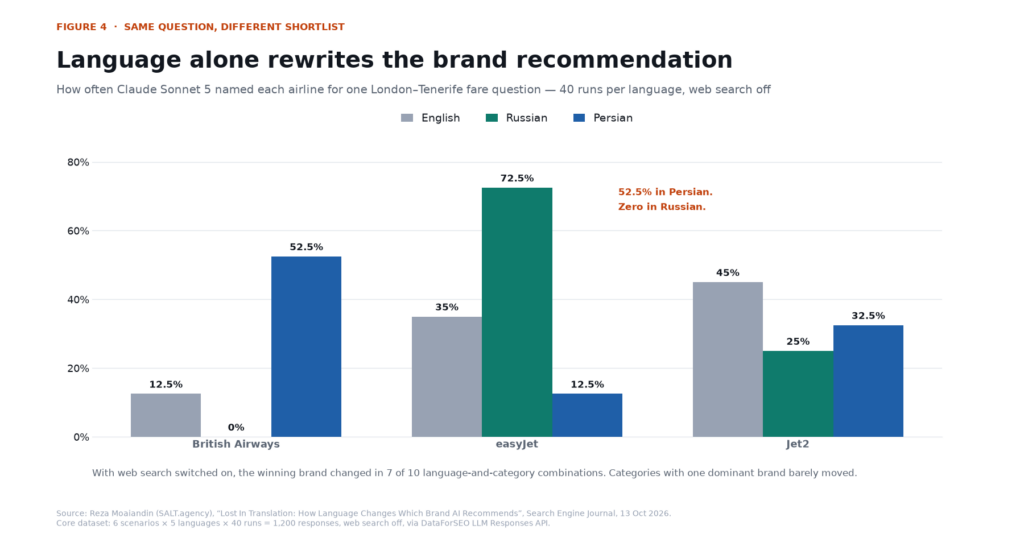
In October 2026, Search Engine Journal published an experiment putting six buying questions to Claude Sonnet 5 in five languages, forty runs each. One asked which airline to fly London to Tenerife.
- Asked in Persian, Claude picked British Airways 52.5% of the time.
- Asked in Russian, it picked British Airways never. easyJet took 72.5%.
Same model, same question, same week. Different language, different winner.
Three honest caveats. Categories with one dominant brand barely moved — Roborock held 87.5% to 97.5% of robot vacuum picks in every language. The study didn’t test Spanish, so don’t port its percentages into your Spanish market. And with web search switched on, 42.7% of responses hit the length limit (83% in Persian), so those figures are softer. But with search on, the winning brand changed in 7 of 10 language-and-category combinations — which tells you the variation is fluid, and therefore influenceable.
Four pillars, not four languages
Structure the work so it doesn’t become an open-ended translation bill.
Choose languages by commercial exposure, not enthusiasm. A B2B brand can defend three or four markets. A thin-margin consumer brand, two. Price native content per language, then pick the number your team can maintain for three years. Every language is a maintenance contract, not a launch task.
Research queries natively. Not translations of your English keyword list. The person who built your English set cannot build the Japanese one through a translator. Borrow a native speaker who knows the category, have them write the questions from core intent without seeing your English wording, and record who wrote what. A machine-translated prompt set measures your translation, not your market.
Publish native, and treat translation as a floor. Here I’ll part company with the purists briefly. CSA Research surveyed 8,709 consumers across 29 countries: 65% prefer content in their own language even when it’s poor quality. Comprehension beats polish for a human deciding whether to buy — and 76% choose the product with information in their language when picking between two similar offers.
But citation rewards something else: authority that reads as native. Translation wins a reader. It rarely wins a citation, because it answers the source market’s questions in the target market’s vocabulary.
Build local proof, because that’s where citations actually come from. This is the pillar everyone skips. An analysis of 167,551 AI citations across 128 brands, 12 home markets and 13 languages found that 85.7% of the sources AI used were third-party sites the brand does not own. Only 14.3% were owned properties.
Translate your own site and you have optimised the 14%. The local publication, the local review platform, the local comparison listicle — those move the number.
The operational playbook
Five steps, in order. Reorder them and you waste money.
1. Audit your footprint by language. Run your ten most valuable buying questions through ChatGPT, Gemini, AI Overviews and Perplexity in each target language. Log which URL gets cited and whether it’s the version you maintain. Repeat each prompt several times — in the controlled probe, the top recommendation changed across six identical runs on four of six prompts, so single runs are noise.
2. Rank the gaps by commercial impact. Multiply market opportunity by visibility gap. Fix the top two. Resist fixing eleven.
3. Build native content only for those gaps. FAQ pages, comparison tables, category explainers, definition pages. Answer first, in the first sentence. Retrieval skips narrative; a 400-word page that settles a specific question beats a 3,000-word one that buries it.
4. Get the technical layer right, because Google is explicit. Google determines a page’s language from its visible content — not the lang attribute, not the URL. Use distinct URLs per language version; never serve variants from one URL via cookies or browser settings, because Googlebot crawls from the US without an Accept-Language header and will simply miss them. Make hreflang reciprocal — if page A names B and B doesn’t name A back, Google may ignore the annotation entirely. Include x-default. Keep every version pointing at every other, or your strongest market gets isolated.
5. Monitor per language, indefinitely. Language versions drift independently. A footprint stable in English can be unstable in Japanese in the same week. Track mention rate, position, factual accuracy and cited URL separately for each language.
The honest caveats
Three things to hold against the enthusiasm.
This isn’t a translation project, and the budget should say so. Native content per language, maintained, is expensive. The right number of languages is usually smaller than the commercial team wants and larger than finance assumes.
Partial translation is the worst outcome, not a compromise. A translated homepage with an English-only blog creates a partial footprint. Worse, in the OMcollective logs, a Belgian bank left an outdated English PDF of its rates online after the Dutch and French pages were updated. The assistant pulled the stale file and quoted it. An abandoned English asset doesn’t sit quietly; it becomes the answer served to customers who never asked for English.
The effect sizes differ in confidence. The ChatGPT English bias rests on a server-log panel of 26 properties — enough for direction, not enough for 2.6× to be a planning constant. The brand-recommendation study used five languages, not fifty. Treat each figure as a direction with a stated margin, and re-measure in your own category.
What this comes down to
AI search is multilingual by construction, and the layers that make it multilingual aren’t neutral. Language decides which candidate pool you’re in. It decides whether a local champion outranks a multinational. On some questions, it decides whether your brand exists in the answer at all.
The brands that get this right won’t be the ones that translated the most pages. They’ll be the ones that stopped treating multilingual GEO as translation and started treating it as local presence — native content, local proof, correct scaffolding, separate monitoring — in the handful of languages their buyers actually think in.
Your buyers are already asking in their own language. The only open question is who the assistant decides to answer with.