Named, Not Cited: Why B2B Buyers Ask AI First — and What Decides the Shortlist
Here is a scene that would have sounded like science fiction five years ago. A platform engineering lead needs a new observability vendor. She does not open Google. She opens ChatGPT and types something like: “We run about forty microservices on Kubernetes, we already pay for Datadog, and the bill is out of control. What should we look at instead, and what will break if we switch?”
Thirty seconds later she has five names, a short paragraph on each, and a rough cost comparison. Two of those five she has never heard of. Two she expected. One she quietly removes from her list because the answer said its pricing model gets ugly at her volume.
No landing page was visited. No form was filled. No SDR knows she exists.
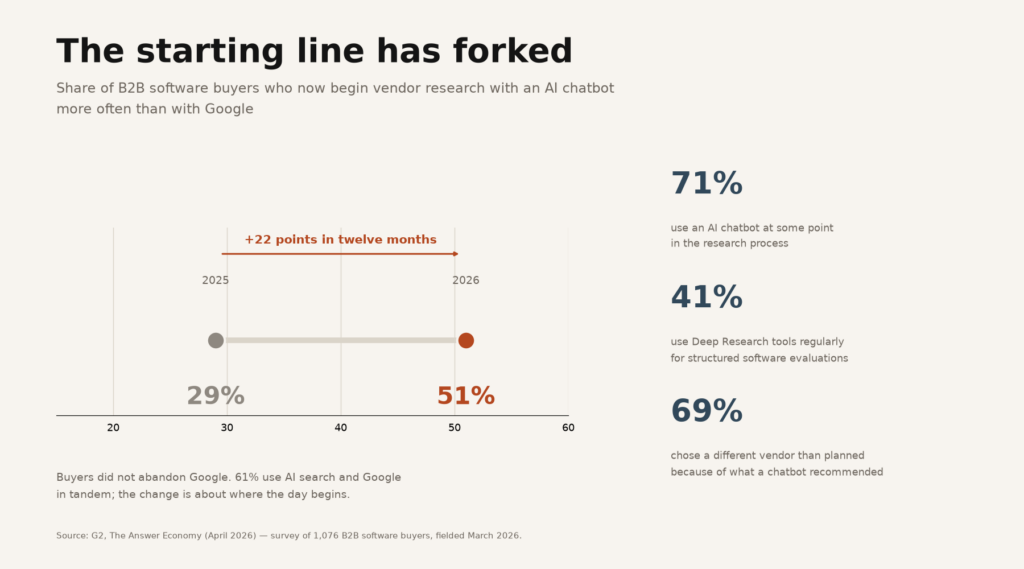
That is the shift this article is about, and it is not a thought experiment. G2 surveyed 1,076 B2B software buyers and decision-makers in March 2026 and found that 51% now begin their research with an AI chatbot more often than with Google — up from 29% twelve months earlier. Seventy-one percent use a chatbot at some point in the process. Another 6 in 10 say they run AI search and Google in tandem rather than replacing one with the other.
So no, search did not die. The starting line simply forked, and half the field took the new lane.
The First Step Moved, and Nobody Sent a Memo
What the old journey looked like
For roughly twenty years, B2B research followed a script. Search for a category term. Open eight tabs. Skim three vendor sites. Download a whitepaper, surrendering an email address. Get added to a nurture sequence. Maybe attend a webinar. Eventually, if everything lined up, book a demo.
The vendor controlled the pacing. They knew when you arrived, which pages you read, and which PDF you wanted badly enough to trade your work email for. Intent data was the whole game, and the form was the toll booth.
What replaced it
The new sequence is shorter, quieter, and mostly invisible to the vendor. Buyers ask a question in full sentences, get a synthesized answer with a shortlist, then go verify. G2’s data makes the compression explicit: 53% of buyers say research done with an AI chatbot is more productive than traditional search, up from 36% just seven months earlier. When a behavior nearly doubles its perceived usefulness in half a year, it stops being a novelty and becomes a habit.
There is a second layer most teams miss. Of those buyers, 41% use Deep Research-style tools regularly — the ones that return a structured, multi-source evaluation report rather than a paragraph. That changes what “being visible” means. A background citation buried on page nine of a generated report does not win anything. Being named in the final recommendation list does.
The number that should worry you
Eighty-five percent of buyers say they think more highly of a vendor when an AI chatbot mentions it in a recommendation. That sounds like good news until you invert it. If the mention is what raises your standing, the absence is what erases it — and the buyer will never tell you, because they never knew you were missing.
Then there is the harder number. Sixty-nine percent of those buyers chose a different vendor than they originally planned, specifically because of what the chatbot surfaced. One in three bought from a company they had never heard of before the answer introduced it.
Your brand equity, your analyst relationships, your decade of conference sponsorships — an answer engine can route around all of it in one prompt.
Why Technical Buyers Trust a Machine More Than Your Homepage
Objectivity is a feeling, not a fact
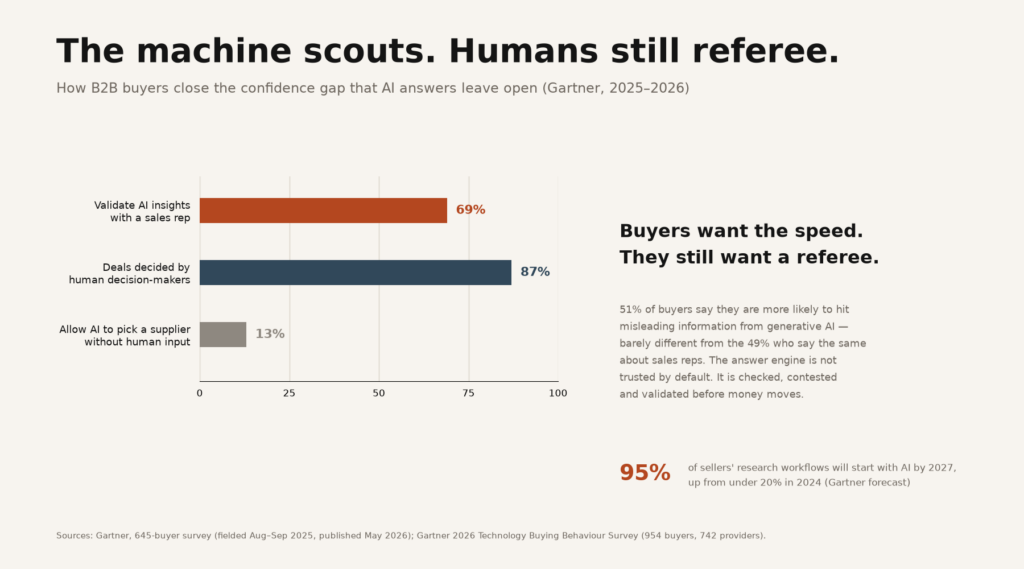
Here is an uncomfortable finding. Gartner asked 645 B2B buyers, in a survey fielded between August and September 2025, where they expect to encounter misleading information. Fifty-one percent said they are more likely to get it from generative AI. Forty-nine percent said the same about sales reps.
Read that again. AI is trusted marginally less than a human seller — not more. Buyers are not naive about hallucinations. They are simply willing to accept a machine’s error rate in exchange for speed, breadth, and the absence of a quota.
That matters because the “objectivity” buyers perceive in an answer engine is real in one narrow sense: it is not your marketing department. It has no reason to flatter you. Buyers know an AI can be wrong; they also know it is not trying to close a quarter.
Specification matching is the quiet killer app
Ask a human seller to compare four vendors against a seventeen-item requirements list, and you will get a deck. Ask an AI, and you get a table.
B2B evaluations are brutal, unglamorous, and specification-heavy. Latency budgets. SSO support. Data residency. Migration paths. Whether the API rate limits will hold at your peak. This is exactly the workload generative models handle well, because the answer is mostly retrieval and reconciliation rather than judgment.
G2 found that comparing vendor strengths and weaknesses is the single most common use of AI chatbots in software research, cited by 41% of buyers — ahead of basic product research, vendor identification, and use-case validation. In other words, buyers are not using these tools to learn what a category is. They are using them to run the comparison their procurement team used to build in a spreadsheet.
The shortlist got shorter
Nobody publishes a definitive count, but the direction is consistent across practitioner datasets: AI answers name a handful of options, not a page of results. That is a structural difference from search. Ranking eighth on Google is a weak position that a determined buyer can still recover from. Being absent from a five-name answer is not a ranking problem at all. You simply are not in the evaluation.
Gartner’s broader 2026 Technology Buying Behaviour Survey — 954 buyers and 742 providers — found that 89% of buyers now use generative AI tools or AI agents in late-stage activities like contract review and supplier selection. Note the qualifier: late stage. This is not buyers kicking tires with a chatbot. It is buyers using AI inside the decision itself.
Named Is Not the Same as Cited
Two failures that look like one
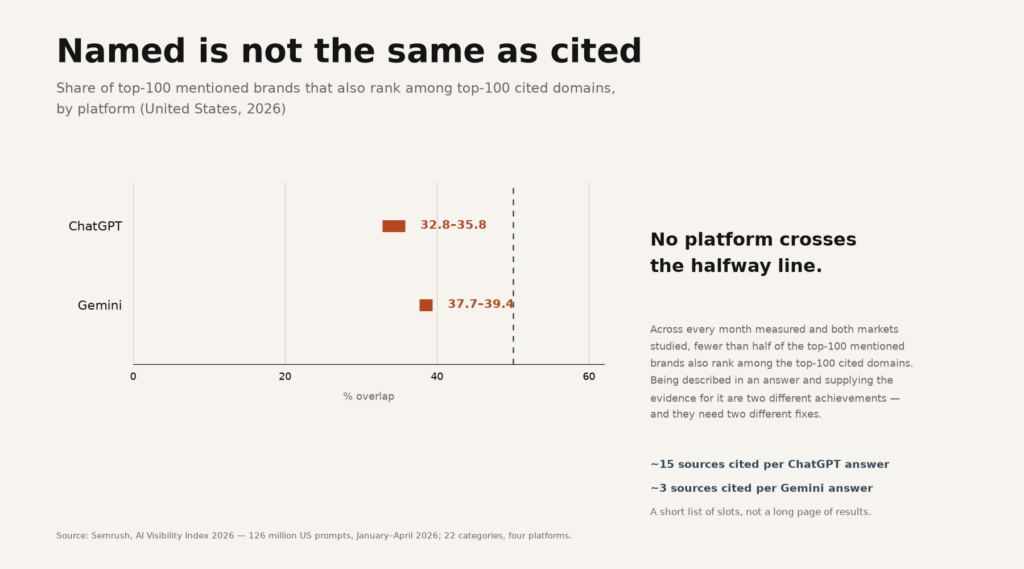
Most teams measure one thing: does the answer mention us? Semrush’s 2026 AI Visibility Index, built on 126 million US prompts across 22 categories and four platforms, found that fewer than half of the top-100 mentioned brands also appeared in the matching top-100 list of cited domains — a gap that held in every month measured and in both markets studied.
That is two distinct problems wearing the same dashboard tile.
A mention means the model described you. A citation means the model used your page as evidence. You can be named constantly and cited never, in which case your visibility is rented entirely from third-party pages you do not control. Or you can supply the evidence and never make the recommendation, which is worse — you are doing the work for a competitor’s slot.
Fifteen sources versus three
The same research found that ChatGPT cites roughly fifteen sources per answer while Gemini cites about three. Think about what that means operationally. On ChatGPT, there is room to be one voice among many. On Gemini, there are three chairs and the music stopped.
And the platforms disagree with each other. Below half overlap between mention lists and citation lists was the norm, not the exception. A strong result on one engine tells you very little about the next one — which is why “we’re doing GEO” as a single quarterly project tends to produce a number that moves and a pipeline that does not.
What B2B GEO Demands That Consumer GEO Does Not
Consumer GEO is largely a content hygiene problem. Answer the question in the first paragraph, use a table, add real numbers, stop burying the lede. Good advice, widely applicable, and insufficient for B2B.
The authority bar sits higher
A technical buyer evaluating an ETL migration has professional liability. If the tool fails, they own it. So the sources that move them are denser than the ones that move a shoe shopper: documentation, benchmarks, security architecture, reference customers, analyst assessments.
Models reflect this. When the query itself is technical, the retrieval skews technical. Thin, adjective-heavy pages do not get cited in a category where the competing sources contain actual throughput numbers.
Your best content is locked behind a form
This is the structural mistake, and it is everywhere.
Gated whitepapers, gated documentation, gated pricing, gated comparison matrices. The logic was sound in 2018: trade information scarcity for contact data. But AI crawlers do not fill out forms. A page that shows a lead-capture wall to a bot is, functionally, an empty page. And an empty page cannot be cited, no matter how good the PDF behind it is.
You do not have to take my word for the mechanism. In the Cloud 100 pricing study run by Growth Unhinged and Profound — 7,675 AI responses across six engines — only 57 of the 77 companies with public pricing pages had pages that crawlers could read in full. Ten hid at least 40% of their body content from bots. These were not obscure startups. These were the hundred largest private cloud software companies, many of them spending seven figures a year on demand generation, invisibly locked out of their own category answers by a React component.
Third-party validation is the currency
Here is where B2B diverges hardest from consumer marketing. Analyst coverage, review platforms, peer communities, and technical press carry weight that your own domain cannot manufacture, and the models know it.
G2’s own research is blunt about this: when buyers were asked what most increases their confidence in a chatbot’s answer, citations from software review sites came out on top. Reviews do double duty — they persuade the human and they supply the trust signal the model uses to decide whether to recommend you at all.
The implication stings for anyone with a content budget and no review program. You can write the best comparison page in your category and still lose the recommendation, because the model’s confidence came from somewhere you never invested.
The queries are longer and uglier
Consumer queries are short: “best running shoes for flat feet.” B2B queries read like a ticket description. “Best CDP for a mid-market retailer with a legacy on-prem CRM, a two-person analytics team, and a GDPR constraint.”
That kind of prompt rewards content that addresses constraints explicitly, including the ones where you are a bad fit. A comparison page that honestly says “we are wrong for teams under fifty seats” is more citable than one that claims universal fit, because it answers the constraint the buyer actually typed.
Your Pricing Page Is in the Answer. It Is Rarely the Source.
Of all the B2B content problems, pricing is the most self-inflicted and the most instructive.
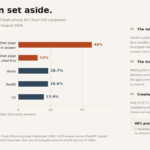
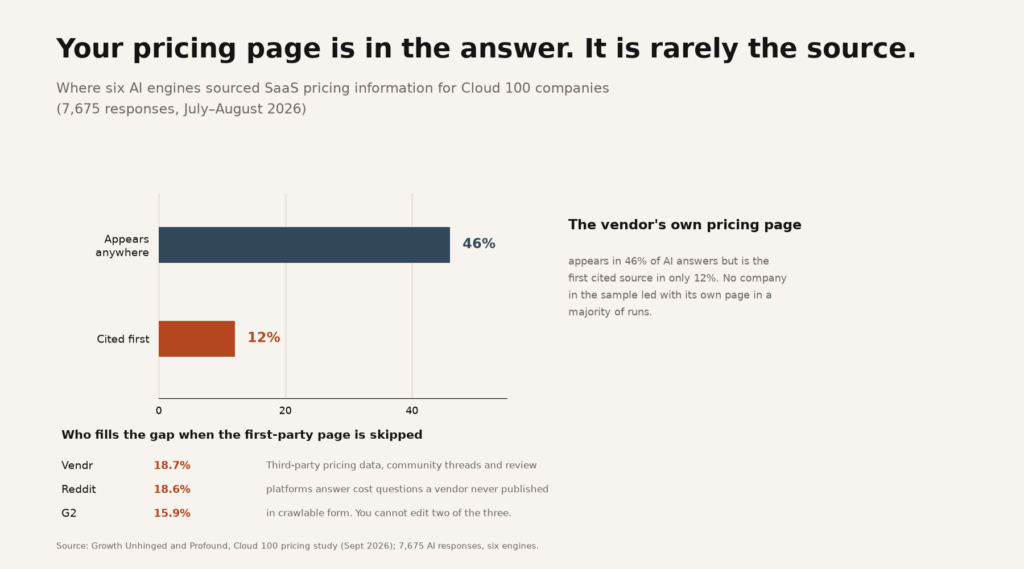
In that same Cloud 100 study, a company’s own pricing page appeared somewhere in 46% of AI answers about its pricing. It was the first cited source in just 12%. No company in the sample led with its own page in a majority of runs.
So who filled the gap? Vendr at 18.7% of answers, Reddit at 18.6%, G2 at 15.9%. One of those you can correct by publishing. Two you cannot edit at all.
The study also caught an extreme case worth sitting with: one company published no prices at all, and the six engines answered anyway, quoting figures for the same seat that ranged from roughly $100 to $2,400 a month. Silence is not a defensive position. It is a vacuum that somebody else’s stale data fills.
There is a nuance here that saves teams with genuinely custom pricing. The study’s strongest performers were not the most transparent — several ranked well above median while showing plans without price points. What separated them was coverage: billing mechanics, what drives cost, overage behavior, minimum commitments, and a concrete entry point. You do not have to publish a number. You do have to publish the logic.
The B2B GEO Playbook
Five moves, in the order that actually produces results.
1. Map the evaluation queries
Not keywords. Questions, written the way your buyer would type them at 11pm. Pull them from sales call recordings, RFP language, support tickets, and the “what should we look at instead” conversations your AEs keep having.
Then group them by job: category discovery, head-to-head comparison, constraint matching, cost, migration risk, security review. Each job maps to a different page type, and a page built for the wrong job does not get retrieved for it.
2. Ungate the parts that win evaluations
Keep the calculator. Keep the ROI model. Keep the implementation checklist that requires context to use well. Ungate the specifications, the comparisons, the architecture docs, and the pricing logic.
The rule of thumb: gate what requires a conversation to be useful, publish what requires reading to be useful. A PDF behind a form is not an asset in an answer engine. A documentation page with real limits in it is.
3. Build authority you cannot publish yourself
This is the slow one, and the one that compounds.
Review volume and recency. Analyst inclusion. Technical press. Peer communities where your engineers answer questions without a marketing brief. Open-source contributions. Conference talks that get transcribed.
None of it can be bought as a media placement, and all of it feeds the confidence signal that determines whether a model recommends you or hedges.
4. Structure for extraction
The academic work here is unusually clear. The Generative Engine Optimization paper published at KDD 2024 — the one that named the discipline — found that structural tactics could lift visibility in generative answers by up to 40% in its benchmark. Forty percent, from formatting.
Practically: answer first, context second. One claim per paragraph. Tables with real numbers. Headings that state the conclusion rather than teasing it. Self-contained passages that survive being lifted out of context, because that is exactly what happens to them.
5. Audit, then close specific gaps
Do not audit “AI visibility.” Audit a list of forty queries your buyers actually ask, on the two or three engines your buyers actually use, and record two things per query: mentioned, and cited.
The gap tells you which fix to run. Missing from the answer entirely is a positioning and authority problem. Mentioned but never cited is a structure and crawlability problem. Cited but described wrong is an accuracy problem, and it is usually caused by your own outdated page.
The Part Everyone Gets Wrong: AI Scouts, Humans Referee
There is a version of this story that says the sales team is obsolete. The data does not support it, and getting this wrong will cost you a budget.
Gartner’s 645-buyer survey found that 69% prefer to validate AI-generated insights with a sales rep. Seventy percent want a fully digital self-service experience and 67% would prefer no rep at all — and yet, at the moment of commitment, they go find a human. Their reasons are specific: understanding their situation, building internal confidence, securing support from people who are not in the room.
The same survey found that only 13% of buyers, in Gartner’s separate buying-behaviour research, permit AI-enabled sourcing platforms to make the final supplier choice without human input. Eighty-seven percent of deals were still decided by human decision-makers.
Forrester’s 2026 buying research adds the structural detail: the typical purchase now involves 13 internal stakeholders and 9 external influencers, procurement is a decision-maker in 53% of cycles, and more than 60% of buyers run some form of trial before committing — 78% of those spending $10 million or more. The evaluation phase did not disappear. It got longer, more political, and more evidence-hungry while discovery got faster.
So the honest division of labour is this: AI scouts, humans referee. The machine reads forty vendor sites in a minute and hands back a shortlist. The shortlist then walks into a room where six people with different objections decide whether it survives. Your job is to be on the list and to survive the room.
And one warning that deserves its own paragraph. Gartner has forecast that by 2027, 95% of sellers’ research workflows will begin with AI, up from under 20% in 2024. That is about sellers, not buyers — a detail that gets mangled constantly in secondhand coverage. Your own sales team is already asking an assistant before they open your CRM. If your rep and your prospect are prompting the same model and getting different answers about your product, you have an internal alignment problem masquerading as a marketing problem.
What the Stakes Actually Are
Let us be precise, because the hype has made people sloppy in both directions.
The volume is still small. Ahrefs’ October 2026 benchmark, covering 118,671 sites, puts AI assistants at 0.46% of tracked traffic against 27.55% for search engines collectively. If you are forecasting pipeline off “AI traffic is exploding,” you are forecasting off a rounding error.
The value per visit is not small. Ahrefs’ own site saw AI search drive 0.5% of traffic and 12.1% of signups — conversion roughly 23 times its organic baseline. Treat that as a directional signal, not a benchmark: it is one site, in one thirty-day window, selling SEO tools to an audience that arrives pre-qualified. Other studies land anywhere from a 31% lift to a much larger multiple depending on what counts as a conversion and how dirty the organic baseline is.
The absence cost is the real number. Forrester found that twice as many buyers now name generative AI or conversational search as a more meaningful information source than any other single channel, ahead of vendor websites, product experts, and sales. Ninety-four percent of business buyers use AI somewhere in the purchase process. When the first filter is automated and the answer names five vendors, the cost of being sixth is not a lower ranking. It is a deal that never appears in your CRM, with no signal that it existed.
That is the strategic case, and it does not require the 23x number to hold up.
The Takeaway
The first step of B2B buying moved, and it moved somewhere most marketing teams cannot see. Technical buyers now open a chat window before they open a browser, get a synthesized shortlist, and walk into their buying committee with a preference already formed.
Winning that moment is not an SEO add-on. It requires three things most B2B organizations have not done together: publishing the technical substance you have been gating, structuring it so a model can extract and quote it, and building the third-party evidence that makes a model confident enough to name you.
Do those three things and you become the default answer — the one that shows up without being asked for by name. Skip them and you will keep winning the deals where the buyer already knew you, while quietly losing the ones where they did not.