Insight: Six Months of Chasing AI Citations With No Traffic to Show for It
The 1% problem hiding inside a 13% weight
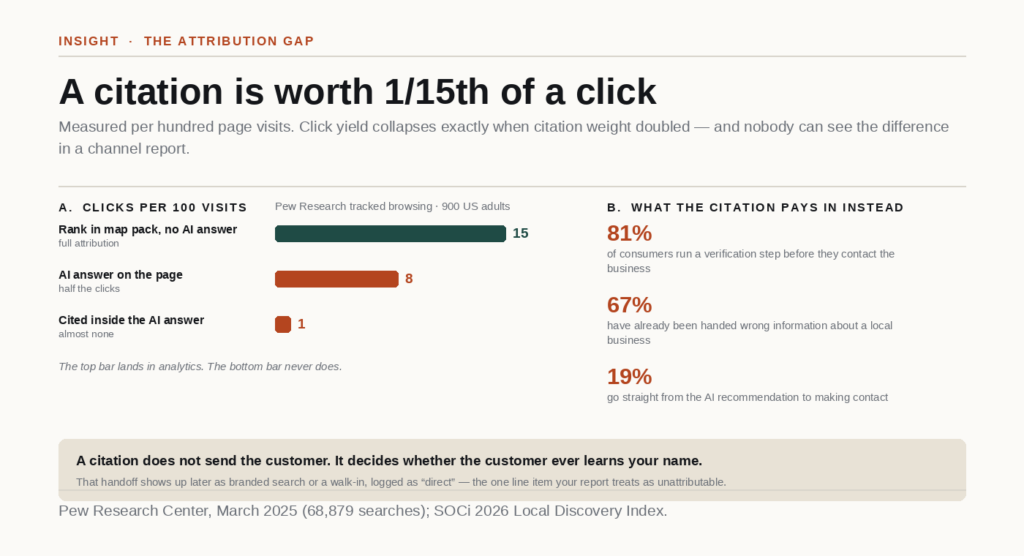
Here’s a number that should bother you. Users click a link cited inside an AI Overview in 1% of visits.
Not 10%. Not 5%. One.
Now hold that next to the finding that made this whole discipline exist: citation weight in AI search doubled to 13%, and three of the top five AI visibility factors are now citation-related. The industry read that and concluded citations had become the prize. They became the gate, yes. But the prize is smaller than the gate lets on.
That gap — enormous strategic weight, almost no measurable click — is the most misread number in local marketing right now. And it isn’t a contradiction. It’s a settlement.
Why the citation was never meant to be a click
The mistake is structural, and it starts with a misapplied model.
A map-pack ranking is a redirection. Someone asks a question, you appear, they click, they arrive. Click-through rate is the honest measure because the whole transaction is a click.
An AI answer is a settlement. The user asked a question; the engine answered it in the same breath. There is nothing left to click for. Pew’s browsing panel is unambiguous here: when an AI summary appeared, traditional result clicks fell from 15% of visits to 8%, and sessions ended without any site visit 26% of the time versus 16%. The summary didn’t compete with the click. It replaced the need that produced it.
So when an engine cites you, it isn’t handing over traffic. It’s quoting you as evidence in a verdict it already delivered. You become the footnote to an answer the user never has to leave.
This is why the citation weight rose exactly as the click yield collapsed. Those aren’t opposing trends — they’re the same trend. Citations matter more precisely because the click is gone. The engine is doing the reading for the user, and being one of the two or three sources it read is now the entire game.
The incentive nobody states out loud
Follow the structure, not the intent.
Google’s revenue comes from queries resolved on Google’s surface, where ads can be sold. Every session that ends on the results page is a session that never becomes an ad impression elsewhere — but also never leaves the property. The summary keeps the user inside the monetized boundary. That’s not conspiracy; it’s just what the architecture rewards.
Publishers who lived on the click are absorbing a cost they cannot bill to anyone. Pew measured the transfer precisely: 88% of AI summaries cite three or more sources, and Wikipedia, YouTube, and Reddit together account for about 15% of citations. Platforms that never needed traffic — that monetize attention directly — are being cited heavily. Sites whose business model was the click are being drained.
For a local business, the asymmetry is worse than for a publisher, because you have no ad inventory to fall back on. But you also have something a publisher doesn’t: a physical door.
What a citation actually pays in
A local business doesn’t need the click. It needs the shortlist.
SOCi’s 2026 Local Discovery Index found that when an AI tool recommends a business, 81% of consumers take a verification step before making contact. Only 19% go straight from recommendation to contact. They check reviews (33%), look at social (20%), search to confirm details independently (16%), or cross-check multiple sources (12%).
That tells you what the citation is for. It’s not traffic generation. It’s name insertion into a consideration set — and the verification loop that follows is where the decision actually closes.
Which reframes the economics entirely. A citation converts at a low click rate but at a high qualified rate, because by the time someone acts on it, they’ve checked you against three other sources and found you consistent. Compare that with a map-pack click, where the user is still deciding whether you’re real.
The catch: 67% of consumers say an AI has already given them wrong information about a local business, and 73% report no increase in trust over the past year. So the citation gets you auditioned, and your listing accuracy decides whether you survive the audition. Those are not two problems. They’re one pipeline, and the weak link is the boring one.
The measurement trap this creates
Here’s where the whole thing cashes out, and why the strategy keeps getting underfunded.
Phone calls tapped from a Google Business Profile and direction requests never generate a website session. They appear in the profile’s Performance report and nowhere in GA4. Even with perfect UTM tagging, you capture only the minority of interactions that involve a website click at all.
Now add the citation layer on top. A user meets you in a ChatGPT answer, verifies you on Google, checks your reviews, then types your name into Maps and calls. In your analytics that reads as direct traffic — the one bucket everyone treats as unattributable noise.
So the citation’s contribution is real, large, and structurally invisible. Which produces a predictable budgeting outcome: the channel that can’t be measured gets cut, right when it doubled in importance.
What this actually implies
Three things follow, and none of them are “get more clicks.”
Stop evaluating citations by referral traffic. An AI referrer showing 2% of sessions isn’t failure — that’s the visible sliver of a mostly offline handoff. Track share of answer and GBP actions instead.
Treat accuracy as revenue, not hygiene. With 67% of consumers already burned by wrong AI information, the business whose hours are correct wins the verification step and the one whose hours are wrong pays for the citation and loses the customer. In this economy the wrong data is worse than no data, because it spends trust you already had.
Price the invisible channel honestly. If you report on a channel that cannot see its own best outcomes, you will systematically defund your highest-leverage work. The correct move isn’t better attribution. It’s admitting the metric boundary and judging the channel on the outcome it can’t measure — calls, walk-ins, branded search.
The citation was never going to pay in clicks. It was always going to pay in being the name someone already trusts before they arrive. That’s worth less per impression and more per relationship, and every report you own is built to see the opposite.