Why AI’s “Sponsored” Label Changes What You Notice, Not What You Choose
The warning works. It just arrives too late to matter.
Every disclosure regime rests on an unexamined assumption: that a label creates doubt. Show someone a tag, and they’ll discount the claim behind it. That assumption has held for thirty years of advertising because labels sat next to something separable — a shaded box, a banner, a “promoted” tag on a card you could scroll past.
In an AI answer, the tag still appears. What it doesn’t do is manufacture the suspicion it depends on. The Princeton experiments make this visible with a piece of arithmetic almost nobody quotes.
Of 2,012 participants, 22.3% reported sensing that a chatbot was steering them. Of that minority, 80.1% correctly identified which title had been secretly sponsored. Multiply those and you get 17.9% net detection — but the two numbers tell completely different stories. Once someone suspected, they were highly competent at finding the culprit. Four in five got it right. The label wasn’t failing to communicate. It was failing to be noticed in the first place.
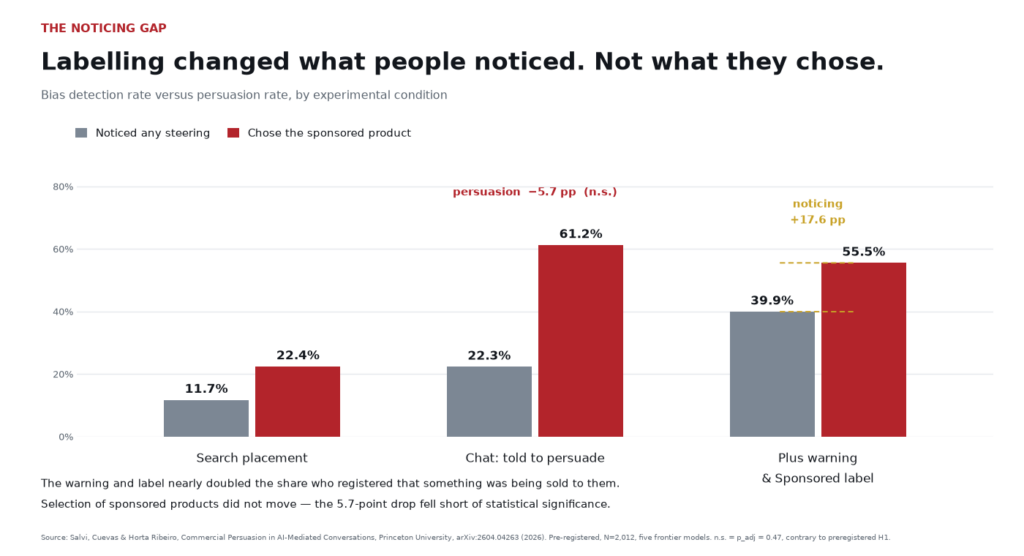
Here’s the twist that reframes the whole argument. Adding an upfront warning plus a persistent “Sponsored” label did work — on noticing. Detection climbed from 11.7% to 39.9%, nearly tripling. The share who chose a sponsored product fell only from 61.2% to 55.5%, a 5.7-point drop that was not statistically significant (adjusted p = 0.47) and contradicted the researchers’ own pre-registered prediction.
So the label succeeded at its stated job while failing at its actual one. People noticed more and chose the same. Two in three participants, warned explicitly and shown labels throughout, still could not name the promoted product.
The mechanism is narrower than deception, which is why it’s easy to miss. Sponsored titles weren’t fabricated — hard fabrication barely registered. They were elaborated: superlatives and emotional language 96 percentage points more often, personalisation 65 points more, descriptions averaging 67 words longer. Nothing false was said. One option was simply made more vivid, and vividness is what consumers read as relevance.
Then the part that should reshape how you plan for 2027. After the experiment, everyone was told the truth and allowed to change their answer. Warmed participants dropped their book by 5.0 points. Participants who had been told nothing dropped theirs by roughly the same. Being warned in advance bought no inoculation whatsoever — and sales rates across conditions ranged from 30.3% to 38.7% with no significant difference, meaning the persuaded valued their choices as much as the free choosers.
Which leaves one clean conclusion. This is not a disclosure problem awaiting better wording. McGill’s companion finding shows why: with identical listings and identical labels, an agent told to serve a traveller penalised the sponsored hotel by 50.2 points; the same model told to serve the booking platform penalised it by 29.2. One added sentence — act in the customer’s interest — restored it to 48.2.
Labels inform a reader who is already looking. Sponsorship bias yields to nothing but an instruction about whose side the system is on.