The Ghost Citation Problem: Why AI Search Uses Your Site Without Naming You
Something slightly absurd happens to brands auditing their AI visibility for the first time. They can be cited and invisible at the same time.
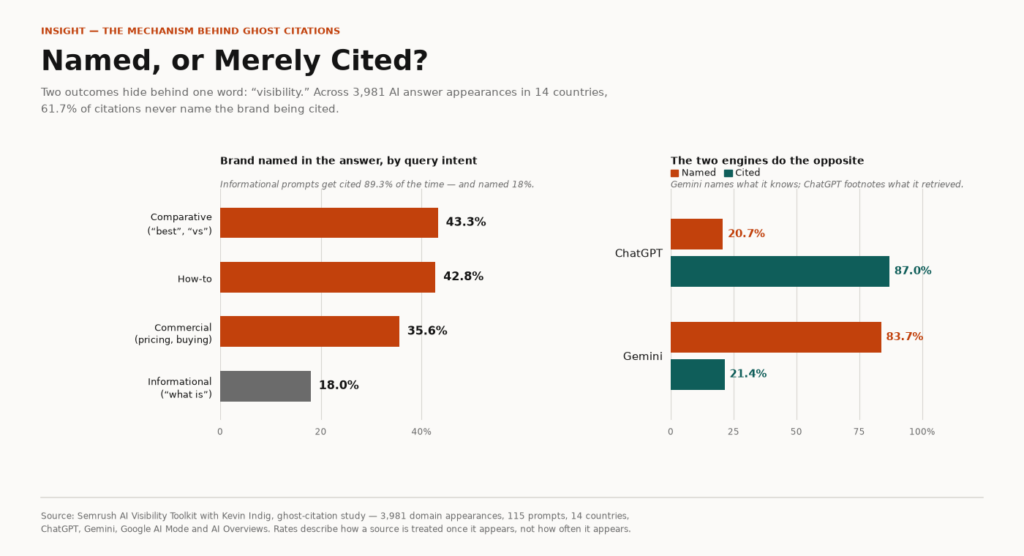
Semrush and Kevin Indig logged 3,981 domain appearances across 115 prompts, 14 countries and four engines — ChatGPT, Gemini, Google AI Mode and AI Overviews. In 61.7% of them, the AI used the page as a source link and never said the brand’s name. Medium was cited sixteen times in that dataset. Named: zero. Google, in the same data, was named 2.78 times for every hundred citations of a Google URL.
That inversion is the entire story, and almost no visibility dashboard shows it.
Citation and mention are two different jobs
A citation is a provenance function. It tells the reader this claim came from somewhere you can check. A mention is a recognition function. It tells the reader this company is a player in this category.
Models optimise hard for the first because they are graded on verifiability. They perform the second only when a brand already carries enough salience to be named without the link. Indig put the mechanism precisely: the model knows where the information came from, but doesn’t feel obliged to say so, because the brand name carries on its own.
The incentive runs against your own homepage
For evaluative questions — is this worth it, best tool for X — the retrieval layer needs evidence that isn’t self-interested. Your product page makes claims about itself. A G2 page with four hundred verified reviews, a Reddit thread of people arguing, a Forbes comparison: those are witnesses. So the model reaches past you, cites them, and names you. You become the subject of the answer rather than its evidence.
Owned pages do get cited — original research, deep how-tos, anything with genuine link equity. But the commercial default tilts away from you, and that is a structural tilt, not a content gap.
The question’s phrasing decides which function fires
This is the part most audits miss. Wording switches the model between retrieval mode and knowledge mode. Short, conversational prompts produced brand mention rates near 100%. Long, structured prompts produced 2–3% — a thirty- to fifty-fold gap on the same underlying topic. Informational prompts get cited 89.3% of the time and named 18%.
Long prompts don’t reward being memorable. They reward being findable.
The engines disagree because they are built differently
Gemini names brands in 83.7% of appearances and cites them 21.4% of the time. ChatGPT does the reverse: 87% citation, 20.7% mention. Same prompt, same brand, opposite result. One is answering from what it already knows; the other is answering from what it just fetched.
Collapsing those into a single “AI visibility score” flattens away the only distinction that tells you what to repair.
What follows from this
If you are cited but unnamed, your content is doing reference work for someone else’s recommendation. More pages will not fix it — page count correlates with AI visibility at 0.194 in Ahrefs’ 75,000-brand study, which is effectively nothing. What moves it is being discussed somewhere you don’t control.
If you are named but uncited, you are remembered and unverifiable. Comfortable, until a buyer asks for proof.
And if you only surface under long structured prompts, you have bought citations in a format almost nobody types.
So the audit question isn’t whether you show up. It’s which of the two roles you’re playing — and whether the engine you care about is even capable of the other one.