The Map Pack Didn’t Die. It Got a Competitor.
The map pack didn’t die. It got a competitor — and a much pickier one
For about a decade, local search had one scoreboard. You ranked in the three-pack or you didn’t. You watched the map, you chased reviews, you prayed the pin landed in the right spot. Simple, brutal, understood.
That scoreboard still works. It’s just no longer the only one, and the new one keeps score differently.
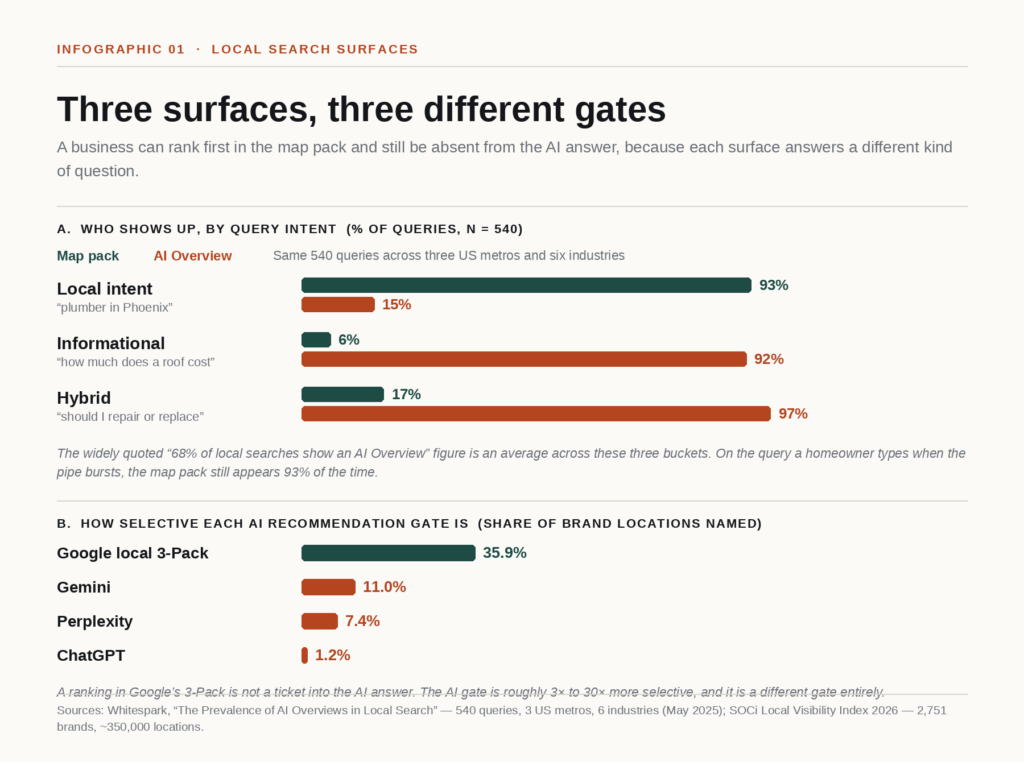
Here’s the part that gets lost in the panic: on the query a homeowner actually types when their pipe bursts — plumber near me — Google’s map pack still appears 93% of the time. The AI Overview shows up on about 15% of those. So if you’ve been told AI has eaten local search, you’ve been told a half-truth, and the half that’s missing is the half that decides where you should spend your next dollar.
But ask that same homeowner, three days earlier, how much should a roof replacement cost — and the picture inverts. AI Overviews appear on 92% of informational local queries and 97% of hybrid ones. The map pack, meanwhile, is almost absent from those pages.
Two different questions. Two different surfaces. Two different games.
And then there’s the third surface nobody budgets for: the chatbot recommendation. Not an AI Overview sitting above search results, but a full answer inside ChatGPT, Gemini, or Perplexity, naming five businesses. That one is not a gate you can rank your way through.
What the “68% of local searches” number actually says
You’ve seen it. AI Overviews now appear on 68% of local searches, versus 39% for the local pack. A 29-point gap. It’s in a hundred slide decks by now.
The number is real. It comes from a Whitespark study — 540 manually run queries across Houston, Phoenix, and Denver, six industries, published in May 2025. What most people quoting it skip is the breakdown underneath, which is the opposite of the headline.
That 68% is an average pulled up by two saturated buckets. Informational queries at 92%. Hybrid queries at 97%. Meanwhile the bucket that actually drives phone calls — local intent — sits at 15%.
The study’s own author calls it “even a modest-sized study.” It’s 17 months old, covers three metros, and includes no automotive, no hospitality, no retail. Treat it as a directional signal, not a census. Run a few of your own searches before you build a strategy on it.
The honest read: AI answers aren’t replacing the map pack. They’re claiming a set of searches the map pack never really served — the research phase, the cost questions, the should I or shouldn’t I questions that happen days before anyone dials.
The quieter threat: fewer slots, different winners
While everyone argued about Overviews, something more consequential happened to the pack itself.
Sterling Sky analysed 322 markets and found that AI-powered local packs surface only 32% as many unique businesses as the traditional pack. In 88% of those markets, the total number of businesses visible to users dropped. Many AI packs show one or two listings instead of three. The click-to-call button often disappears.
Read that again, because it’s the opposite of a ranking problem. It’s a census problem. There are simply fewer chairs, and the people sitting in them are frequently not the same people who sat in the old three-pack.
At the same time, paid inventory moved in. Local pack ads grew from under 3% to roughly 22% of tracked mobile keywords in about a year. Local Services Ads went from 11% to 31% of tracked queries. Organic slots didn’t just shrink — they were partly converted into something you rent.
So a business can hold position one, keep its profile clean, keep collecting reviews, and watch the phone ring less. Nothing is broken. The room got smaller.
Why the AI answer picks someone else
Here’s the uncomfortable mechanic. Ranking well and being cited are only loosely related.
A Ziptie study found that being in Google’s top ten organic results gives you roughly a 25% chance of appearing in the AI Overview for that same query. Three times out of four, the pages Google ranks are not the sources its AI quotes.
So what is it reading?
Per SOCi’s 2026 benchmarking, ChatGPT’s local answers are grounded in sources like Yelp and Bing’s index — not your Google Business Profile. Gemini is grounded in Google Maps. Claude draws through the Brave index. Three engines, three different maps of reality.
Then there’s the accuracy problem. Measured field by field against Google Maps as the source of truth, ChatGPT got 85.0% of business details right, Gemini 90.7%, Claude 88.1%. Names and addresses are close to solved. Hours are not — on ChatGPT, fewer than 70% of locations had correct hours. Phone numbers sat at 76.7%.
That matters more than it sounds. A recommendation with the wrong closing time isn’t a win. It’s a handoff to a competitor who was open.
Citations stopped being plumbing and became the gatekeeper
This is the structural shift that explains everything above, and it’s the one I’d put on a wall.
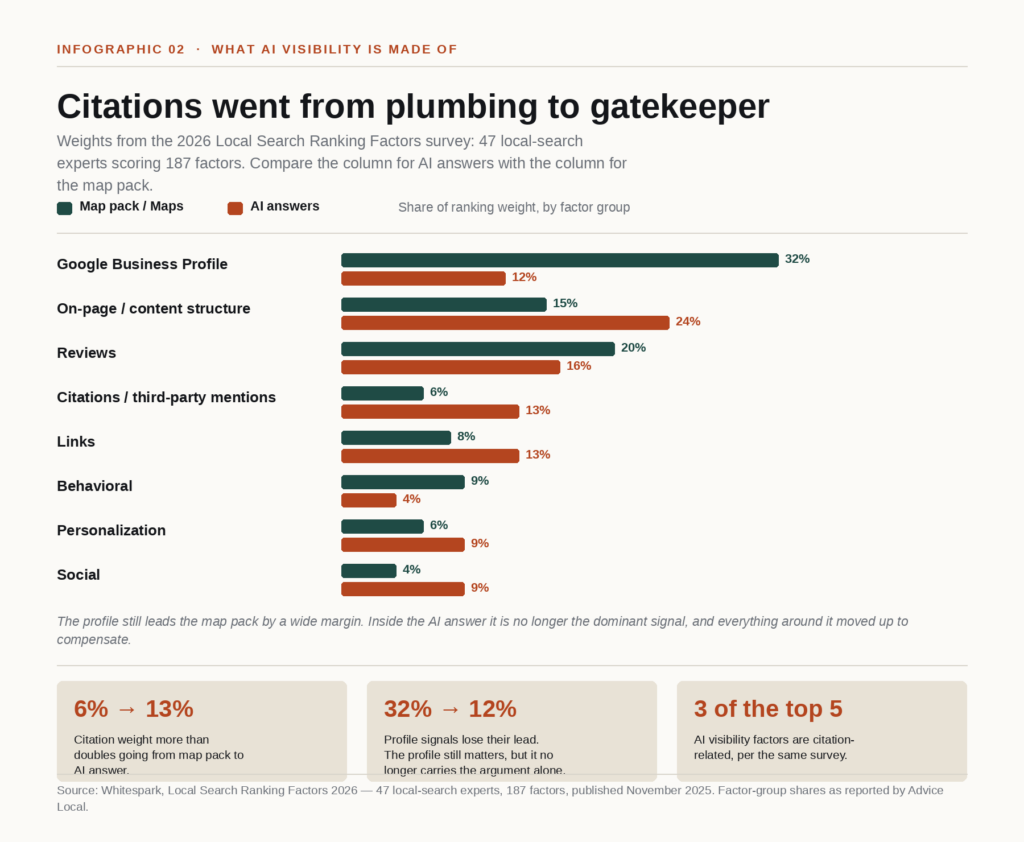
The 2026 Local Search Ranking Factors survey — 47 local-search experts scoring 187 factors — added an “AI Search visibility” category for the first time. Put the two columns side by side and the reversal is stark.
In the map pack, citations carry 6% of the weight. They’re plumbing: necessary, unglamorous, rarely the reason you win. In AI answers, citations carry 13% — more than double — and three of the top five AI visibility factors are citation-related. The survey’s blunt summary: in AI search, mentions are the new link.
Meanwhile the Google Business Profile went from 32% of the map-pack weight to 12% in AI answers. On-page content went the other way, from 15% to 24%.
The profile didn’t become unimportant. It became table stakes — the thing that has to be right before anything else counts. What changed is that it’s no longer sufficient on its own.
The verification loop nobody prices in
There’s a consumer-side story that most GEO advice ignores, and it changes what “winning” means.
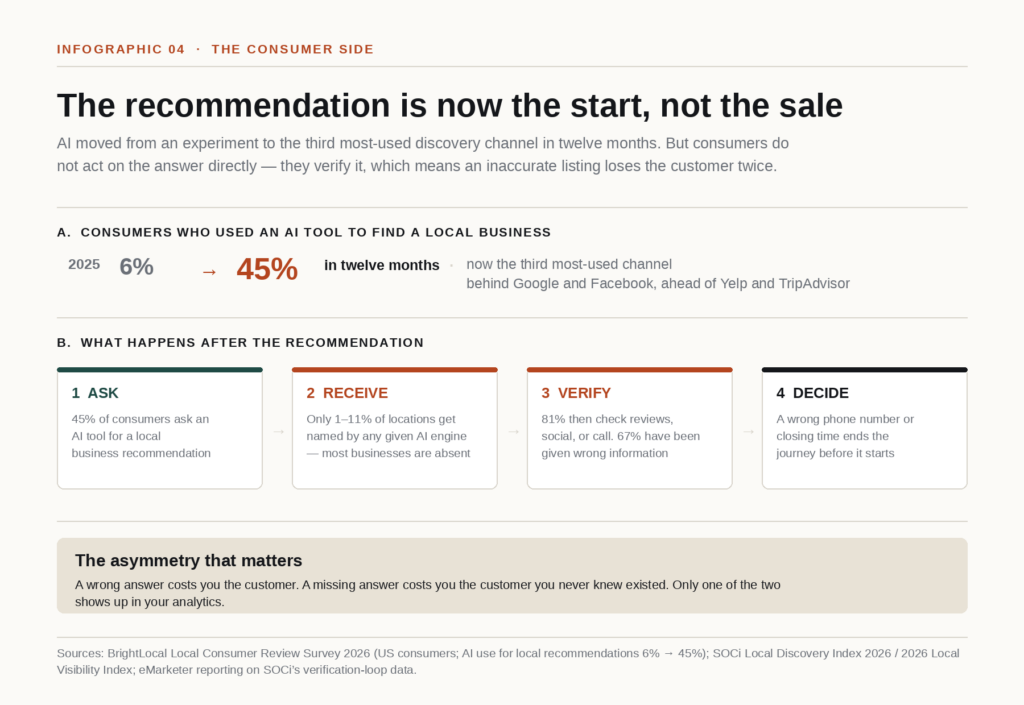
BrightLocal’s 2026 survey found that 45% of consumers used an AI tool to find a local business in the past year. A year earlier, that figure was 6%. It’s now the third most-used discovery channel, behind Google and Facebook, and ahead of Yelp and TripAdvisor. Google review usage slipped from 83% to 71% in the same period.
But here’s the correction. SOCi found that for 81% of consumers, an AI recommendation doesn’t end the search — it starts a verification cycle. They check reviews, look at the business’s social presence, search the brand name, or just call. And 67% report having been given incorrect information about a local business by an AI.
So the realistic model isn’t AI names you, customer arrives. It’s AI names you, customer checks whether you’re real, then maybe arrives — with a one-in-three chance the AI already got a fact wrong and sent them looking elsewhere.
What local GEO is not
Three things worth clearing up before the playbook, because they cost people money.
It is not global GEO with a postcode attached. A national brand wins AI citations by publishing authority content at scale. A plumber in Tucson doesn’t need a 4,000-word pillar page. He needs his hours to be right in eleven places and forty recent reviews that mention the neighbourhood by name.
It is not a schema project. More on this below, but the short version: the evidence that structured data lifts AI citations is much weaker than the industry claims.
It is not a reason to abandon the map pack. The pack still shows on 93% of local-intent queries. Businesses that pour everything into “AI visibility” while letting their profile go stale have traded a working channel for a speculative one.
The playbook, in leverage order
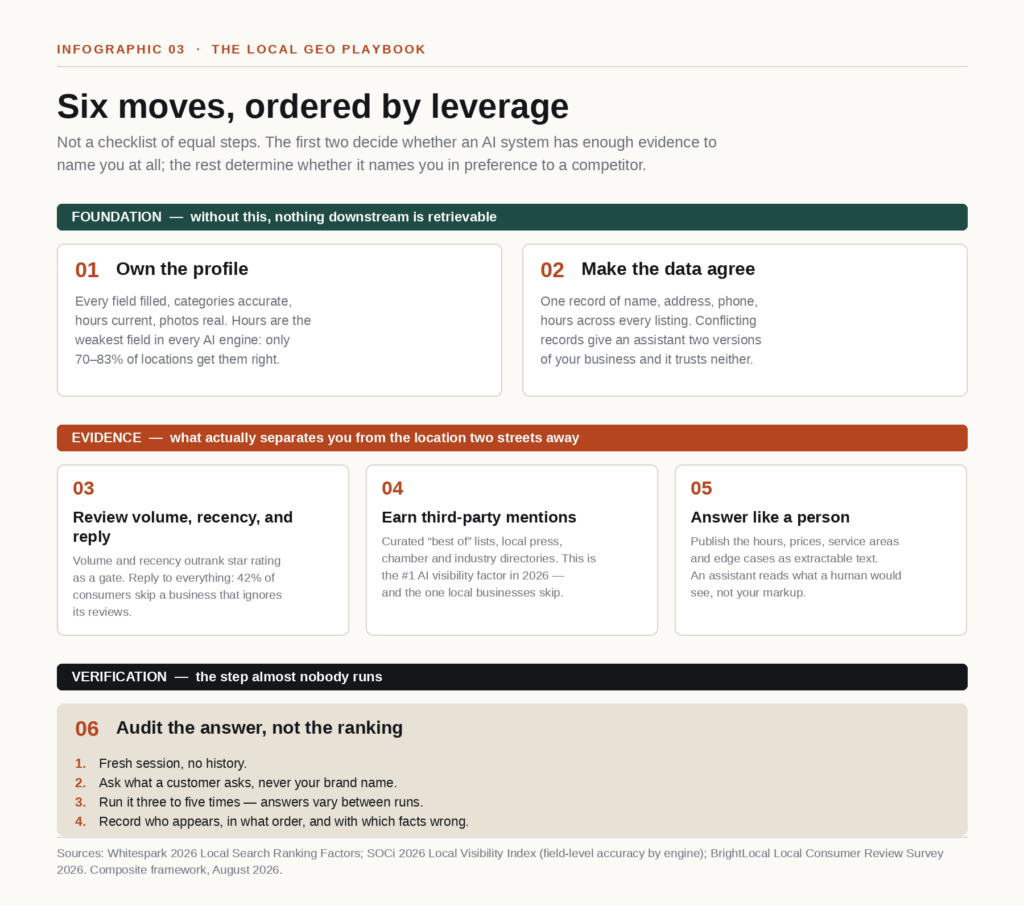
Not six equal steps. The first two decide whether an AI system has enough evidence to name you at all. The rest decide whether it names you instead of the shop two streets over.
1. Own the profile, field by field
85% of US small businesses now have a Google Business Profile. Only 35% maintain an active one, and 21% haven’t touched it in over three months. That gap is the cheapest advantage available.
Fill every field. Get the primary category right — it’s the single most common negative factor. Keep hours current, including holidays, because hours are the weakest field in every AI engine. Upload real photographs, because Google’s vision systems read them for geographic legitimacy, and stock imagery of a generic office registers as boilerplate.
2. Make the data agree with itself
One record of name, address, phone, and hours — identical across your profile, your site, Bing Places, Apple Business Connect, and the directories that matter in your category.
This sounds administrative. It isn’t, and here’s why: when an assistant finds two versions of your business, it doesn’t pick the better one. It discounts both. In traditional local SEO, an inconsistent citation was a minor ranking friction. In AI retrieval, where a model is cross-referencing eight to ten sources before it commits to a name, a conflict can remove you from consideration entirely.
3. Fix the review gate, not just the star rating
47% of consumers won’t use a business with fewer than 20 reviews. 47% of small businesses have fewer than 20. The two numbers are the same number, which tells you most of the market is disqualifying itself.
Beyond volume, recency and response rate now function as gates rather than ranking nudges. 89% of consumers expect a reply to reviews; only 51% of owners reply regularly; 42% of consumers are unlikely to use a business that ignores feedback. SOCi’s benchmarking found locations recommended by ChatGPT averaged 4.3 stars, with 4.2 acting as a rough floor below which recommendation rarely happens at all. A quarter of a star is the difference between a recommended slot and an at-risk one.
And a detail worth stealing from the data: businesses that proactively ask for reviews land between 11 and 50 reviews 57% of the time, versus 50% for those that don’t. Asking is the whole mechanism.
4. Earn the mentions you can’t buy
This is the highest-leverage step in the entire playbook and the one local businesses skip most often, because it doesn’t feel like marketing.
Curated “best of” lists. Local press. Chamber of commerce and industry-body directories. Sponsorships with a public mention. A genuinely useful answer in a local subreddit — posted with the community’s permission, not as a drive-by plug. Podcast appearances with show notes that name you.
The 2026 survey found inclusion in expert-curated “best of” lists is the single most important AI visibility factor. That’s not a technical lever. It’s a relationships lever, and it’s why the business with worse SEO sometimes wins the answer.
5. Answer like a person, on the page
When an assistant fetches your page, it reads what a human would see. Not your JSON-LD. The visible text.
A German firm, searchVIU, tested this directly: they placed a price in JSON-LD only, nowhere in visible HTML, and asked five AI systems to find it. None did. Not once. Prices in visible text were found reliably.
So put the answers where a person can read them. Hours in a table, not a paragraph. Service area stated in the words buyers actually use. Price ranges with the variables that move them. The awkward questions — do you charge for quotes, how fast can you get here, do you work weekends — answered in two sentences each, near the top.
6. Audit the answer, not the ranking
The step almost nobody runs, and the only one that tells you whether any of the above worked.
Open a fresh session — no chat history about your business, which can bias the model. Ask what a customer asks, never your brand name. Run it three to five times, because the same prompt returns different answers between runs. Write down who appears, in what order, and which facts are wrong.
Then compare. If a competitor appears consistently and you don’t, that’s the single most actionable signal you’ll get: it tells you the query is answerable, just not with you.
The schema question, asked honestly
Most GEO content tells you to add LocalBusiness schema and watch the citations arrive. The strongest 2026 evidence says: not so fast.
Ahrefs tracked 1,885 pages that added JSON-LD for the first time between August 2025 and March 2026, matched them against 4,000 control pages, and measured citations 30 days before and after. The result across Google AI Overviews, AI Mode, and ChatGPT: no meaningful lift. AI Overviews actually showed a 4.6% relative decline; the other two moved by amounts indistinguishable from noise.
The trap it exposes is one worth remembering. Pages cited by AI are roughly three times more likely to carry JSON-LD than pages that aren’t. Real correlation. But the cause isn’t the markup — it’s that well-maintained sites do both. They invest in technical hygiene, publish better content, keep pages fresh. Schema rides along with quality; it doesn’t produce it.
Google’s own guidance agrees: structured data isn’t required for its AI features. A separate 2026 study found detailed, attribute-rich schema was cited somewhat more often than bare plugin-generated schema, which suggests schema is a tie-breaker at best.
Keep it. It helps machines parse you cleanly, it supports rich results, and it costs nothing to maintain. Just don’t spend your quarter on it while your hours are wrong in six directories.
What to measure instead
Stop treating the ranking as the headline metric. It decoupled from the phone call.
Three things are worth tracking weekly:
Share of answer. For ten queries that matter to your category, in a fresh session, how often do you appear across ChatGPT, Gemini, Perplexity, and AI Overviews? Record it as a percentage, not a yes/no.
Field accuracy. When you do appear, is the phone number right? The hours? Ask a competitor to check you, because you’ll miss your own errors.
Calls and booked jobs, by source. GBP actions. Direction requests. Forms. The numbers that survived the change intact are the ones attached to a human deciding to show up.
The honest caveats
AI answers are non-deterministic. The same prompt run twice can name different businesses. A citation today is not a citation tomorrow. This is not a stable asset the way a map-pack position was, and any agency promising you a fixed AI ranking is selling you something that doesn’t exist.
The Seer conversion figure is a single client. You’ll see “ChatGPT converts at 15.9% versus 1.76% for organic” repeated everywhere. It comes from one B2B client over six months, and a paired 54-site study found no significant difference. AI-referred traffic probably converts better because the visitor has already been qualified by the conversation — but don’t model a 9x lift into a forecast.
The biggest studies are vendor studies. SOCi sells local visibility software. Whitespark sells local SEO tools. Uberall sells listings management. Their data is directionally useful and methodologically disclosed, but every one of them benefits from the story being true. Read the methodology, not the headline.
Your foundation may be the actual problem. 84% of small business owners are confident customers can find them online, while nearly half fall below the 20-review threshold that half of consumers require. Before you optimize for AI, check whether you’d pass a test a human would apply.
Where this ends up
Local discovery is being re-decided, but not in the way the loudest version of the story claims. The map pack is intact for the searches that ring the phone. AI answers own the research that happens before it. And chatbot recommendations — the most selective surface of all — are where the next decade of local brand equity gets built or lost.
The businesses that come out ahead won’t be the ones that abandoned one channel for the other. They’ll be the ones that noticed the three surfaces have different rules, kept their data boringly accurate across all of them, and stopped treating “we rank third” as a synonym for “we’re visible.”
Which is less exciting than a GEO hack thread. It’s also the only version that survives contact with the data.