What AI Says About You When You Are Not in the Room
You can recite your Google position to one decimal place. Ask what Gemini tells a stranger about your pricing and the room goes quiet. That silence is the job.
The number you have, and the number you need
Ask a marketing lead where they rank and you will get a number. Ask what ChatGPT says when a prospect types “is this company any good” and you will get a shrug, then a story about someone checking it once in March.
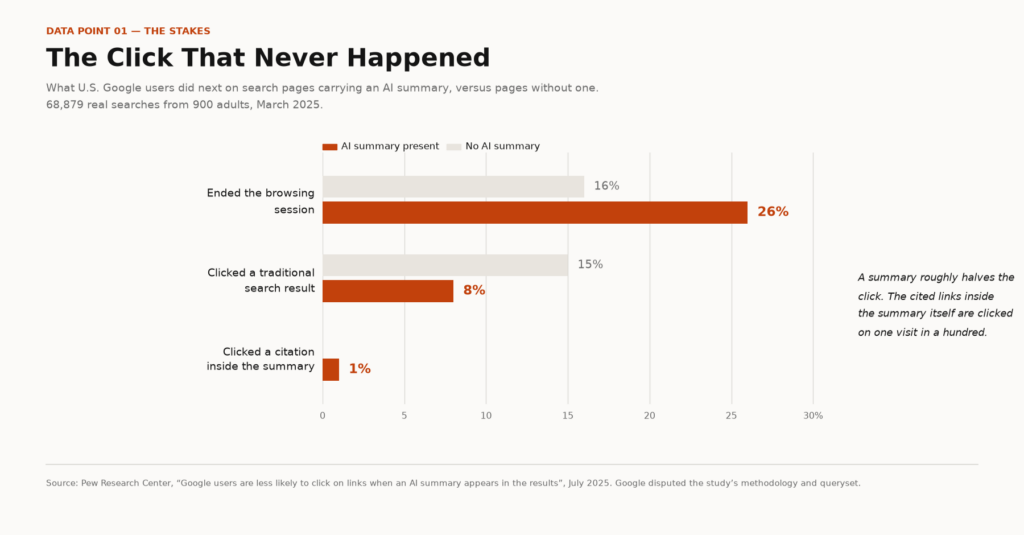
Both of those things cannot be equally true. Half of American adults now use AI chatbots — 49%, up from 33% in 2024 — and the single most common reason they open one is to search for information, at 42%. Six in ten read the AI summaries sitting at the top of search results. If that many people are forming opinions inside a surface you have never once inspected, you are not running a search strategy. You are running a rumour.
Traditional search handed us a ledger: impressions, clicks, position, all of it reconcilable. AI answers hand us something more like gossip. No reliable referrer. No readable ranking. No alarm when the model misstates your headcount, retires a product you still sell, or quietly hands your differentiator to a competitor.
That is the gap this audit closes. Not with a dashboard, at first — with a spreadsheet, a fixed list of questions, and the willingness to read answers you will not enjoy.
The blind spot has a shape, and it is not ignorance
It is worse than ignorance. It is confident ignorance, which is a different disease.
Look at what marketing leaders say about this. In a survey of 350 decision-makers across the U.S., U.K. and Australia, 83% ranked accurate representation in AI systems as a top or high priority for the coming year. Then look at what they do: 55% regularly measure how they appear. And in the U.S., 92% have checked at least once — a number that sounds reassuring until you notice how much of it is one person running three prompts on a Tuesday and calling it a programme.
Separately, Fractl and Search Engine Land found that 27% of brands have already been misrepresented in an AI-generated answer. Fourteen percent say that misrepresentation went on to affect a customer relationship, a sale, or a public-relations situation. Only about a quarter of marketers have any process for catching it.
Sit with that ratio. A quarter of brands know they have been described wrongly. A quarter of marketers are looking. Those two numbers are not the same quarter, and the overlap is where the damage happens.
Four things AI search tells you that Google never did
Here is the useful reframe. An AI audit is not a worse version of a rank tracker. It surfaces four categories of finding that a keyword report cannot produce.
It tells you what the model believes. Not what you published — what survived the model’s synthesis of your site, your reviews, your press, and a Reddit thread from 2023. Those are different objects, and the second one is the one your buyer receives.
It tells you what you are absent from. Google shows you position 40 for a term and you can work on it. AI search shows you nothing at all. You cannot see the answer where three competitors were named and you were not.
It tells you about errors you cannot otherwise detect. A bad review is visible, arguable, and respondable. A hallucinated feature is delivered privately, one buyer at a time, and leaves no trace in your analytics. You will never see it unless you go looking.
It tells you who is doing the recommending. In category questions — “best X for Y” — the shortlist is the whole game. Whatever does not appear on that list did not compete.
What a footprint is actually made of
Five dimensions. Score each one separately, because they fail in different ways and get fixed by different teams.
Presence
Does your brand appear at all, for branded queries, category queries, comparison queries and problem-first queries? Binary, and easy to measure badly. Be strict about the definition: a brand name appearing inside an answer is a mention. A link to your domain is a citation. They are not the same achievement, and confusing them is the single most common mistake in this work.
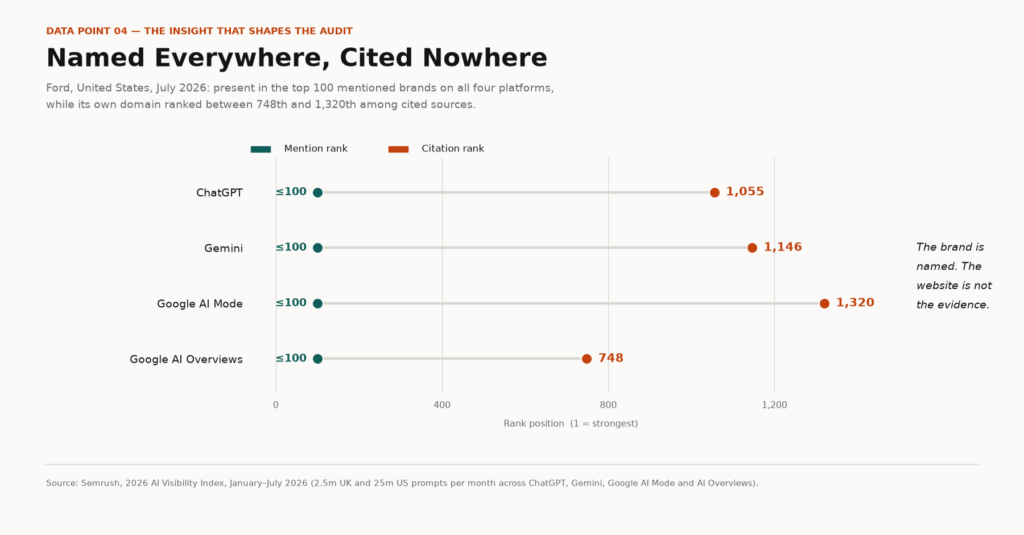
Semrush’s 2026 AI Visibility Index makes the distinction concrete. Across 22 categories and four platforms, fewer than half of the top 100 mentioned brands also appeared among the top 100 cited domains. In the U.S. in July, Ford sat inside all four top-100 mention lists while its own domain ranked 1,055th on ChatGPT, 1,146th on Gemini, 1,320th on AI Mode and 748th on AI Overviews. Named everywhere. Cited nowhere.
Accuracy
When the model does describe you, is it right? Products, pricing, positioning, leadership, geography, claims. Not “roughly right” — right.
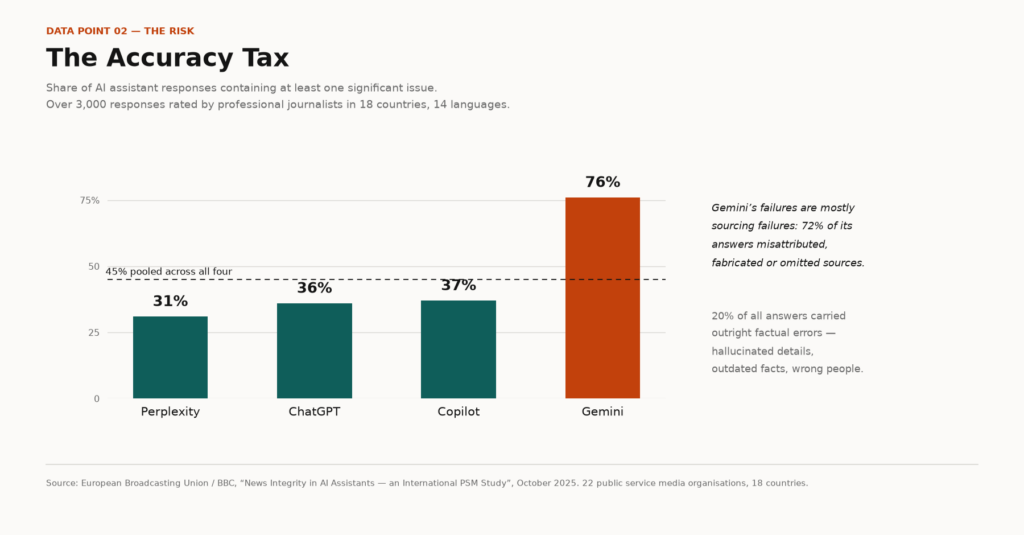
This is where most first audits produce their worst moment. You will find a discontinued product presented as current, an acquisition that never happened, or a headquarters in the wrong city. The EBU and BBC study of more than 3,000 responses found that 20% of AI answers across four major assistants contained significant accuracy problems, including hallucinated detail and outdated information.
Valence
Is the framing positive, neutral, or hedged? “A well-known vendor, though users report support delays” is a mention. It is also a wound.
Valence matters more in AI than in search, because the buyer is reading a synthesized judgement at the exact moment they are forming one. Skyword’s April 2026 survey of 1,000 U.S. adults found that when brand messaging and an AI answer conflict, only 29% trust the brand outright and just 12% trust the AI. Fifty-four percent go looking for a third opinion. You are not arguing with a machine. You are arguing with a machine in front of a jury.
Share of voice
In the questions that matter, how often are you named relative to competitors? This is the number that reframes budgeting. A brand with strong presence in branded queries and zero presence in category queries has a distribution problem, not an awareness problem.
Misrepresentation
The catch-all, and the one with legal exposure. Factual errors, stale claims, fabricated capability, misattributed quotes. Track every instance, with the date and the platform, because you will need the pattern before you can find the source.
Building the query set
Do this once, properly, and then stop changing it. Comparability is the entire value.
Four buckets, roughly 40 to 60 prompts for a mid-sized brand.
Branded. “What is [brand]”, “Is [brand] legit”, “Who owns [brand]”, “[brand] pricing”. Your own name is the easiest place to catch errors, because you know the right answer.
Category. “Best [category] for [need]”, “Top [category] tools 2026”, “[category] for small business”. This is where absence is expensive.
Comparison. “[Brand] vs [competitor]”, “[Competitor] alternatives”. Comparison prompts produce mentions at a far higher rate than dry informational ones, which makes them disproportionately worth tracking.
Problem-first. “How do I solve [problem]”. The queries where nobody is shopping yet, and where the model is most likely to recommend whoever explained the problem best.
Write them the way buyers write them. Conversational. Short. Slightly ungrammatical. Long technical prompts flatter your vocabulary and misrepresent your market.
Running the probes without fooling yourself
Four disciplines, and skipping any one of them turns your audit into fiction.
Run each prompt more than once. AI answers are not deterministic. Pew’s own methodology notes that a summary for a given search may change over time, and platform citation weighting shifts when vendors retune their systems. A single snapshot is a rumour with a timestamp. Three runs per prompt, per platform, minimum.
Control what you can. Same account state, same location, logged-out where possible, same day where feasible. Record the model version and the date. If you cannot control a variable, write down that you could not.
Log the answer verbatim. Screenshot and paste. Paraphrasing destroys the evidence and loses you the exact sentence you will need when you escalate.
Cover the platforms your buyers actually use, not the ones you find interesting. ChatGPT reaches 44% of U.S. adults, Gemini 24%, Copilot 17%, Meta AI 14%. Overlap between platforms is weaker than people assume — in the U.K., any two of four platforms shared only 63 to 70 of their top 100 mentioned brands. Success on one engine tells you very little about the next.
Scoring it
Keep it boring. A four-point scale per dimension, per prompt.
Zero: absent. One: present but wrong or hostile. Two: present, accurate, unremarkable. Three: present, accurate, recommended.
Then aggregate into a footprint per platform. You are looking for shape, not a single grade. A brand at three on presence and one on accuracy has a very different problem from a brand at one on presence and three on accuracy, and the two fixes share almost no budget lines.
Reading the footprint
Five archetypes, each with an obvious first move.
Present, accurate, positive. Defend and extend. Port the winning pattern to more queries before a competitor copies it.
Present but wrong. Urgent. Correct the sources the model is drawing from — your own pages, stale third-party profiles, that 2022 review everybody cites. Do not try to argue with the model.
Absent from category queries. The straight GEO opportunity. You know which questions to answer, because you can see who is answering them now.
Negative or misrepresented. Reputational, and it moves fastest. Skyword found 17% of consumers have switched brands because of AI-generated information and 19% have avoided a purchase. This is not a content backlog item.
Unstable — different answer every run. An authority gap. The model has no confident synthesis of you, so it improvises. That gets solved with corroborated, consistent third-party signal, not more pages.
From audit to roadmap
Sequence by damage, not by ease.
Fix misrepresentation first. It is the only category with live commercial exposure. Then close category-absence gaps, because that is where the pipeline is leaking invisibly. Authority and stability come last, because they are slow and expensive and pointless to chase before the errors are corrected.
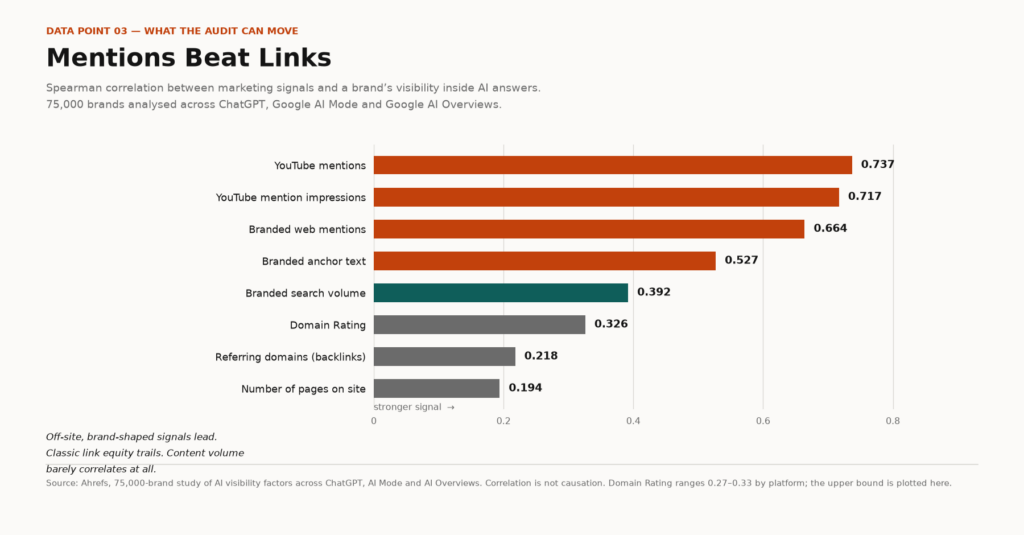
Then, when you do spend, spend informed. Ahrefs’ analysis of 75,000 brands is the most useful public map of where AI visibility actually comes from. YouTube mentions correlate with AI visibility at roughly 0.737 on a Spearman scale. Branded web mentions sit at 0.664. Branded anchor text, 0.527. Referring domains, 0.218. And the number of pages on your site lands at 0.194 — effectively nothing.
That last figure should end an argument in your next planning meeting. Programmatic content volume does not buy AI visibility. Being talked about, across places you do not own, does.
The cadence question
An audit is a baseline, not an event.
Monthly for categories where answers move — pricing, fast-moving software, anything with active competitor campaigns. Quarterly otherwise. And always re-baseline after a platform announces a change, because citation behaviour shifts when vendors adjust weighting.
Watch two things between audits. First, representation drift: the slow change in how a model describes, compares and recommends you, which is only visible against a prior record. Second, branded search volume. Adobe’s data shows 66% of consumers visit a brand’s site directly to verify an AI recommendation, and AI-referred retail visitors converted at a 60% higher rate than non-AI traffic in July 2026. The click may never appear in your referral report. The demand shows up somewhere.
What this audit will not tell you
Credibility requires limits, so here are mine.
It does not measure impressions. You will know you were named; you will not know how many people read it. It does not attribute revenue — the halo lands in branded search and direct traffic, where your attribution model will credit something else. Prompt samples are small, and personalization means your logged-out answer is not every buyer’s answer. And agentic commerce, where software buys on a human’s behalf, is largely unmeasurable today; the instruments for it do not exist yet.
What it does give you is the one thing no dashboard currently provides: a documented, dated, defensible record of what the machines are saying about you, and what that changed.
The takeaway
You cannot manage what you have not read. Right now most brands have read almost none of it — 27% already know they have been misdescribed, and roughly three-quarters have no process that would have caught it.
So the order of operations is not glamorous. Write the questions down. Run them three times. Read the answers with your stomach, not your brand guidelines. Score them honestly. Then fix the worst thing first.
Everything else — the content roadmap, the digital PR, the authority building — is downstream of that spreadsheet. Audit first. Optimise second. And keep the receipts, because six months from now someone will ask how you knew.