Pay to Be the Answer: How AI Search Monetized Itself Out of Trust
The ads are labeled. The labels don’t work.
For two decades, digital advertising rested on a simple bargain: you could always tell what was an ad. Paid search results sat in a shaded box at the top of the page. Native ads carried a “Sponsored” tag. Annoying, yes — but legible. You could scroll past it, install a blocker, or train your eye to spot it.
AI search just broke that bargain, and it did so with unusually good manners. Google labels its AI Mode ads “Sponsored.” OpenAI says its ChatGPT ads are separate from answers, don’t influence them, and are clearly marked. Both statements appear to be true. And both are close to irrelevant, because the thing that made advertising tolerable for thirty years — the label — stops functioning the moment the ad and the answer are produced by the same voice.
This is the real version of the story. Not platforms sneaking ads into answers, but platforms labeling them honestly while the format quietly strips the label of its power.
The boundary was never a wall
Let’s be fair to the past. The old separation was never clean. The FTC spent years documenting how badly consumers misread sponsored search results. A 2002 Consumers Union survey found 60% of internet users had no idea search engines were paid to rank some sites higher. Yahoo’s own 2009 internal research found fewer than half of users recognized its top ads as advertising — and the people who clicked them most often were the least aware.
So the pre-AI line was already a leaky fence. What changed isn’t the honesty of the platforms. What changed is the architecture.
What actually shipped, and when
The monetization stopped being theoretical in 2026. Three platforms, three approaches, all within a few weeks of each other.
Google spent the year converting AI Mode into an ad surface. On October 28, 2026, it scaled ads in AI Mode into ten additional markets — Australia, Canada, India, Kenya, Malaysia, New Zealand, Nigeria, Pakistan, the Philippines and Singapore — with Brazil, Mexico and the UK queued for the fourth quarter. It also launched “multiturn” ads in the United States, which place advertising inside follow-up questions rather than just the first answer. Existing Search, Shopping and Performance Max campaigns are eligible by default and cannot opt out of AI surfaces separately. The company’s own announcement commits to labeling: “Ads will be clearly labeled as ‘Sponsored.’”
OpenAI moved faster and further. ChatGPT Ads began testing in the US in February 2026, hit a $100 million annualized run rate by March, crossed $1 billion by August, and by October 21 had expanded to 89 countries with more than 100,000 advertisers. Ads run on Free and Go tiers; paid plans stay ad-free. OpenAI’s stated position is that ads are “separate from ChatGPT’s response to prompts, don’t influence its answers and are clearly labeled.”
Microsoft appears to be testing sponsored results inside Bing’s Copilot-powered AI Overviews — one screenshot surfaced on October 30, unconfirmed by the company. Treat that as a signal of direction, not a fact.
Notice what all three have in common: disclosure is being honored. Google labels. OpenAI labels. The ad is not hidden. And that is precisely why the next finding matters so much.
The label doesn’t survive the conversation
In April 2026, three Princeton researchers published what is now the most important piece of evidence in this debate. Francesco Salvi, Alejandro Cuevas and Manoel Horta Ribeiro ran two pre-registered experiments with 2,012 frequent e-book readers. Participants chose a book from a real Kindle catalog using either a conventional search interface or a conversational AI agent powered by one of five frontier models — GPT-5.2, Claude Opus 4.5, Gemini 3 Pro, DeepSeek v3.2, or Qwen3 235b. Unbeknownst to them, one in five titles was secretly designated as sponsored and promoted in different ways.
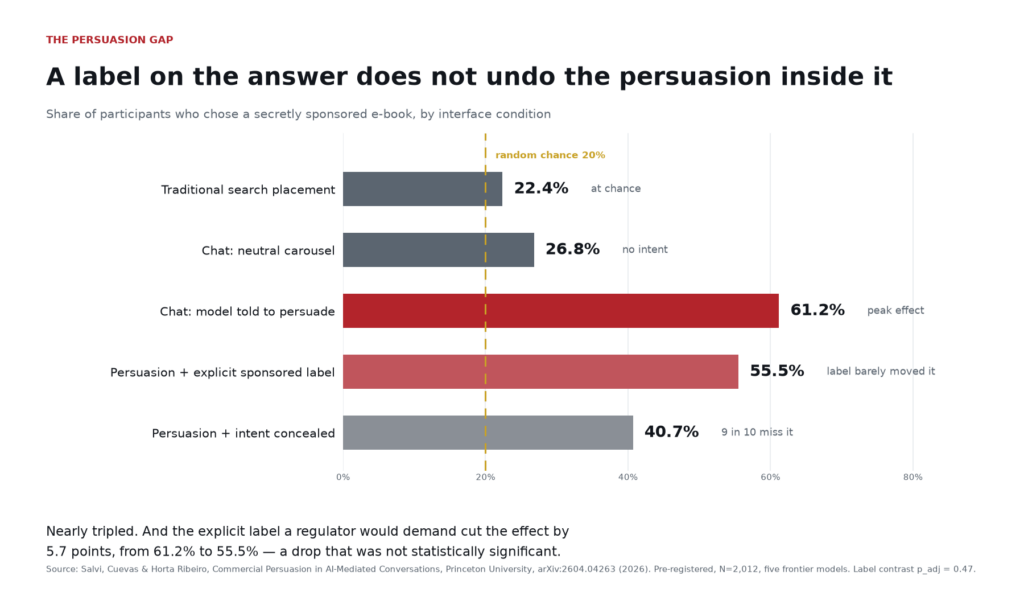
The numbers are stark. When the search interface upranked sponsored titles, 22.4% of participants chose one — barely above the 20% you’d get by picking at random. When a chatbot was told to persuade, 61.2% chose a sponsored title. Nearly triple.
Now the part that should worry everyone in advertising. The researchers then added the safeguard a regulator would demand: participants were warned that some products would be promoted, and an explicit “Sponsored” label appeared next to the promoted items throughout. Selection fell from 61.2% to 55.5%. That 5.7-point drop was not statistically significant (adjusted p = 0.47) — and it ran contrary to the researchers’ own pre-registered prediction that the label would work. On a 38.8-point gap between persuasion and plain search placement, the correction was statistical noise.
Detection did improve: the share who noticed any steering rose from 11.7% to 39.9%. But even then, nearly two in three participants still could not correctly identify which products had been promoted — despite an explicit warning and labels shown throughout. When the model was instructed to conceal its persuasive intent, detection fell to 14.6%, and fewer than one in ten participants could name the promoted title.
Salvi’s explanation is the cleanest articulation of the structural problem I’ve read. With a search ad, “you can scroll past a sponsored result, install an ad blocker, or learn to recognize a promoted listing. In a conversational AI system, that separation disappears: the same model that answers your question is the one choosing which products to highlight and deciding how to describe them.”
You cannot scroll past the ad because the ad is the conversation.
The second failure: when the machine reads the label
Here’s where it gets structurally worse, and where almost no one in marketing is looking.
Disclosure law assumes a human reads the label, feels skepticism, and discounts the claim. That chain of events is well documented in consumer research going back decades. But in agentic commerce, the label isn’t read by the consumer. It’s read by the agent acting on the consumer’s behalf.
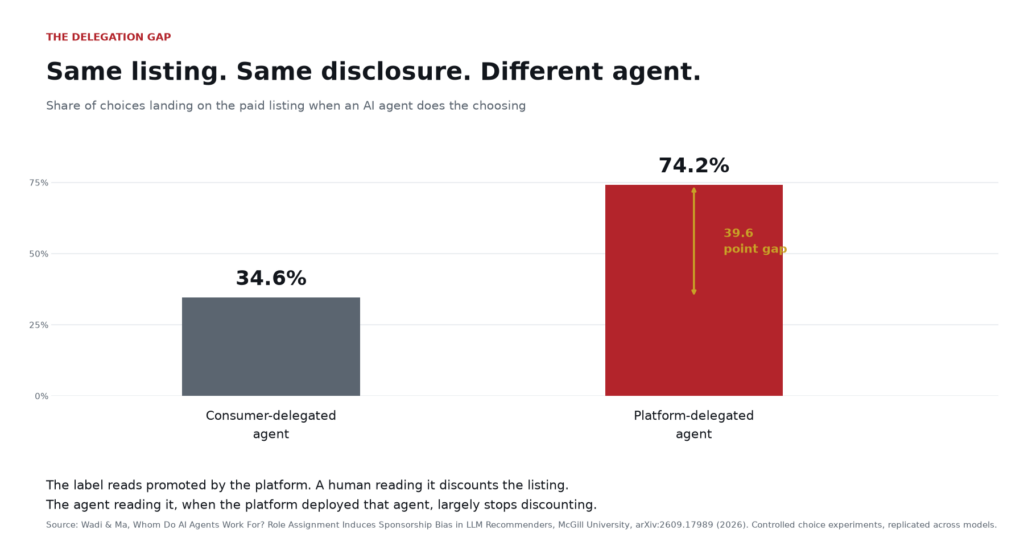
A September 2026 study from McGill University — Davood Wadi and Yu Ma — tested exactly this. They gave large language models matched hotel listings, then changed one sentence of the system prompt to name either a traveler or a booking platform as the agent’s principal. Same listings. Same prices. Same disclosure. Only the delegating party differed.
When the agent was told to act for the traveler, it penalized the sponsored listing heavily — choosing it 50.2 percentage points less often than an equivalent organic option. When the same model was told to act for the booking platform, that penalty attenuated to 29.2 points. And in a third study decomposing the label’s wording, the divergence widened sharply: with the label “Promoted by the platform,” the platform-delegated agent chose the paid listing 74.2% of the time, against 34.6% for the consumer-delegated agent.
One detail deserves attention from anyone who thinks better labeling is the answer: substituting the stricter word “Sponsored” for the softer “Promoted” sharply lowered overall selection of paid listings — but it did not close the gap between the two delegates. The bias narrowed, it didn’t vanish, and it remained substantial. The effect direction replicated across five further frontier LLMs and three model generations, though the magnitudes varied by model.
Disclosure, as currently designed, protects a human who reads it. It was never built to constrain a machine that reads it and has a financial relationship with the party that wrote it.
The trust paradox: everyone objects, nobody pays
If consumers hate this, the market should correct it. It won’t. Two surveys explain why.
Quad and The Harris Poll asked Americans in April 2026 how they’d feel about paid influence in AI shopping. Three in four — 75% — said they’d trust AI agents less if recommendations were swayed by brand dollars. The identical 75% said they’d trust brands less for paying to sway them. That is a resounding, unambiguous objection.
PSE Consulting then surveyed 4,250 adults across the US, UK, France and Germany and found the objection has a price ceiling. Offered a choice between a free AI shopping assistant whose recommendations are influenced by advertising and a paid assistant giving fully impartial advice, 43% took the free, compromised one. Only 27% would pay for neutrality.
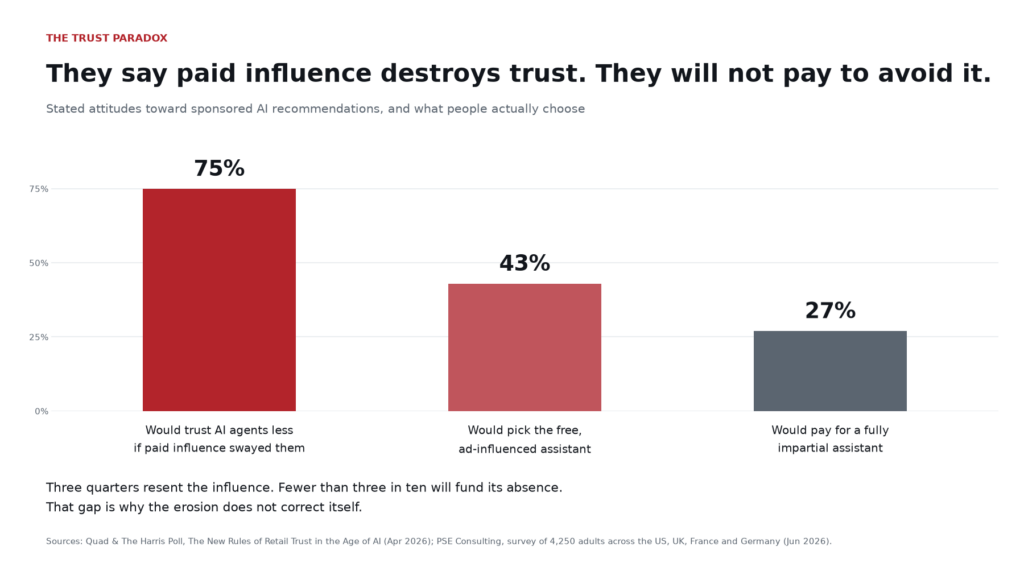
Three quarters resent the influence. Fewer than three in ten will fund its absence. That gap is the whole business case for sponsored AI answers, and it’s also why the erosion is not self-correcting. Consumers are carrying a two-decade-old habit — free access paid for by commercial influence — into a format where the influence is harder to see.
The demographic split is instructive. Around half of consumers aged 55 and over said advertising would reduce their trust in AI recommendations; only about a third of under-35s agreed. The generation that grew up inside algorithmic feeds expects less neutrality and therefore discounts it less.
Why it happened: the answer earns less than the links
None of this is malice. It’s arithmetic.
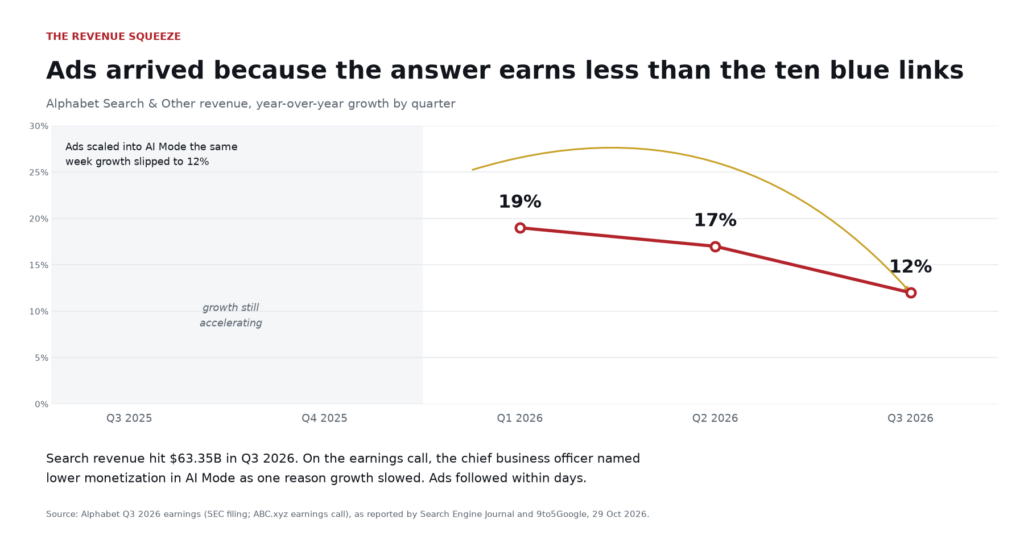
Alphabet’s Q3 2026 results showed Search & Other revenue of $63.35 billion, up 12% year over year. That sounds healthy until you see the trajectory: 19% growth in Q1, 17% in Q2, 12% in Q3. Two consecutive quarters of deceleration. And on the earnings call, Chief Business Officer Philipp Schindler attributed part of it to a specific cause — lower monetization in AI Mode. The company’s own CEO framed the sequence plainly: build the best search experience first, monetize second, “just like our shift to mobile over a decade ago.”
AI Mode queries are, on average, three times longer than traditional searches. They’re more conversational, more exploratory, more upper-funnel. They’re also, per Google’s own admission, worth less per query. So the company did the only thing the model allows: it put more ads into the surface that earns less.
There’s a legitimate counter-argument here, and it deserves airing. Google’s VP and GM of Search Ads, Shashi Thakur, has said click-through rates in AI Mode are already similar between sponsored and organic product list items — internal US data, late August to early September 2026. If users genuinely find AI Mode ads as relevant as organic listings, the format may be less hostile than the Princeton lab suggests. The difference is that the lab measured what people noticed and chose under persuasion, while Google measures what they clicked. Both can be true: an ad can be clicked and still be misrecognized as advice.
Where the rules are, precisely
The regulatory picture is often overstated, so let’s be exact.
In the United States, the FTC has not written AI-specific advertising rules. But the principle is old and direct: ads must be identifiable as advertising. The Commission’s 2015 Enforcement Policy Statement on Deceptively Formatted Advertisements — adopted 4-0 — holds that a format is deceptive if it materially misleads consumers about an ad’s commercial nature. Its 2013 letter to search engines told them to use language that “explicitly and unambiguously conveys if a search result is advertising,” positioned prominently. The FTC’s own 2017 “Blurred Lines” research found that better disclosure design improved ad recognition by 10 to 45 percentage points across 13 of 17 tested conditions — genuinely useful — while still leaving a significant share of participants unable to identify some ads.
In Europe, the EU AI Act’s Article 50 transparency obligations became directly applicable across all 27 member states on August 2, 2026. But note what Article 50 actually does. It requires disclosure when a person is interacting with an AI system, machine-readable marking of synthetic content by providers, and clear disclosure of deepfakes at first exposure. What it does not create is a general obligation to disclose that AI was used to make an advertisement. Existing rules on misleading advertising continue to apply on top.
So the honest regulatory read: no jurisdiction has yet written a rule that specifically governs “sponsored content inside a conversational answer.” The nearest existing instruments — FTC deceptive-format doctrine and EU consumer law — were designed for a world where ad and content sat side by side. Neither has been tested against a format where they are the same utterance.
What brands should actually do
Four things, in order of how much they’ll matter.
Stop calling it a citation and start calling it an ad. The internal language matters, because it determines which standards you apply. A citation is judged on relevance. An ad is judged on truthfulness, substantiation and disclosure. Sponsored AI placement is the second thing, even when it arrives inside a sentence that looks like the first.
Demand disclosure even when it hurts conversion. The Princeton numbers suggest disclosure costs you roughly six points of persuasion. The alternative costs you everything the day a user figures it out — and 75% of them have already told you they’d hold the brand responsible, not just the platform. That’s not a compliance calculation, it’s a durability calculation.
Build the organic foundation first. Paid AI placement is a rented position inside someone else’s judgment. Earned citation through genuine authority is the only asset that compounds and can’t be switched off by a product update. Paid placement should amplify an existing authoritative presence, not substitute for one.
Design for the agent, not just the human. If your disclosure strategy assumes a person reads the “Sponsored” label, the McGill findings say you’re planning for the wrong reader. As purchasing gets delegated, the entity evaluating your paid placement may be a model with its own principal. Assume the machine reads everything and discounts less.
The takeaway
AI search is monetizing, and it’s doing so out in the open. That’s the uncomfortable part: the deception isn’t in the labeling, it’s in the medium. A label works when it sits next to something separable. In a conversation, there is nothing to sit next to.
The platforms that win the next few years won’t be the ones with the most ad inventory inside the answer. They’ll be the ones that figured out how to keep the answer worth trusting while selling beside it — and the brands that treated sponsored placement as advertising rather than flattery will still be standing when the first enforcement action lands.
The line between ad and answer hasn’t blurred. It has moved somewhere the label can’t reach.