Why AI-Referred Shoppers Went From Worst to Best in Twelve Months
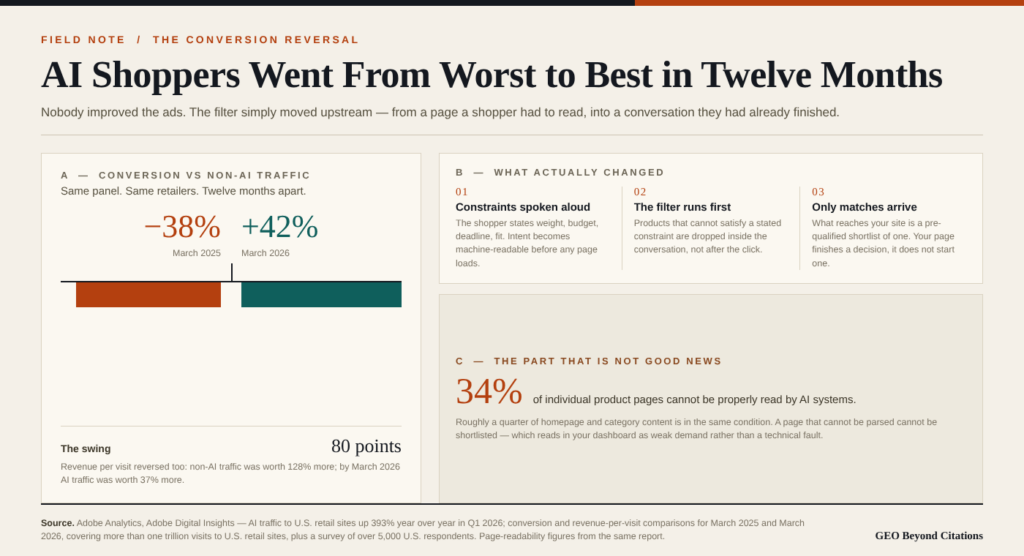
A year ago, this channel was embarrassing. Adobe’s transaction data had AI-referred retail traffic converting 38% worse than ordinary traffic in March 2025. Every analyst who wanted to dismiss generative search had their number, and it was a good one.
By March 2026 the same panel showed AI referrals converting 42% better, generating 37% more revenue per visit, staying 48% longer, and bouncing 32% less. An eighty-point swing in twelve months, measured across more than a trillion visits to U.S. retail sites.
Nothing about the landing pages changed. So what did?
The filter moved upstream
I have spent the last year watching referrer reports and talking to teams who live in them, and the honest answer is that the model of the journey inverts.
In a classic session, the shopper arrives half-formed. They land on a category page, scan, filter, compare, get distracted, and leave. The filtering happens on your site, after the click, and you absorb the cost of everyone who was never going to buy.
In an AI session, the filtering happens before your URL exists on anyone’s screen. The shopper says: light carry-on, fits overhead, one week in Europe, under a certain weight. Those constraints are now machine-readable. Products that cannot satisfy them are removed inside the conversation. What arrives at your site is not a browser. It is a shortlist of one, checking whether the description they were given is true.
That is the entire mechanism. The channel did not get better at selling. The bad fits stopped being sent.
The uncomfortable corollary
Here is where it stops being a happy story.
The same Adobe analysis found roughly 34% of individual product pages cannot be properly read by AI systems, along with about a quarter of homepage and category content. A machine that cannot parse your page cannot place you on the shortlist. And a missing shortlist entry does not appear in your dashboard as a technical fault. It appears as soft demand.
I have sat in meetings where a team concluded their category was cooling off, when the actual finding was that their product data lived in an accordion widget no crawler could open. That is a much harder conversation, because it has no villain. Nobody deleted your traffic. Your page simply declined to be legible.
What this changes about the job
Two reframes, and neither is comfortable.
First, conversion rate is now partly an inherited property. If the pre-filter is doing the qualifying, your conversion number reflects a decision made somewhere you cannot see, by a system you did not configure. Celebrating a 42% lift without asking what got filtered out before it is how teams mistake a better match rate for better marketing.
Second, the work shifts from persuasion to verification. The shopper is not being convinced on your page. They are checking. Which means the highest-leverage page in your site may be the specifications table, not the hero.
The reversal is real, and it is one of the more instructive things to happen in measurement this year. But it is a story about filters, not about funnels — and the brands that read it as a funnel will spend the next twelve months optimizing the wrong end of a conversation they never joined.