Google Is Putting Ads Inside the Answer. Advertisers Can’t Opt Out.
Google expanded AI Mode ads to 10 more countries on October 28 — and introduced ads that follow you into follow-up questions. Existing campaigns are automatically eligible. There is no switch to turn it off.
On October 28, alongside Alphabet’s third-quarter results, Google’s Shashi Thakur published a short blog post announcing that ads in AI Mode would go live in ten countries beyond the United States: Australia, Canada, India, Kenya, Malaysia, New Zealand, Nigeria, Pakistan, the Philippines and Singapore. Brazil, Mexico and the United Kingdom are slated for the fourth quarter. No European Union market appears on the list.
The same post introduced something that matters more than the geography. In the U.S., Google began serving “multiturn” ads — sponsored placements that can appear not only after the first question but in the answers to follow-up questions, as a conversation continues.
Read the two changes together and the direction is unambiguous. Ads in AI Mode first appeared in the U.S. in May 2025. For eighteen months, the rest of the world used the product ad-free. That period is over, and the unit of monetization has shifted from the query to the conversation.
The part advertisers didn’t ask for
The mechanics of eligibility are worth stating precisely, because they determine how much control a media buyer actually has.
Google’s guidance says existing Search, Shopping and Performance Max campaigns can serve in AI Mode. No new campaign is required, no separate budget, no additional fee. The billing model is the same as regular Search.
And there is no way to decline. Advertisers cannot target AI Mode as a standalone placement, and they cannot exclude it separately from Search. Negative keywords and brand exclusions still apply — those are real controls — but the surface itself is not something you opt into or out of.
One more layer deserves attention. Some AI Mode and AI Overviews placements carry a short AI-generated explanation connecting the ad to the user’s query and to the AI’s response. That text can draw on public information, including the advertiser’s own website. Google treats these explanations as independent context rather than advertiser creative. Advertisers cannot write them, edit them, approve them, or opt out of them.
So a brand’s paid message can now reach a user in a conversational context, framed by a machine-written sentence the brand never sees and cannot change. That is a genuinely new condition for paid search, and it arrived without a settings toggle.
Matching behavior also differs by campaign setup, and this is where teams can exercise real judgment. Exact and phrase match keywords qualify for AI Mode only when the query expresses direct commercial intent. Broad match or AI Max campaigns qualify for direct matching and contextual matching against both the query and the AI response. Shopping and Performance Max get both.
The practical implication is narrow but useful: gaining access to some AI Mode inventory does not require switching to broad match. A team can keep tight keyword control and still be eligible. Any move toward broader matching should survive its own performance argument.
Why now: the monetization gap
The timing is not a coincidence, and Google has been fairly direct about it.
Alphabet reported $127.6 billion in third-quarter revenue, up 25 percent year over year. But Search and other advertising grew 12 percent to $63.35 billion — down from 17 percent in the second quarter and 19 percent in the first. Sequentially, that segment added just $79 million. Paid clicks rose 8 percent against 11 percent for the first nine months of the year, while cost per click rose 4 percent.
On the earnings call, chief business officer Philipp Schindler attributed part of the slowdown to the product’s own success: “the strong growth in AI Mode queries had an impact because of the lower monetization we were seeing in AI Mode.”
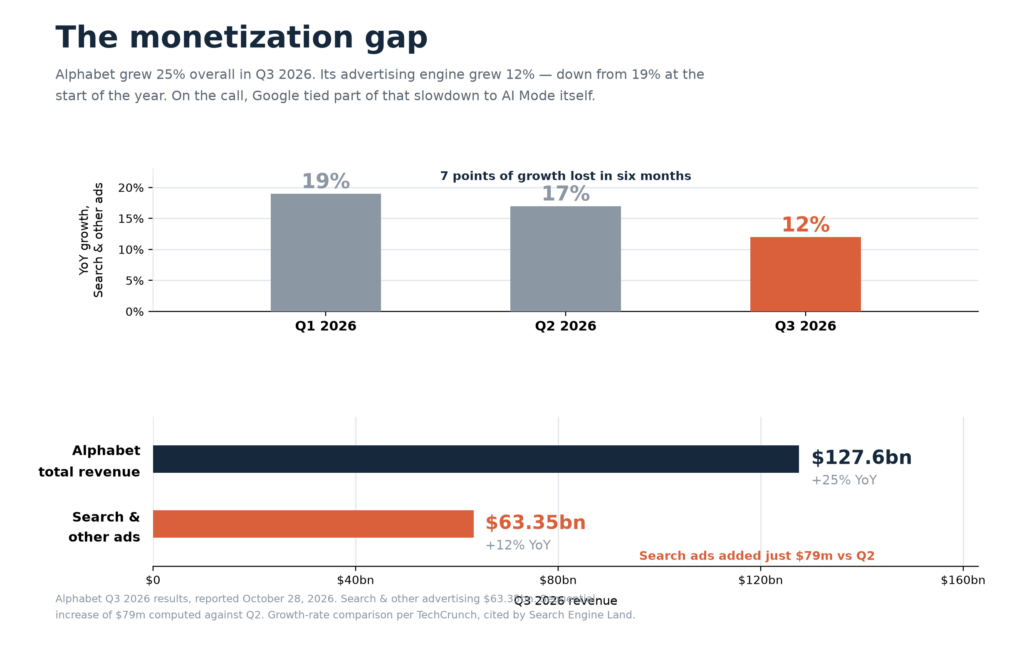
Translation: users are moving into AI Mode faster than Google can earn from them there. Investors reacted sharply, with Alphabet shares falling double digits — Bloomberg put the single-day market value loss at roughly $511 billion, which would make it one of the largest one-day losses on record for any company.
This is the central tension in AI search, and it is not unique to Google. Conversational answers keep users on the results page, which is good for engagement and bad for the economics of a page that used to carry ten blue links and a stack of ads. Google has three levers available: show ads on more AI Mode queries, charge more per click, or show more ads per query. The October 28 announcement pulls the first lever explicitly.
The four-ad question
Then, on November 4, a screenshot changed the conversation.
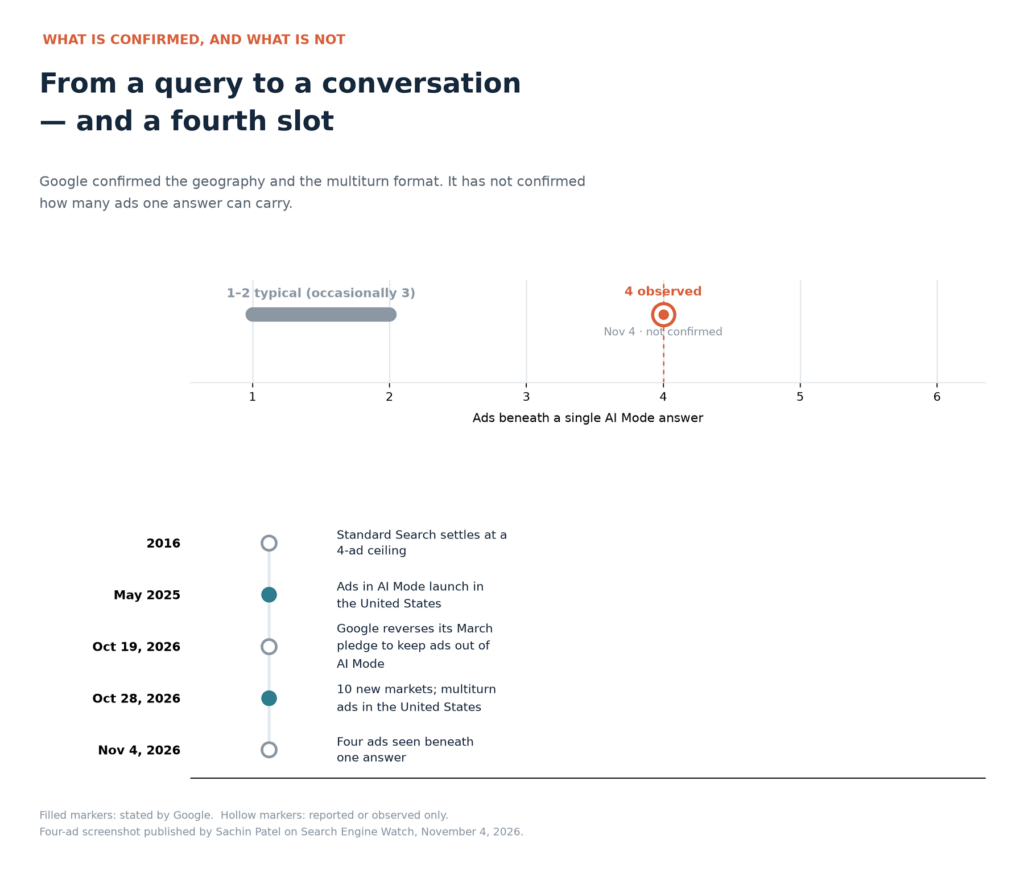
Sachin Patel, posting on Search Engine Watch, captured an AI Mode answer with four distinct Google Ads stacked beneath it — advertisers including HubSpot, Yext, Siteimprove and an entity listed as eintelligenceweb. The query concerned AI SEO. Barry Schwartz surfaced the example on Search Engine Roundtable, adding a caveat: he was not certain the configuration was new.
Historically, AI Mode answers showed one or two ads, occasionally three.
Four is not arbitrary. Google established a four-ad ceiling on standard search results back in 2016, and it has held there since. If AI Mode is now matching that ceiling, the ad load beneath an AI answer has roughly doubled in a single step.
But be careful with this one. Google has not confirmed that a four-slot layout is live as a product, how widely it runs, which query categories trigger it, or whether it is a deliberate test. The reporting rests on a screenshot and a user-level observation, not a company statement.
What Google has said on the record is direction, not density. On the earnings call it stated it would show more ads, more often, in AI Mode, and it is scaling ads across both AI Overviews and AI Mode to more users and more queries. More users and more queries describe reach. Four cards under one answer describes density. Only the first is confirmed.
There is a useful distinction hiding in Google’s own numbers, too. The company says click-through rates for sponsored and organic product listings in AI Mode are already similar. Note that this refers to product listings — visual units with images and prices, not text links. Google has not published the underlying rates, and neither the CTR claim nor the “queries are three times longer” figure was measured in the ten newly added markets. Search Engine Roundtable’s author has publicly questioned whether the parity holds for text ads.
So the honest position for a media buyer is this: the inventory expansion is official and already in effect. The ad-density story is an observed ceiling, not a documented baseline.
What this changes in practice
Four things are worth acting on now.
Your AI Mode spend is already happening, unseen. Because eligibility is automatic and reporting is aggregated, impressions, clicks, conversions and costs from AI Mode and AI Overviews feed into the same campaign totals as everything else. A change in campaign ROAS cannot, by itself, establish what AI Mode contributed — you would need to separate budget changes, bidding, promotions, seasonality and query mix first. If you have not yet built a baseline, build one before you need to explain a shift.
Check whether your negative keyword list survives the new surface. Negative keywords still apply, but AI Mode matching can be contextual — evaluated against the query and the AI’s response, not just the typed words. Contextual matching increases the range of language your exclusions have to cover. Review them against conversational phrasing rather than keyword phrasing.
The AI-generated explanation is a brand-safety surface you don’t control. A machine-written sentence linking your ad to a query is now part of your paid presence. It draws on public information. Treat it the way you treat other uncontrolled surfaces: monitor it, and budget for the possibility that it says something you wouldn’t.
Measure citation and paid placement as separate outcomes. This is the measurement mistake most likely to be made in the next two quarters. Whether your brand is cited in an AI answer and whether your ad appears around that answer are different things, tracked in different systems, and one does not imply the other. A screenshot showing four ads under an answer is not evidence about your organic visibility, and a citation is not evidence about competitive paid pressure at that decision point.
The broader read is that Google is now selling two products on the same page: the answer, which it must keep trustworthy to keep users, and the placements around it, which it must monetize to keep revenue growing. The October announcement expanded the second. The November screenshot suggested the second may be growing faster than the first.
Neither tells us yet whether AI Mode can carry the revenue that classic search is losing. Google does not break out AI Mode revenue or ad volume, and it has not published performance benchmarks for advertisers. The next quarterly report is when that gap starts to become visible in the numbers rather than in screenshots.