Amazon Blocked Meta’s AI Shopper. Walmart Built It a Door.
Two retailers answered the same question within a month of each other, in opposite directions. The reason has less to do with AI strategy than with where each company’s revenue actually happens.
In late September, shoppers trying to buy through Meta’s Muse agent on Amazon.com started hitting a notice: an unauthorized agent was violating Amazon’s Conditions of Use. Amazon told Adweek that Meta never said Muse would be shopping its store.
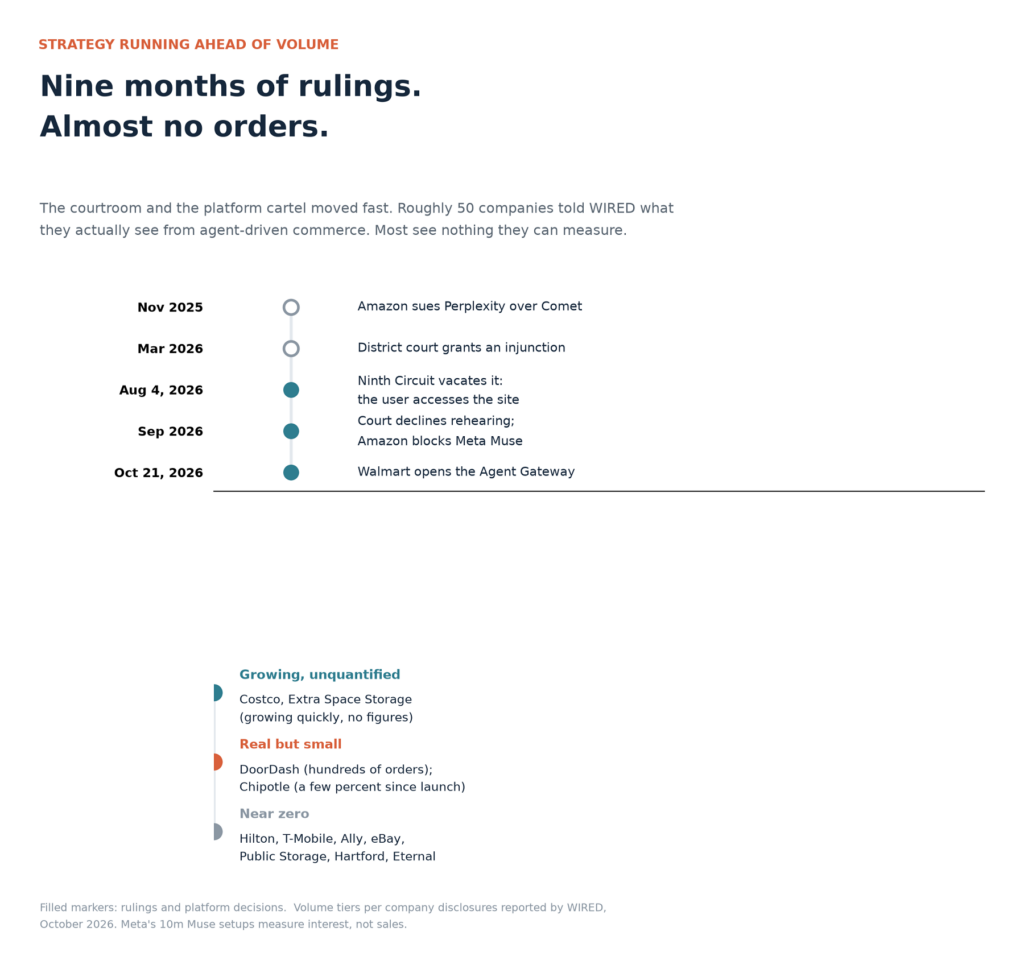
On October 21, Walmart did the opposite. It published terms for AI agents, introduced “Agent Profiles” that let a customer authorize an individual agent, track its purchases separately, set a spending limit of $50, $100 or $200, or require approval for every transaction. It announced the Walmart Agent Gateway, a platform allowing assistants including ChatGPT, Gemini and Muse to connect directly to Walmart and Sam’s Club systems to search products and complete purchases. Available to all account holders, no membership required.
The obvious reading is a race to own the customer relationship. The more useful reading is that each company is protecting a different path to a sale, and the decision follows from how each business is built.
The structural reason
Amazon’s commerce happens inside Amazon’s app and website. That is where it has spent a decade building personalization, ranking and a $70-billion-plus ad business. In May it replaced Rufus with Alexa for Shopping, letting customers ask questions directly in the main search bar. An outside agent that enters that environment, builds its own shortlist and completes a purchase removes the surface where Amazon’s personalization and sponsored placements do their work. Adweek reported Amazon’s line: an agent shopping for a customer bypasses the personalization and insights built into its experience.
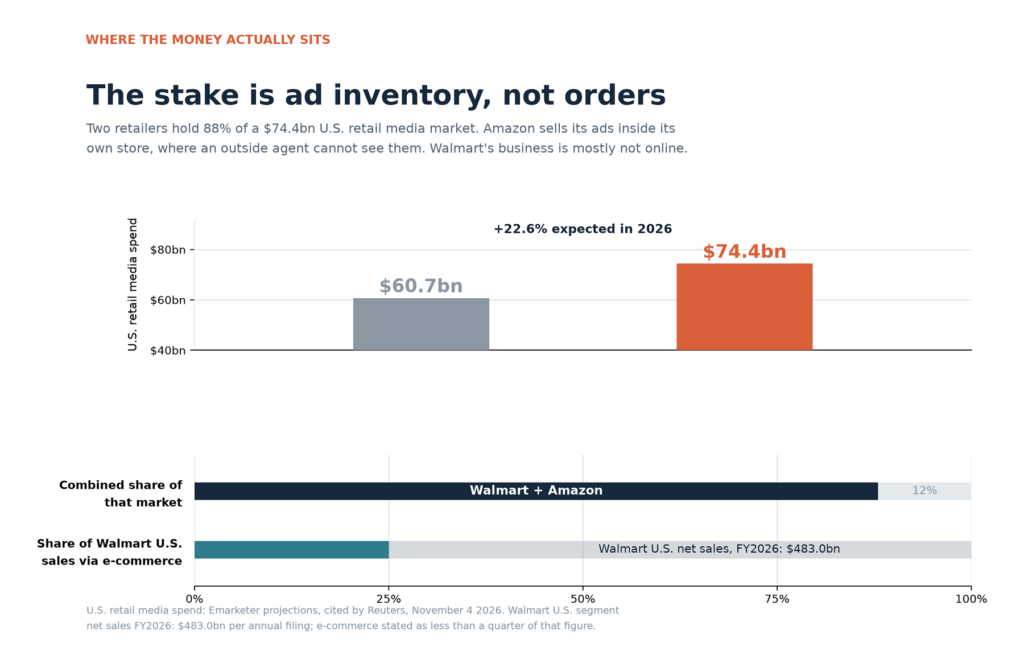
Walmart is still mostly a physical retailer. Its U.S. segment booked $483.0 billion in net sales in fiscal 2026, and less than a quarter of that came through e-commerce. Its announcement lists stores and clubs, online, pickup and delivery, its Sparky assistant, and integrations with Muse, ChatGPT and Gemini as ways customers already shop with it — agents are one pathway among several, not the load-bearing one. “Shopping with an agent won’t be for everyone, and it doesn’t have to be,” the company wrote.
Walmart still kept a lock on the door. Agents that violate its terms get blocked, and the announcement did not say which agents are approved for the gateway first.
Amazon’s position is not a permanent refusal either. CEO Andy Jassy has said Amazon expects to partner with third-party agents eventually, while continuing to block many bots. Asked about shopping agents on a recent call, his assessment was blunt: still “not great.”
The legal layer matters more than the press release
This fight already has a courtroom history, and it shapes what other retailers can do.
Amazon sued Perplexity in November 2025 over its Comet browser’s agent, arguing the tool entered its store without authorization while presenting itself as an ordinary Chrome browser. In March 2026 a district court granted Amazon a preliminary injunction. On August 4, the Ninth Circuit vacated it, reasoning that because the agent acts only when its user directs it, “it is the user who ‘accesses’ Amazon’s computers.” In September the court declined to grant a rehearing. The underlying case continues.
That ruling is why the current phase looks the way it does. Retailers can no longer rely on a broad technical claim that an agent “broke in.” So they are doing what platforms do instead: writing terms of use, building gateways, setting approval rules, and blocking case by case. Amazon’s public framing shifted accordingly — third-party agents, it told Reuters, should operate openly and respect a service provider’s decision about whether to participate.
Both companies are arguing over the same asset: control of the moment a shopper makes up their mind. Perplexity’s defense was that Amazon is “more interested in serving you ads, sponsored results, and influencing your purchasing decisions.” Amazon’s is that a store may decide which software comes through its door. Neither is wrong. They are describing the same mechanism from opposite sides.
The stake is the ad inventory, not the order
Retail media is the reason this is a strategic question rather than a technical one.
Walmart and Amazon are the world’s two largest retail media businesses, holding a combined 88 percent of what Emarketer projects as $74.4 billion in U.S. retail media spending in 2026. Brands are expected to spend 22.6 percent more on retail media in 2026 than the $60.7 billion they spent in 2025.
Follow the money into the income statements. Advertising generates roughly 10 percent of Amazon’s net sales, and that growth slowed to 11 percent in the third quarter. At Walmart, advertising, membership and marketplace together produced 45 percent of the growth in quarterly operating income.
An agent does not see that inventory. Search Amazon yourself and the results page blends sponsored listings with organic ones, flagged in small type, with the sponsored block at the top. Send an agent and you get back a short list with a sentence of explanation. You do not see the products it discarded, and you cannot tell whether its ranking reflects quality or what a seller paid.
That is the actual threat: not that agents take orders away, but that they route around the units brands pay for. Morgan Stanley researchers estimated in July that agents could account for 10 to 20 percent of U.S. e-commerce spending by 2030. Even the low end of that is a meaningful share of a $74.4 billion market.
The reality check nobody puts in the deck
Here is where the coverage usually overstates things, and where the data is unusually clear.
Meta says more than 10 million people in the U.S. and Canada set up Muse within six weeks, that shopping is its most common use, that more than a quarter of weekly active users shop with it, and that the average purchase exceeds $200 including travel. Those figures come from Meta.
Transaction volume is another matter. Roughly 50 companies described their experience to WIRED, and the pattern is consistent: DoorDash said it receives hundreds of orders through Muse and other agents. T-Mobile said it has seen nothing significant. Hilton called agent bookings insignificant. Ally Financial called activity low. eBay called it very small. Public Storage and Hartford reported similar. India’s Eternal estimated agent-driven commerce was close to zero.
Some movement is real at the margin. Chipotle’s chief digital officer said orders through agents rose by a few percent since Muse launched, after failures with loyalty discounts and post-closing orders, and the company is simplifying its site code so agents can navigate it. Costco and Extra Space Storage said sales from AI chatbots are growing quickly and credit content optimization for it. Insurify blocked Muse, then reversed course and built tooling to help agents show accurate offers.
So the strategic repositioning is running ahead of the volume. Companies are paying for preparation on a channel that has not yet proven it justifies the cost.
What this means if you sell through a gatekeeper
A brand that depends on one retailer for new customers inherits that retailer’s rules, including every change to them.
Know which pathway your revenue rides on. If most of your sales come through Amazon, your exposure is Amazon’s decision to exclude agents, and you cannot override it. If you sell through Walmart, or through your own store, the calculus differs. This is a portfolio question, not a platform-optimization question.
Treat product data as a ranking input, not a copy task. ReFiBuy, a firm that optimizes for agentic commerce, published research in October finding that products ranked in the top three of Meta AI search results appeared in Muse recommendations 89 percent of the time. Its framework separates basic structured data (level 1), conversational attributes (level 2) and shopper-context matching (level 3), and argues an agent needs at least level 2 to match a product to a specific person. When the data cannot answer a shopper’s question, the agent recommends a competitor whose data can.
Watch what the biggest advertisers are actually buying. Procter & Gamble is currently soliciting startups for technology to make brand content “AI-ready,” with a submission deadline of November 13. The scope is specific: crawler access and site structure, automated schema generation and validation at scale, answer-first content built from real consumer questions, product detail page optimization across brand sites and retailers, and accuracy safeguards including source traceability. That is not a content team experimenting. It is a procurement process for a channel a $400-billion-revenue company expects to need.
Do not plan around Black Friday as proof. November 27 is the first major shopping event since Muse launched, and it will produce a lot of confident claims from a small sample. Agent volume out of one holiday weekend, on one agent, in two markets, will not settle whether this channel works.
The honest summary is that the two largest retail media businesses in the United States have placed opposite bets on who controls the point of decision, and neither has evidence yet that the bet pays. What is settled is narrower and more useful: the gatekeeper’s rules have become part of your product’s distribution, and they can change without your input.