The $2,000 Commercial: How AI Collapsed Video Ad Production — and Why the Cheapest Ads Are the Most Expensive
A $2,000 spot aired during the NBA Finals. That should have been the story.
On June 11, 2025, somewhere in the third quarter of the NBA Finals, a surreal thirty seconds of television happened. An old man in a cowboy hat carried a chihuahua. A person swam through a pool of eggs. An alien chugged a beer.
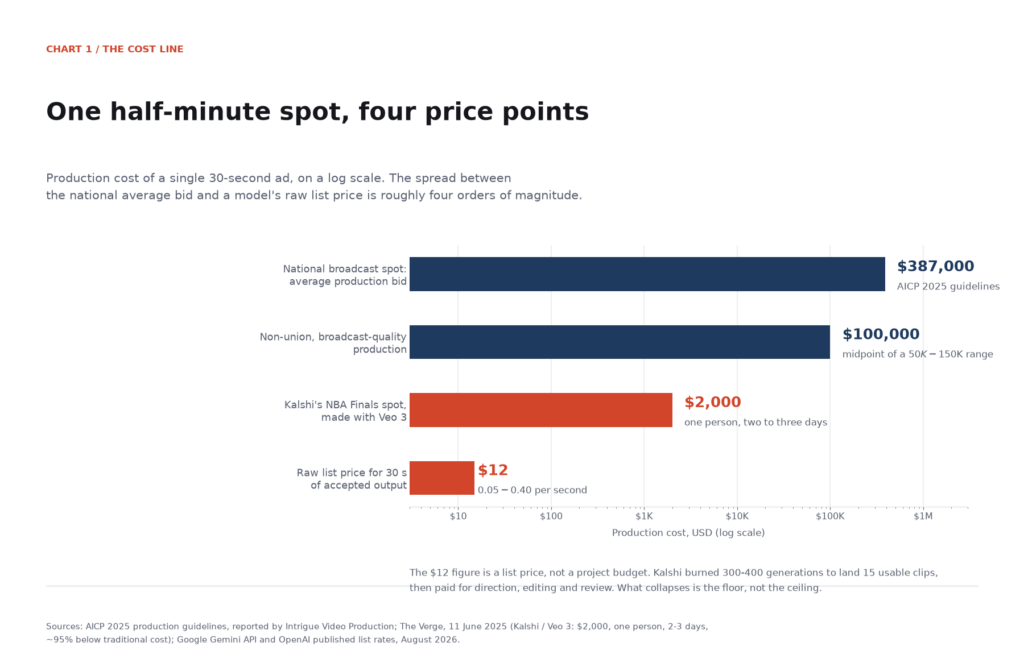
It was an ad for Kalshi, a prediction market. The filmmaker PJ Accetturo says Kalshi hired him to build it with Google’s Veo 3. His own account of the job, posted to X: “This took about 300–400 generations to get 15 usable clips. One person, 2–3 days. That’s a 95% cost reduction vs traditional ads.”
Now hold that next to the benchmark the US commercial production industry uses. Per the AICP’s 2025 guidelines, the average production bid for a national thirty-second television commercial runs about $387,000. Not the ceiling. The midpoint, union crew, agency involvement, the whole apparatus.
Two thousand dollars. Three hundred and eighty-seven thousand dollars.
That gap is the entire article. The rest is how it reshapes the argument you’re expected to make on Monday.
What actually collapsed
Here is the part most coverage gets wrong. AI video didn’t get cheaper than video. It deleted most of the line items.
A traditional spot is a stack of multipliers: locations, crew day rates, talent session fees plus residuals, equipment packages, permits, catering, insurance, post, and the brutal fact that a second shoot day can add $60,000 to $80,000 to a $150,000 job because nobody discounts day two. Every one of those line items is a place the budget can grow.
Generative video removes the physical production entirely. No location. No call sheet. No reshoot because the hero product caught a glare. A 2026 pricing survey of AI video models puts published per-second rates from about $0.05 (Veo 3.1 Lite, 720p) to $0.40 (Veo 3.1, 720p–1080p), with Sora 2 at $0.10 per second standard. Thirty seconds of raw accepted output can cost less than a sandwich.
But — and this is the caveat that keeps consultants employed — the generation price is not the project price. Accetturo’s 300–400 attempts to get 15 usable clips is a roughly 4% acceptance rate. The $2,000 bought a finished, broadcast-ready film: script, shot list, prompts, edit, review, delivery. What collapsed is the floor. What did not collapse is the ceiling, or the judgment required to reach it.
The second collapse nobody budgeted for
Cheap production is half the earthquake. The other half is that everyone noticed.
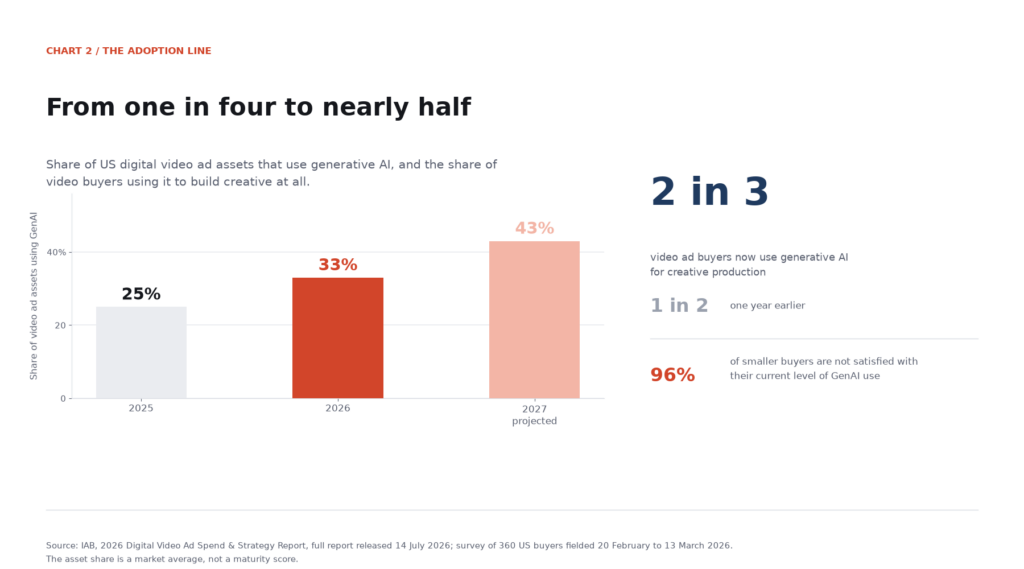
The IAB’s 2026 Digital Video Ad Spend & Strategy Report, released in full in July 2026, found that nearly two in three video ad buyers now use generative AI for digital video creative, up from about half in 2025. One third of their ad assets will involve GenAI this year, up from one quarter, with 43% projected for 2027.
Read that as a media planner, not a technologist. Within eighteen months, nearly half the video ads in the feed will carry a model’s fingerprints somewhere in the chain.
And notice who moved first. The IAB’s 2025 study projected that by 2026 small spenders — under $10 million in annual video budget — would run 45% of their digital video through GenAI, midsize brands 42%, and the largest advertisers only 36%. The cost collapse was never evenly distributed. It landed hardest exactly where production budgets were thinnest. A regional retailer that could never justify a crew now ships motion creative every week.
That is genuinely good news. It is also how you get a feed where everything moves the same way.
What AI video is genuinely good at
Let me be specific, because vagueness is how agencies lose money.
Concept iteration. Twelve takes on one idea in an afternoon was impossible in 2019 and is trivial now. The IAB’s buyer data names audience versioning the single most common use case: 42% of buyers using or planning to use GenAI say they use it for different versions of the same video across audiences.
Abstract and conceptual work. Animated explainers, product visualisations, motion graphics, surreal comedy. Where realism isn’t the point, the models are already excellent. Kalshi worked precisely because absurdity was the brief.
Support footage. B-roll, backgrounds, transitions, plate extensions. The unglamorous connective tissue that used to eat a post budget.
Functional, product-led storytelling. This one surprised me. In the Ipsos and Syracuse study, the AI versions of the Febreze and Herbal Essences spots beat their human counterparts — 147 against 142 and 152 against 137 on creative effect. Why? Those briefs were formulaic: problem, solution, reason to believe. Advertising has written that ad ten million times. The models have read all of them.
What it still can’t do
Real product fidelity in motion. Generating a convincing bottle is one thing. Generating your bottle, correctly, while liquid pours, at the right angle, is another. TikTok integrated Dreamina Seedance 2.0 into Symphony Creative Studio in May 2026, aimed squarely at inconsistent product rendering and unnatural motion. That tells you how hard the problem still is.
Human nuance. The uncanny valley didn’t close. It got better lit. Kantar and iMotions ran facial coding across 356 GenAI video ads against a conventional control. The GenAI ads produced stronger facial expressiveness — 71st percentile against 59th — but the intensity skewed toward confusion, sadness and furrowed brows, and overall emotional valence fell to the 37th percentile against the control’s 44th. People react more. They don’t enjoy it more.
The creative leap. This is the deepest limit, and Ipsos names it plainly: the most effective human ads don’t follow the script, they break it. Breaking a pattern is the one thing a pattern-completion engine structurally cannot do.
Brand centrality. Kantar’s data shows GenAI ads scoring lower on brand linkage on average, worst where the model handled visualisation unsupervised. The model does not know your brand book. It doesn’t know the claim your legal team killed in March. One widely circulated unofficial Liquid Death spot built on Veo 3 produced strong emotion and landed its brand memorability in the bottom 25% of all ads Kantar has tested — the story worked, the brand didn’t ride along.
The effectiveness gap you cannot see
Here is the finding that should stop you mid-scroll.
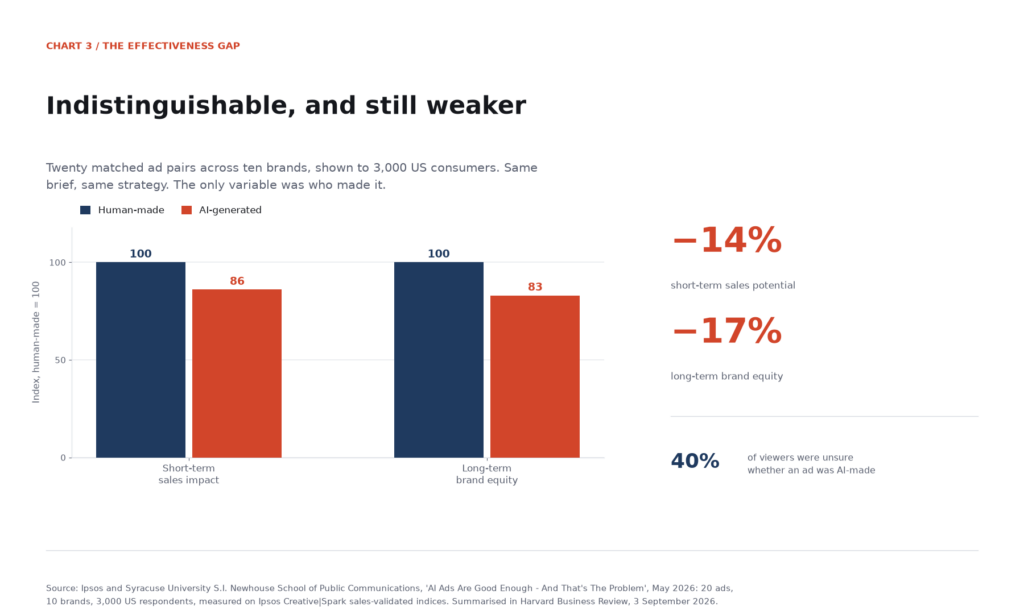
In 2026, Ipsos and Syracuse University’s Newhouse School ran twenty matched pairs. Ten real 30-second brand films — Cheerios, Chewy, Febreze, Fiat, H&M, Old Navy, Herbal Essences, Ray-Ban Meta, TurboTax, Visa. Researchers reverse-engineered the strategic brief behind each one, then had AI build a new spot from that same brief with no human intervention in the final production route. Same strategy. Same brand. Different maker.
Then they tested all twenty with US consumers on sales-validated measures.
Viewers could not reliably tell the difference. Around 40% were unsure either way, and the share who confidently identified an AI ad was indistinguishable from the share who wrongly suspected a human ad.
And yet: human-made ads were about 14% stronger on short-term sales impact and 17% stronger on long-term brand equity.
That is the trap. Not ugly AI ads. Presentable AI ads that sail through internal review because nothing looks broken, then quietly underperform in market. You will not find this in a CTR report. You’ll find it in a flat year.
One detail explains the mechanism better than the headline does. In the study, 49% of the original human films were built on storytelling. Among the AI replicas, only 30% were. Given the same brief, automated production drifted toward product demonstration and a sequence of attractive shots. It lost the narrative on the way.
Why “good enough” is the most expensive thing you can approve
Follow the incentives and the trap builds itself.
The CFO sees production costs fall. The CMO sees cycle times shrink. The CEO sees evidence of AI adoption. Everyone asks for more assets, faster, across more channels. Within two quarters, “good enough” is the operating standard, and the system rewards volume, speed and savings over distinctiveness.
The IAB data confirms the drift is structural, not anecdotal. Cost efficiency became advertisers’ top cited benefit of AI in 2026 at 64%, up from fifth place in 2024. The IAB’s own authors flag the risk in the same breath: applying AI primarily to reduce production cost “could undermine quality.”
Then the P&L tells you the truth a year later, when the brand has been quietly discounting itself.
The flattening: when every feed moves the same way
You’ve felt it. The same slow push-in. The same shallow depth of field. The same buttery skin. The same three-second hook, the same over-clean transition.
Part of this is aesthetic convergence — everyone renting the same handful of models. Part of it is the brief. WARC’s survey of 400 marketers across the UK, US, Australia and Brazil found 67% still brief AI with demographic data as the primary input, even though 59% agree demographic segmentation is no longer effective. Only 17% always feed community or behavioural signals into the workflow.
Feed generic input, get generic output. Then multiply it by a thousand variants and wonder why nothing breaks through.
And here’s the cruel inversion: as synthetic video floods the feed, real footage becomes the scarce, premium signal. Not because it’s better made. Because it’s evidently made by people, in a place, at a time.
The audience has started scoring you
For two years the story was that consumers couldn’t tell. That story is closing.
The IAB’s January 2026 consumer study found 71% of Gen Z and Millennial consumers believe they’ve seen an AI-made ad, up from 54% in 2024. More than half want disclosure of AI video and AI images specifically. And sentiment has curdled unevenly: 39% of Gen Z feel negative about AI-generated ads, nearly double the Millennial rate of 20%.
Meanwhile the industry’s self-assessment is off in a very specific way. 82% of ad executives believe younger consumers feel positive about AI ads. 45% of those consumers actually do. That 37-point gap has widened, from 32 points in 2024.
DoubleVerify’s 2026 global study, across 22,000 consumers in 22 markets, draws the practical line. Across EMEA, 42% say they’d feel negatively toward a brand using AI to make ads that look low-quality, uncanny or strange. Only 29% of UK consumers respond negatively when AI-made advertising looks polished. Separately, 56% of consumers say they cannot consistently identify AI-generated content at all.
Quality, not provenance, is the dividing line. Nobody is angry that you used a model. They’re angry that it looks like you didn’t care.
Kantar’s data makes the same point more sharply than any survey. When viewers can tell AI was used, satisfaction sits at 57%. When the AI is woven invisibly into the craft, it rises to 69%. The penalty isn’t for the technology. It’s for the tell.
Two cases, both instructive. McDonald’s Netherlands pulled a 45-second AI Christmas spot three days after it went live, after a wave of “AI slop” comments. Its production company defended the work by claiming “ten people, five weeks, full-time” — a figure its own studio elsewhere described as seven weeks, and which drew the obvious reply from another producer: what about the actors and the choir who would have been in it? Enormous human effort, invisible in the output. That is the whole problem in one sentence.
The testing math changes everything
Now the good part. Here is why cheap video is genuinely transformative — and why it still isn’t enough.
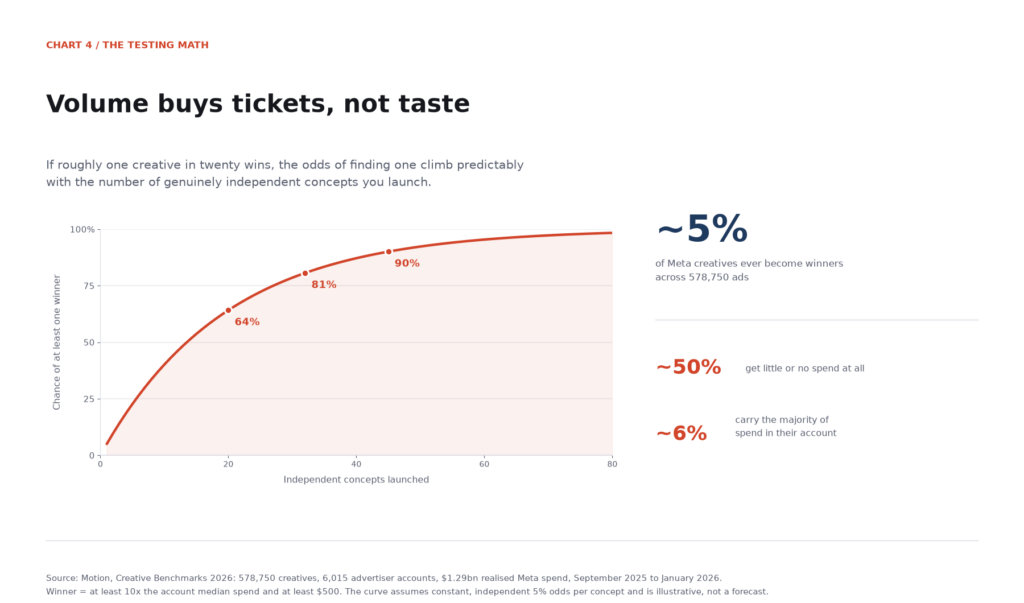
Motion’s 2026 Creative Benchmarks analysed 578,750 creatives across 6,015 advertiser accounts and $1.29 billion in realised Meta spend. About 5% of creatives became winners, defined as spending at least 10× the account median with a $500 floor. Roughly half received little or no spend. Around 6% of ads in any account captured the majority of that account’s spend.
If the hit rate is roughly fixed, output becomes a capacity question. At 5%, launching 20 independent concepts gives you about a 64% chance of at least one winner. Thirty-two gets you to 81%. Forty-five gets you to 90%.
Which means the real unlock isn’t “cheaper video.” It’s video you can afford to lose. At $387,000 a spot, you get one hypothesis and a committee defending it. At a few hundred dollars a clip, you get twenty — and twenty hypotheses is where the maths starts working.
But note the word independent. Twenty reskins of one idea are not twenty chances. This is the number that should worry you: 88% of marketers say GenAI increased their creative volume; only 45% say it significantly improved quality. And 73% use it for visual production while just 41% use it for testing and optimisation.
They aren’t testing. They’re shipping.
So what do you actually do?
Four moves, in order of leverage.
1. Split the portfolio by job, not by channel. Volume work — versioning, localisation, hook variants, format cuts — goes to AI, where the economics are absurdly good and the cost of being wrong is measured in dollars. Brand-defining work — the film that carries the idea — stays human. Not out of sentiment. Because the data says the human version is worth 14–17% more, and that’s the version you’ll live with for three years.
2. Anchor AI output with real artefacts. A real product shot. A real customer’s hands. A real location you actually have a permit for. Hybrid work preserves the one thing models can’t fake: evidence that something happened.
3. Fix the brief before you touch the model. Cheapest intervention available and almost nobody does it. Feed the system behavioural signals, community language, cultural context — not a demographic box. Anchor it in distinctive brand assets so it stops defaulting to the template look. WARC’s S.C.A.L.E. framework names the last stage “Evolve”: treat every campaign as a live learning system and carry the lesson into the next brief.
4. Measure efficacy, not efficiency. Cost per asset is the easiest number to report and the most misleading. Test whether the AI version produced equal or better attention, persuasion, memory, conversion and trust against the same brief. If it did, scale it. If it didn’t, shelve it before you buy media behind it.
The compliance clock is already running
One operational fact that belongs in every 2026 creative plan: the EU AI Act’s Article 50 transparency obligations became applicable on 2 August 2026, and the Commission published its final Article 50 guidelines and the Code of Practice on AI transparency in July 2026.
Providers must machine-mark synthetic output. Deployers — which includes brands and agencies publishing the content — must clearly disclose deepfakes. And the definition is far wider than the American colloquial sense: it covers AI-generated imagery resembling existing people, objects, places, entities or events that could falsely appear authentic. A synthetic virtual model in a product shoot can qualify. A manipulated before-and-after almost certainly does.
The artistic carve-out exists, but where content is both commercial and creative, the commercial character generally prevails. Advertising will rarely qualify. Penalties run to €15 million or 3% of global turnover.
The platforms are building their own rails in parallel. TikTok’s Symphony stamps generated assets with C2PA provenance metadata. Meta labels AI content in “About this ad.” Google has shifted labeling responsibility toward advertisers, and has put Veo inside Ads Asset Studio — images in, YouTube-ready video out — placing generation directly inside the buying interface.
The direction is unambiguous: provenance is becoming a production requirement, not a footnote.
What this means for the next eighteen months
Three predictions I’ll stand behind.
The premium on evident humanity goes up, not down. As 43% of video assets carry a model’s fingerprints, undisclosed real footage becomes a differentiator. Expect “shot on location” to become a creative claim the way “no preservatives” did.
The bottleneck moves from production to judgment. When anyone can generate a hundred videos by Friday, the scarce resource is knowing which three deserve budget. That is a taste problem, and taste does not scale by GPU. Meta’s numbers hint at the supply side: its video generation tools reached a $10 billion annual revenue run rate in Q4 2025. Supply is not the constraint. Discrimination is.
Small brands win share, not categories. The cost collapse hands them reach and iteration speed they never had. It does not hand them a point of view. That asymmetry is where the next round of brand-building happens.
The takeaway
Video got cheap. Differentiation didn’t.
The brands that win the next two years won’t be the ones making the most video, or even the cheapest. They’ll be the ones using the collapse to test relentlessly — twenty hypotheses instead of one — while spending their scarce human craft on the handful of moments that actually define who they are.
Everything in between can be generated. The two ends can’t.