Advertisers Spent Big on ChatGPT Ads. A New Study Says Most of Them Sold Nothing.
A 60-week analysis of 1,898 online stores finds paid ChatGPT traffic converts at roughly a third of the rate of Google search ads — and that one advertiser accounts for most of the purchases that did happen.
For every dollar a retailer spent on ChatGPT advertising, it booked about 52 cents in revenue. The same dollar spent on Google search ads returned $3.40.
That gap comes from a working paper published in October 2026 by Maximilian Kaiser of Vienna University of Economics and Business and Christian Schulze of Frankfurt School of Finance & Management. Titled “Can Advertising Fund Free AI? Evidence from ChatGPT’s International Advertising Rollout,” the study tracked 1,898 e-commerce sites across 60 weeks — from late June 2025 to August 22, 2026 — covering nearly 10 billion visitor sessions and roughly $16 billion in annual sales. It has not yet completed peer review.
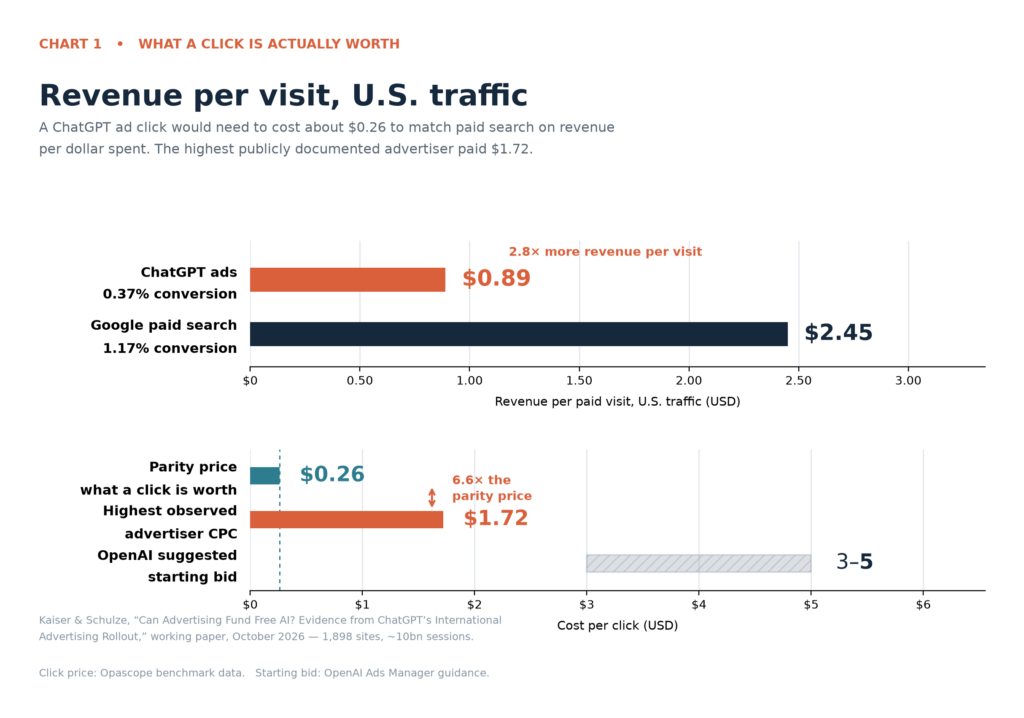
The headline comparison is stark. In U.S. traffic, a visit from a ChatGPT ad produced 89 cents in revenue, against $2.45 from a paid Google search click — a gap of about 64 percent. Conversion rates followed the same pattern: 0.37 percent for ChatGPT ads versus 1.17 percent for paid search. Among the 87 advertisers that bought both channels for U.S. traffic, 84 earned less per visit on ChatGPT and 85 converted at a lower rate.
Perhaps the more uncomfortable number sits underneath. Of the 102 advertisers with complete revenue data, 82 percent recorded no purchase at all from their ChatGPT ads. Among the 87 dual-channel advertisers, 73 generated zero sales across a combined 18,726 paid ChatGPT sessions; the remaining 14 accounted for all 570 purchases attributed to the channel in that group.
The authors were careful to price the comparison rather than just describe it. Using paid search as a benchmark, they calculated a “parity price” — the cost per click at which a ChatGPT click would return as much revenue per dollar spent as a search click. The answer: roughly 26 cents. The highest publicly documented account in their dataset paid $1.72 per click, more than six times that figure, according to Opascope’s benchmark data. OpenAI’s own guidance suggests starting cost-per-click bids at $3 to $5.
Why the gap exists
The researchers do not attribute the shortfall to poor ad execution. Their explanation is about where the user is in the buying journey.
Someone typing a product name into Google is usually close to a decision. Someone in a conversation with a chatbot may still be exploring — asking what a category contains, what trade-offs matter, which option suits a particular constraint. A sponsored card attached to that conversation reaches a person earlier in the process, and the study’s data suggests that gap in intent shows up in the last click.
The separation of ads from answers may compound the problem. ChatGPT displays sponsored cards labeled and kept apart from the response itself — a design choice OpenAI reiterated in its October 21 post. The authors note the tension directly: moving ads into the answer would likely raise click value, but at the cost of user trust in whether the answer is still impartial.
There is also evidence the ads may be displacing something that worked better. Organic referrals from ChatGPT to the same stores fell an estimated 5.9 percent in the first 13 weeks after advertising launched, relative to organic search referrals and to the European Union, which had no ads during the study window and served as the control group. Adjusting for regional adoption differences narrows the range to somewhere between 7.2 and 8.4 percent. Across all countries in the financial sample, unpaid ChatGPT visitors converted at 1.31 percent and generated $2.48 per session, against 0.31 percent and 73 cents for paid visitors.
In other words: ChatGPT’s free recommendations outperform its own paid placements, by a wide margin.
The caveats matter
The findings are directionally strong but not airtight, and the authors are explicit about this.
One advertiser accounted for 66 percent of all paid ChatGPT purchases in the financial sample and 76 percent of U.S. paid ChatGPT revenue. Remove that single account and both the conversion and revenue gaps widen further — meaning the headline numbers, if anything, understate the problem for the average advertiser. But it also means the underlying sample is thin at the top, and resampling put the parity price anywhere between 5 and 57 cents rather than cleanly at 26.
The data captures the last click before each visit. It does not include prompts, ad impressions, or which subscription tier a user was on. And the advertisers in the sample chose to buy ChatGPT ads, so the study reflects their outcomes rather than proving the ads caused the shortfall. On the paid-search side, the comparison assumes similar profit margins across channels — an assumption the authors flag.
There is also a material counterpoint. OpenAI reported on August 31 that one e-commerce advertiser achieved a 3x return on ad spend over 28 days, measured by a different methodology. DoubleVerify, which launched attribution measurement for ChatGPT ads, reported that Weight Watchers’ attributed cost per acquisition came in 15.3 percent below its benchmark. OpenAI’s own ads FAQ states that the platform “does not yet have performance benchmarks across advertisers, industries, or campaign types” — which cuts both ways.
What the study does cleanly establish is narrower and still significant: within the same stores, comparing the same weeks and the same device types, ChatGPT ad traffic underperformed paid search on both conversion and revenue.
The stake for OpenAI
The company is not waiting on academic consensus to scale.
ChatGPT ads launched in the U.S. on February 9, 2026, for Free and Go tier users. By August they had reached nine markets. By late October, OpenAI had expanded to 89 countries and reported more than 100,000 advertisers running campaigns since the pilot began. Annualized ad revenue hit $1 billion by August, up from $100 million in March — a tenfold climb in five months. The company has since signed deals with Magnite and PubMatic to sell unsold inventory, and it is reportedly weighing an IPO.
Against that, the economics per free user are unforgiving. Advertising generates roughly $1 per free user per year, according to the paper’s fact sheet, while inference costs alone run about $5. OpenAI’s own 2030 projections imply around $40 per free user — a target that requires the ads to get dramatically better, not merely more numerous.
There is a structural constraint too. Adthena data cited by Digiday shows brands advertising on ChatGPT grew from 1,082 in June to 6,333 by August across the U.S., UK, EU, and Australia. But Similarweb and Graphite data indicate the ads reach less than half of eligible users — 45.7 percent in the UK, 43.4 percent in the U.S., and just 27.8 percent in Mexico. For now, at least, the ceiling is not demand from advertisers. It is the ad load OpenAI is willing to serve.
That reluctance is itself the strategy. Every additional placement trades user trust for revenue, and the study’s organic-referral finding suggests that trade is not free.
What this means if you buy media
Three things are worth acting on now, regardless of how the peer review lands.
Calculate your own parity price. Divide your revenue per visit from ChatGPT ads by your revenue per visit from paid search, then multiply by your search cost per click. That is the price at which ChatGPT clicks match search on tracked revenue per dollar. If you are paying above it — and at the $3 to $5 starting bids OpenAI recommends, most advertisers likely are — you are buying optionality, not performance. Price it as such.
Check your sessions for ad-review crawler traffic. OpenAI’s documentation notes that ad-review crawlers may visit landing pages using tracking parameters, and third-party analytics can misflag those visits as paid. Any ChatGPT channel report built on raw session counts should be cleaned before you draw conclusions.
Test it as an upper-funnel channel, not a search substitute. The intent gap is the finding, not a temporary artifact. If ChatGPT ad traffic behaves like awareness inventory — earlier in the journey, lower immediate conversion — measure it with incrementality or assisted-conversion frameworks rather than last-click ROAS, or you will misjudge it in exactly the way the study warns about.
For consumer brands stocked in retail, there is a second-order question worth tracking: whether OpenAI eventually connects ad exposure to downstream purchase data the way Walmart Connect and Amazon have. Until it does, ChatGPT ads remain a channel you can measure against your own site — and only your own site.