Sentiment at Scale Is Solved. Understanding Isn’t.
A brand usually finds out it has a problem in one of two ways. Either somebody forwards you a screenshot at 11 p.m. with the message “have you seen this?”, or a dashboard tells you the mood shifted four hours ago and nobody was watching the dashboard.
The first option is what AI sentiment analysis promises, and it is also the promise that gets oversold hardest, because “sentiment” sounds like a solved problem: a number between minus one and one, moving up or down, easy to put on a slide. Anyone who has actually read a few thousand reviews knows the number is the least interesting part.
So let me be precise about what this technology does well, where it quietly falls apart, and what the teams getting real value out of it do differently.
The tool stopped being a mood ring
Early sentiment analysis was closer to word-counting than to understanding. A lexicon said “great” was positive and “broken” was negative, and the model added up the hits. That approach got you a directional signal on a million tweets for very little money, which is exactly why it spread.
What changed is that the unit of analysis moved. Modern systems do not just score a document; they score aspects within it, detect specific emotions rather than generic polarity, and estimate how strongly someone feels what they feel. A review that reads “the fabric is beautiful, the sizing is a joke, and support never answered” is no longer one muddled neutral score. It is three signals pointing at three different departments.
That shift, from a label to a structured reading, is the actual product. Everything else is packaging.
The market grew faster than the vocabulary
Precedence Research puts the global sentiment analytics market at $6.44 billion in 2026 and projects $19.01 billion by 2035, a 12.78% CAGR across that window. Professional services take the largest component share, retail is the biggest vertical, North America leads today, and Asia-Pacific is the fastest-growing region.
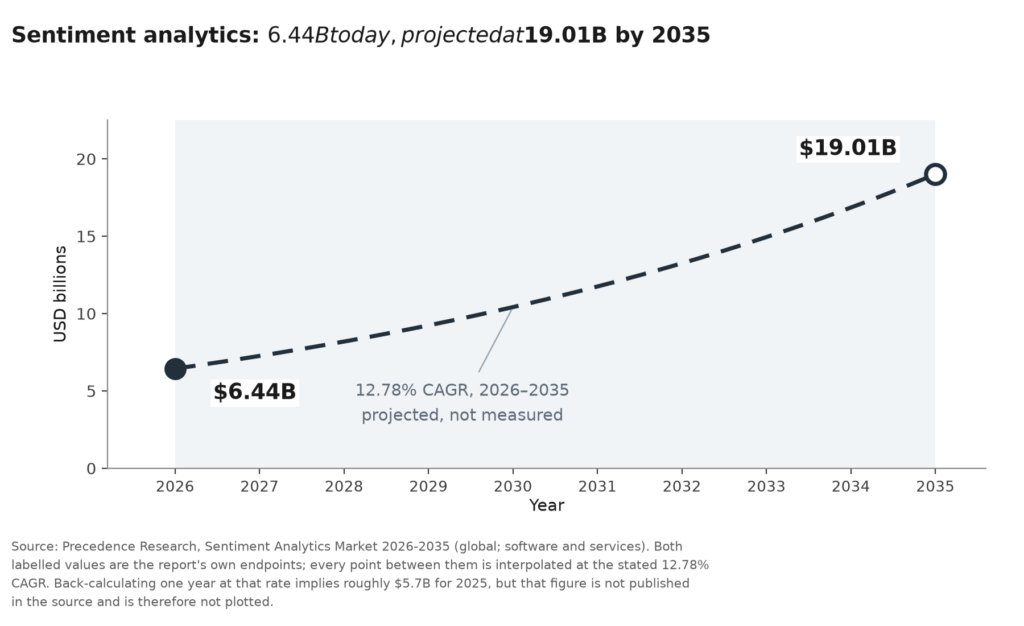
One caveat worth carrying into any budget conversation: research houses disagree by a factor of two or three on this category depending on whether they count software licences, managed services, or the whole social listening stack. Treat the absolute number as a scale indicator. The direction is what matters, and the direction is unambiguous.
What the money is actually buying
Most of that spend is not going to “analyse sentiment.” It is going to the plumbing around it: connectors for a dozen platforms, taxonomy design, multilingual coverage, and the workflow that routes a flagged conversation to a human before it becomes a headline. The analysis itself is increasingly a commodity line item. The integration and the judgement are not.
The real conversation is bigger than your reviews page
Here is a habit that costs brands money. They install a listening tool, point it at their own handles and their Trustpilot page, and call it done. Meanwhile the actual conversation is happening in a Discord server, under a creator’s video, in three languages, on a platform nobody on the team uses.
The blind spot is not small. IDC’s long-standing projection is that roughly 80% of the world’s data is unstructured, and most of it never gets looked at. Customer feedback is the textbook case: collected automatically, read almost never.
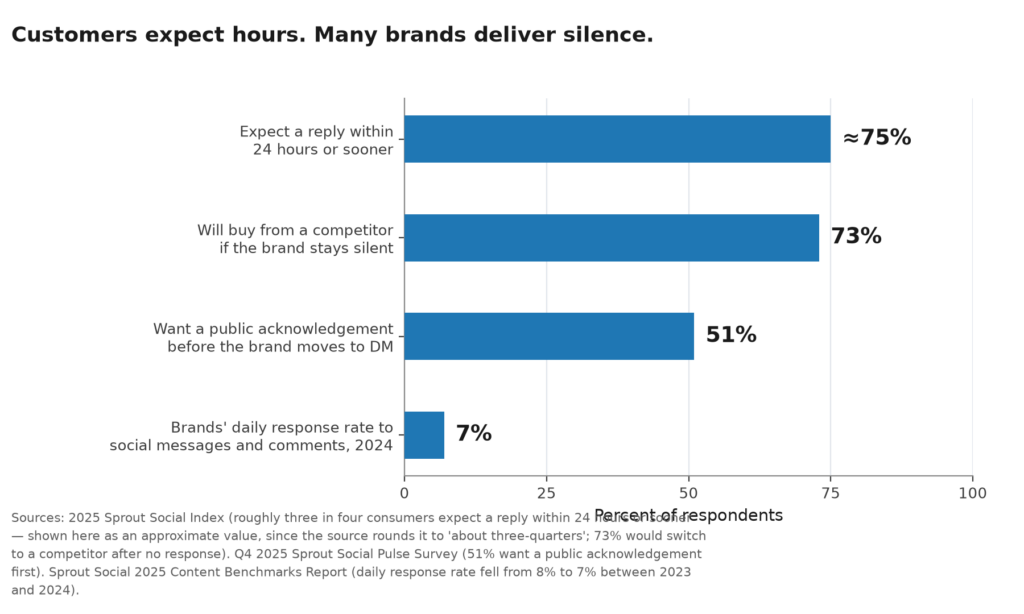
Speed matters more than volume here, because the audience is watching in real time. In the 2025 Sprout Social Index, roughly three in four consumers expect a response on social within 24 hours or sooner, and 73% said they would buy from a competitor if a brand simply does not answer. A Q4 2025 Sprout Social pulse survey adds the nuance most teams miss: 51% of people who complain publicly want a public acknowledgement first, before anyone slides into their DMs.
Four jobs brands actually hire this for
Strip away the vendor decks and the use cases collapse into four:
Catching the thing before it spreads. Sentiment velocity, meaning how fast negative volume is accelerating, is a better tripwire than absolute negativity. A brand can sit at 12% negative forever and be fine. A jump from 12% to 19% in ninety minutes is an event.
Mining product truth at a scale no research team can staff. Thousands of reviews, grouped by the aspect they complain about, ranked by how often the complaint shows up alongside a churn signal. This is where sentiment analysis pays for itself fastest.
Testing whether a campaign landed emotionally. Not clicks. Whether people felt something. A campaign can hit every traffic target and still make the brand feel cheaper than it did last quarter.
Watching the competitive frame. Not to copy competitors, but to notice when their sentiment sags and your category’s switching conversations start.
Here’s the uncomfortable number
McKinsey surveyed more than 260 customer-experience leaders and found something that should embarrass the measurement industry. 93% rely on a survey-based metric as their primary CX measure. Only 15% are fully satisfied with how their company measures CX. Only 16% say surveys give them granular enough data to address root causes. Only 13% are confident their sample represents their customer base. And 4% say their system lets them calculate the ROI of a CX decision.
Four percent.
Also worth sitting with: the typical CX survey reaches about 7% of a company’s customers. That is the sample an entire industry has spent two decades optimising.
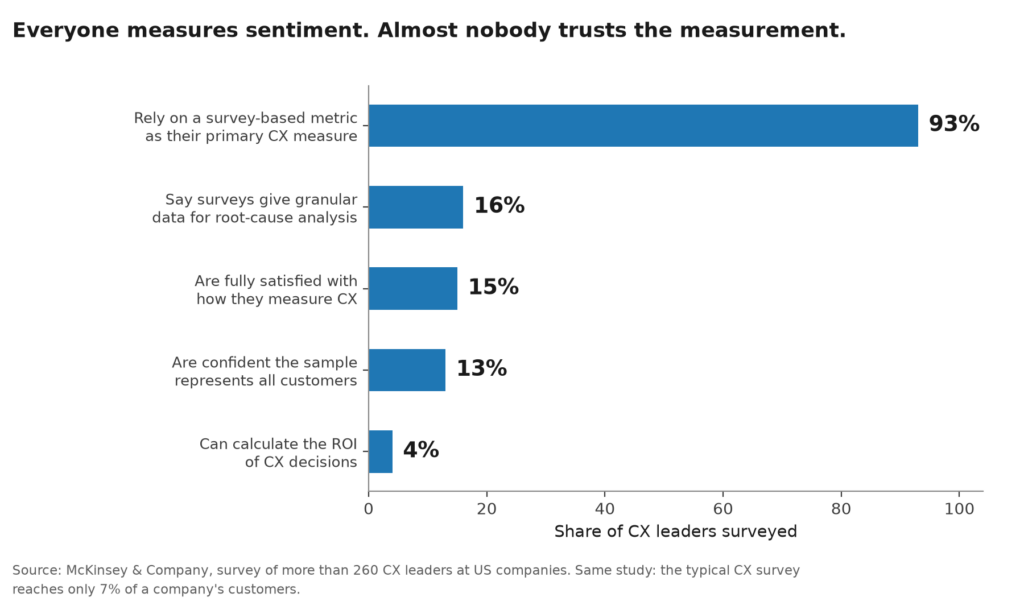
This is the real opening for AI sentiment work. Not “we can score tweets now,” but “we can finally listen to the 93% of customers who never fill in your form, and we can do it continuously instead of quarterly.”
Nuance is the frontier, and the frontier is where it breaks
Now the honest part.
Sarcasm is a 0.57 problem wearing a 0.81 badge
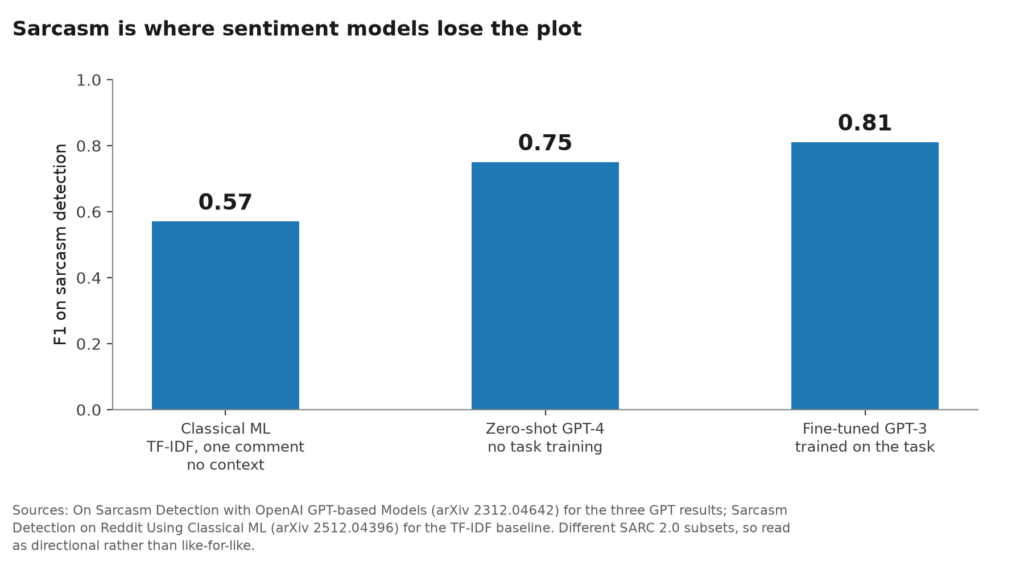
Sarcasm detection is the standard honesty test for sentiment systems, because the literal words and the intended meaning point in opposite directions. “Oh great, another late delivery” contains only positive words and roughly zero positive feeling.
The measured numbers are sobering. A recent study using classical machine learning on a 100,000-comment sample of the Self-Annotated Reddit Corpus landed at an F1 of about 0.57, barely better than guessing with extra steps. Published zero-shot GPT-4 results on the political-balanced slice of SARC 2.0 sit at 0.70 accuracy and 0.75 F1. Fine-tune a large model specifically on the task and the largest fine-tuned GPT-3 reaches 0.81 accuracy and F1.
Read that carefully: the win came from training on the task, not from the model being enormous. Capability scales with supervision here, not with parameter count alone. A vendor pitch built on “frontier model, zero configuration” is selling you the 0.75, not the 0.81.
Whole-post scoring throws away the argument inside the post
Here is a benchmark result I keep coming back to, because it explains most of the bad sentiment dashboards I have seen. In SemEval-2014 Task 9, the best system scored 86.63 F1 on phrase-level polarity, judging the sentiment of a marked expression. On message-level polarity, collapsing an entire post into one label, the best system in the same competition scored 70.96.
Fifteen-point-seven points, gone, purely because the task required averaging across parts of a post that disagreed with each other. That is not a model failure. It is a design failure the model faithfully reproduces.
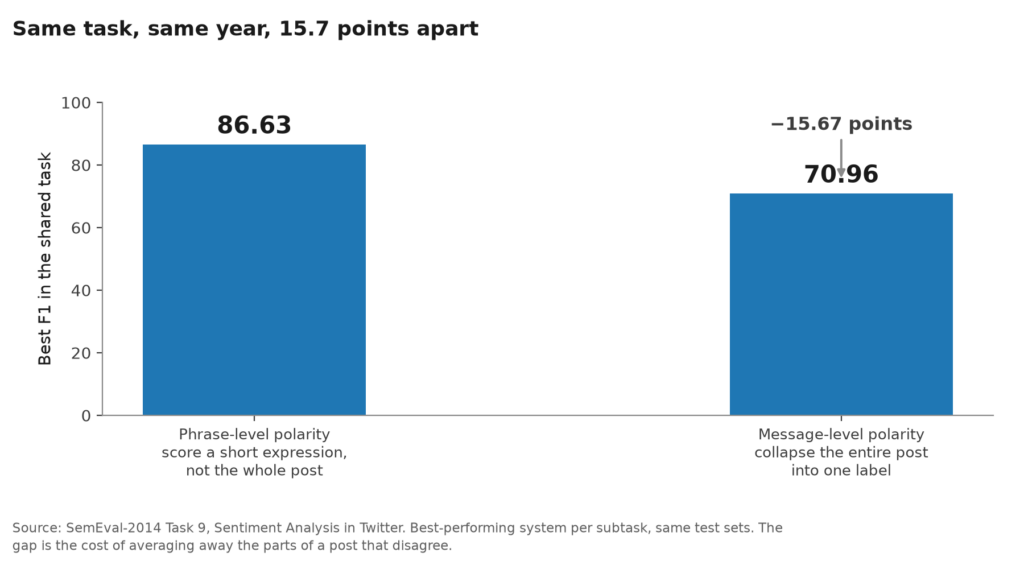
If your monthly report says “sentiment is 72% positive,” you are looking at the 70.96 version of your customers. The useful version reads closer to: sentiment toward shipping fell nine points, sentiment toward price held, sentiment toward the new packaging collapsed.
Culture doesn’t map one-to-one
The other frontier vendors gloss over. Emotional expression is not a universal constant that happens to be written in different alphabets. A phrase that reads as flat in one market reads as warm in another; understatement is a register, not an absence of feeling; and a translated benchmark does not test cultural competence, it tests translation.
Research on culturally grounded NLP keeps landing in the same place. Performance gaps persist across languages even where coverage looks solved, and prompt language, tokenisation, and who annotated the evaluation set all move the result. If you operate in more than three markets, budget for per-market validation. Not necessarily per-market training, but per-market validation, definitely.
Scale and accuracy were never actually enemies
The framing that “you can have scale or you can have nuance” is mostly a vendor constraint dressed as a law of physics. It is a cost curve, and cost curves are negotiable.
The ceiling isn’t the model. It’s us.
This is the part almost nobody mentions. When researchers evaluate multilingual sentiment systems against carefully built human annotations, model performance converges on inter-annotator agreement rather than on some hypothetical ideal. In plain terms: two humans reading the same post often disagree about whether it is negative or merely tired. The model’s ceiling is set by how much humans disagree with each other.
Which means an “94% accuracy” claim deserves one follow-up question: accuracy against what? Against a single annotator’s opinion? Against majority vote? Against a taxonomy with twelve near-synonymous negative codes? The honest answer changes how much you should trust the dashboard.
Your baseline is the only benchmark that matters
Every brand has a resting emotional temperature. A budget airline sits in a different place from a luxury hotel, and neither is doing badly. Comparing your absolute score to a competitor’s absolute score is worse than useless, because it rewards you for operating in an agreeable category while hiding you from a real deterioration.
Measure deltas from your own baseline. Track the second derivative: not where sentiment is, but whether the rate of change is accelerating. A score drifting from 68 to 66 over a quarter is weather. A score dropping from 74 to 69 in six hours is a signal, and it deserves a phone call.
A playbook that survives contact with reality
Tier the listening
Do not apply your expensive analysis to everything. Use cheap, fast, high-recall scoring across the full volume to establish the baseline and catch spikes. Run aspect-level and emotion-level analysis only on what gets flagged, plus whatever the cheap model is unsure about. Send the top-N items and every anomaly to a human.
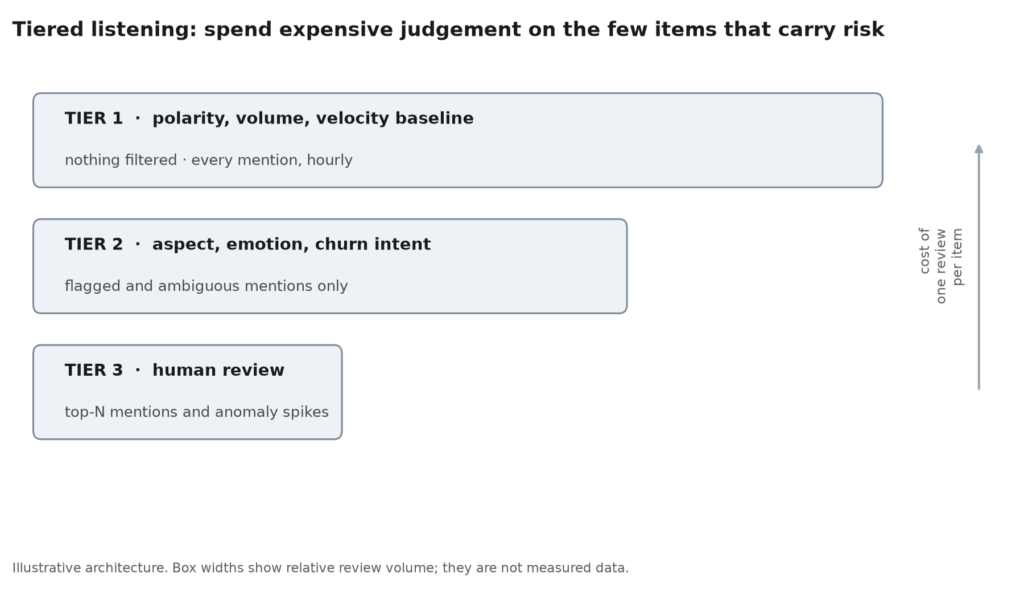
The point of the tiers is not cost savings, though that helps. The point is that human attention is the scarcest input in the system, and you should spend it where a wrong call is expensive.
Score the parts, not the whole
One score per brand is a number nobody can act on. Score product, price, delivery, support, and packaging separately, and let each route to the team that owns it. This is also the single change that most improves the perceived usefulness of a listening programme among the people who have to use it.
Track velocity, not snapshots
Build alerts on rate of change and volume-normalised deltas, not on thresholds. “Negative sentiment above 20%” fires constantly during a product launch. “Negative sentiment up 40% in two hours on a topic that was flat yesterday” fires once, and it is usually right.
Calibrate multilingual before you trust multilingual
Run a few hundred items per market through human review and compare. If your German output looks more negative than your Spanish output for a structurally similar complaint, that is a model artefact, not a cultural finding. You will not discover this from dashboards. You have to read the raw text.
Close the loop or don’t bother
McKinsey’s case material makes the mechanism clear. One airline scored 1,500 variables across 100 million customers daily and used it to identify which relationships were at risk for a specific reason, such as a delay or a cancellation, then offered those customers personalised compensation. The result was an 800% uplift in satisfaction and a 60% reduction in churn among priority customers. A US healthcare payer synced four billion records across nine systems to find the exact thresholds where patients gave up on digital self-service, then reached out proactively.
Neither of those is a sentiment dashboard. Both are sentiment wired to a decision. A dashboard without the wiring is an expensive way to feel informed.
Where this is heading next
Two things are already visible.
First, the product is moving from measurement to intervention. Gartner projects that 40% of enterprise applications will include task-specific AI agents by the end of 2026, up from under 5% in 2025. Once a sentiment model can act by drafting the response, opening the refund, or routing the case, the quality of the sentiment read stops being a reporting question and becomes an operational one. Getting it wrong gets expensive quickly.
Second, the cautionary tale is already written. Klarna’s AI assistant handled 2.3 million conversations in its first month, covered two-thirds of support chats, and cut average resolution time from 11 minutes to under 2, while repeat inquiries fell 25%. The company later publicly walked part of it back and began rehiring humans for complex cases, with its CEO acknowledging an over-correction on cost. The efficiency was real. So was the gap where nuanced judgement used to sit.
That is the whole story of this technology in one paragraph: the volume gets handled, and the judgement is where you still have to invest.
The short version
Sentiment analysis at scale is largely solved. Sentiment understanding at scale is not, and will not be for a while, because the bottleneck keeps moving: from model capability, to data quality, to taxonomy design, and finally to the uncomfortable fact that humans disagree about feelings.
The brands getting real value are not the ones with the biggest listening platform. They are the ones who score the parts, tier their attention, calibrate against their own baseline, and have somebody on the other end of the alert who is allowed to act.
Read the room. Then do something about it.