Why AI Made Content Cheaper and Publishing Slower
Every marketing team has a version of this week. Someone produces four campaign emails on Monday morning. By Thursday, one has shipped. The other three are still moving between a writer, a legal reviewer, and a brand editor, each of whom keeps finding something the draft got subtly wrong.
The stated reason is caution. The real reason is an accounting error so basic it is almost embarrassing: we measured the part of the work AI made cheap, and we did not measure the part it left untouched.
The number that should have ended the debate
In 2025, a team at METR ran a randomised controlled trial on experienced open-source developers: sixteen engineers, 246 real tasks, in repositories where each developer averaged five years of familiarity. Tasks were randomly assigned to allow or disallow AI tooling. Cursor Pro and Claude 3.5/3.7 Sonnet.
Before starting, the developers forecast that AI would cut completion time by 24%. After finishing, they estimated it had cut time by 20%. Both beliefs were wrong in the same direction. Allowing AI increased completion time by 19%.
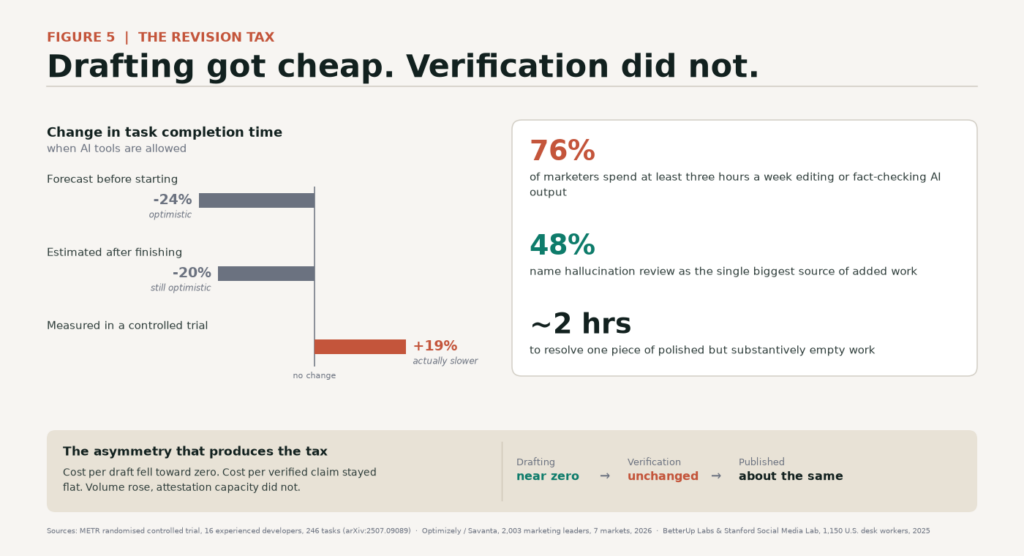
Note what the second number means. The developers were not guessing. They had just finished the work, and they still reported a 20% saving while the clock said they had lost 19% of their time. The error survived direct experience. That is the detail worth sitting with, because it explains why this problem persists through years of adoption rather than resolving after the first bad quarter.
Where the time actually goes
The mechanism is not mysterious once you stop treating “content production” as one activity.
Drafting is a generation task. Cost per draft has collapsed toward zero, and it keeps falling.
Verification is an attestation task. Someone has to check whether the claim is true, whether the number is current, whether the customer name is spelled correctly, whether the regulatory wording holds in this market. That cost depends on how much attestation capacity the organisation has, and it has barely moved. No model has made a compliance reviewer twice as fast, because the reviewer’s job is to be slow on purpose.
When you cut the price of generation without touching the price of attestation, you do not get more published output. You get more drafts entering the same queue. The queue becomes the constraint, and the queue’s length is now set by content volume rather than by drafting talent.
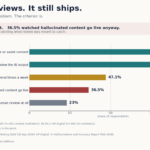
Optimizely’s 2026 study of 2,003 marketing leaders across seven markets put numbers on the result. Seventy-six percent spend at least three hours a week editing, fact-checking or correcting AI output. Forty-eight percent name hallucination review as the largest single source of added work. And 25% admit they frequently or always publish AI content they know is not fully on-brand when a deadline closes in.
That last figure is the one to watch. It is the point where governance fails not because nobody cared, but because the revision tax exceeded the time available.
BetterUp Labs and Stanford measured the downstream version of the same tax. Forty percent of US desk workers received “workslop” in a single month: output that passes the glance test and fails on inspection. Each incident consumed nearly two hours to resolve, roughly twenty minutes more than if the sender had simply done the work themselves. At scale that is about $186 per employee per month.
Why nobody sees it
The tax is invisible for three structural reasons, and each one has to be dismantled separately.
It is paid by someone other than the buyer. The executive who approved the tool sees the first draft arrive in eleven seconds. The revision tax is paid by the editor, the fact-checker, and the account manager reconciling three contradictory drafts. Optimizely found that 69% of C-suite leaders believe AI adoption is fully aligned across their organisation, while only 27% of analysts agree. That 42-point gap is not a communication failure. It is two people looking at different parts of the same ledger.
It does not appear on any dashboard. There is no line item for hours spent fixing AI drafts, and no ticket is filed when a campaign slips two days because three outputs contradicted each other. Unmeasured work does not get managed; it gets absorbed, and it displaces the strategic time AI was supposed to create. In the same study, 39% said they are too busy managing workflows and outputs to think strategically.
Fluency defeats skim-reading. When a colleague writes a draft, you can see where the thinking thinned out. AI output has uniform confidence, so a fabricated statistic sits in the same paragraph as a verified one, delivered in identical register. You cannot triage it. You have to read every line at full attention, which is precisely the expensive mode of reading that the whole promise was supposed to eliminate.
The uncomfortable implication
If this is right, then most AI productivity programmes are measuring the wrong variable, and they will keep reporting success while the bottleneck moves downstream. Faster drafting is not a productivity gain. It is a change in where the queue forms.
That does not make AI useless. It means the return on AI in content is governed almost entirely by what you do to the verification layer. Teams that build machine-readable claim libraries, pre-approved proof points, and single-source templates convert drafting speed into publishing speed. Teams that do not simply move the queue.
The METR result is not an argument against AI tooling. It is an argument against assuming that a faster first step makes the whole process faster, when the slowest step has not been redesigned.
The revision tax is real, it is measurable, and it accrues to whoever is holding the manuscript at four in the afternoon. Until someone puts it on a dashboard, it will keep being mistaken for diligence.