Why Reviewing Every AI Draft Still Lets the Hallucination Through
The comfortable explanation is the wrong one
When hallucinated copy reaches the public, the reflex is to blame a missing approval step. Add a reviewer, the reasoning goes, and the problem closes.
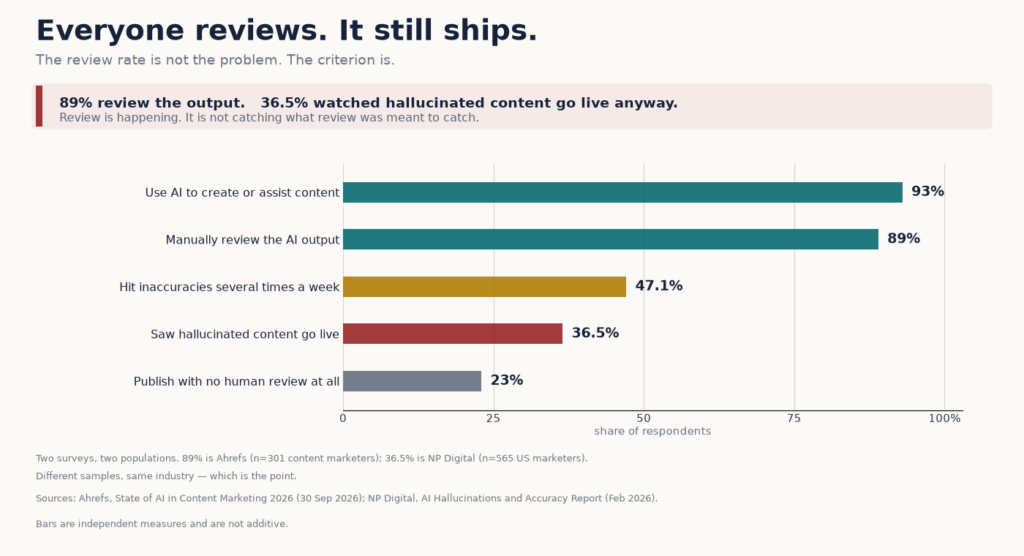
The numbers say the reviewer is already there. Ahrefs’ 2026 survey of content marketers puts AI use at 93% and manual review of AI output at 89%. This is not an industry shipping unchecked drafts. It is an industry checking them, at scale, and still watching fabricated content go live — 36.5% of respondents in NP Digital’s parallel study said they had seen exactly that.
Two surveys, different samples. Facing the same direction. So the interesting question is no longer whether anyone reviews. It is what the reviewer is actually looking for.
Reviewers verify voice, not provenance
Ask a marketer to review a draft and they will do what they were trained to do: check tone, tighten rhythm, confirm the claim fits the campaign. All of that is judgement about register.
Hallucination is built to pass a register test. A fabricated statistic does not arrive with a warning label. It arrives in the same confident, well-formed sentence as a true one, often with a plausible institution attached. The model is optimising for exactly the property the reviewer is evaluating — does this read right — so the check and the failure are aimed at the same target.
That is the mechanism. The review criterion and the failure mode are correlated, which is the worst possible arrangement for a control.
The economics make sampling inevitable
Generation costs close to nothing per draft. Verification costs something real per claim, because someone has to leave the document, find the source, and read it.
At a few drafts a week, that cost is absorbable. At the volumes AI makes possible, it is not, so teams sample. Sampling is a rational response to a fixed review budget, and it is also how a fabricated figure in paragraph six survives a review that read paragraphs one through four closely.
And there is no signal to triage on
A human reviewer triaging a document needs something to sort by — a typo, an awkward clause, a bold claim that smells inflated. Hallucination offers none of these. It is fluent, on-brand, and unremarkable. The absence of friction is the tell, and absence is very hard to notice.
This is why the fix has never been more review. It is a different question asked at the point of review, and it has to be a mechanical one: where is the source for this number? Not “does this feel right.” A reviewer who cannot answer with a document is not reviewing; they are reading.
Until that question is asked per claim, adding reviewers just moves the queue.