Why AI Local Recommendations Never Settle: The Corroboration Threshold Behind a Coin-Flip Shortlist
If you have ever run the same local question through ChatGPT twice in one week and gotten two different lists of businesses, you probably assumed the model was being flighty. It isn’t. The instability is structural, and once you see the mechanism, it changes what you should be optimising for.
Here is the insight in one sentence: AI local search does not rank businesses, it corroborates them, and corroboration is a threshold that most small businesses sit just underneath.
What is actually happening when the answer appears
A traditional map pack runs one query against one index and sorts by proximity, relevance, and prominence. Deterministic, more or less. Ask the same question from the same place twice and you get the same three pins.
An AI answer does something structurally different. It decomposes your question into a fan of sub-queries, retrieves passages from each, and then synthesises a response. The model isn’t selecting from a ranked list of businesses. It’s assembling a paragraph, and the businesses that survive into that paragraph are the ones for which it found enough consistent evidence to state a fact confidently.
That is the whole mechanism, and it explains every weird behaviour you’ve observed.
The evidence for it, in three numbers
BrightLocal ran 200,085 non-branded local prompts across ChatGPT, Google AI Mode, and AI Overviews, re-running each one multiple times over 60 days and from different points on a map. Nearly two million citations later, here’s what fell out.
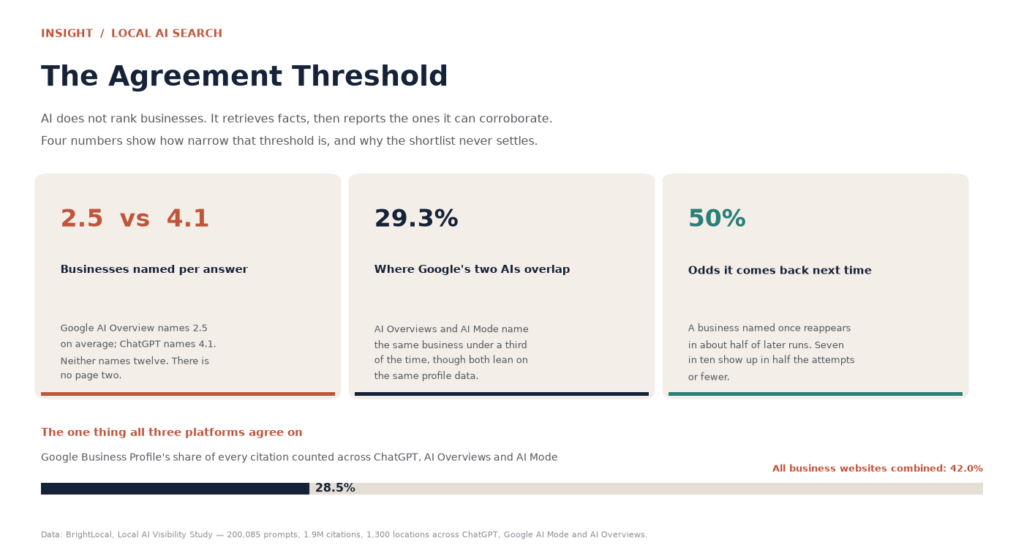
The lists are short and they are different lengths. ChatGPT names 4.1 businesses per answer on average. AI Mode names 3.5. AI Overviews names 2.5, which is suspiciously close to the three-pin pack it replaced. There is no page two to fall onto.
Google’s own two AIs barely agree with each other. AI Overviews and AI Mode name the same business only 29.3% of the time. Both draw heavily on Google Business Profile. If profile data were the deciding factor, that overlap would be far higher. It isn’t, because each surface fans out differently and lands on different supporting evidence.
A business named once comes back about half the time. Persistence sits at 50% for ChatGPT and AI Mode, 58% for AI Overviews. Between 71% and 80% of businesses appear in half the runs or fewer. Meanwhile Google Maps has 99% agreement across repeat attempts. Maps is a lookup. AI is a reconstruction, and reconstructions don’t repeat cleanly.
The economics nobody states out loud
Now the part that isn’t in the study, but follows from it.
Every additional business named in an answer costs the model something. Not compute, exactly, but risk. To name a business, the system has to assert that it exists, serves your need, and is plausibly better than the alternatives. Each assertion is a claim it can be wrong about. So it names very few, and it prefers the ones where multiple independent sources agree.
This is why the profile matters less than you’d think and the open web matters more. A Google Business Profile is one source. It’s a strong one, at 28.5% of citations, but it is one. A business corroborated by its own site, a Yelp listing, two local news mentions, and forty recent reviews gives the model four independent reasons to feel safe naming it. A business with only a profile gives it one.
The instability follows directly. When the evidence is thin, the model’s choice among near-equivalent candidates is close to arbitrary, and small perturbations in retrieval flip it. When the evidence is thick and mutually consistent, the business gets named almost every time. Persistence isn’t a measure of popularity. It’s a measure of how many independent sources agree about you.
What this means if you run a shop
Three things, and they invert some standard advice.
Stop treating AI visibility as a ranking problem. You cannot rank your way into an answer. You can only become the thing that’s easy to corroborate.
Stop concentrating every fact on one property. If your hours, prices, and services exist only on your profile, you have one source and a coin-flip outcome. Put them on your own site in plain extractable form, and make sure the same numbers appear on the two or three directories your industry actually uses.
Stop chasing the 1.2% headline. The reason ChatGPT recommends so few businesses isn’t that the bar is impossibly high. It’s that most businesses give it nothing to work with beyond a single stale listing. That’s a fixable problem, and fixing it is cheap.
The uncomfortable part is that none of this is a growth hack. It’s the same boring work of being consistent, specific, and well-documented, just measured differently. The businesses that win the AI layer won’t be the ones who gamed it. They’ll be the ones who were already telling the truth in enough places that the machine could check.