Why Instant Retail Grew 48% the Year Speed Stopped Mattering
In 2025, China’s instant retail market reached RMB 1.19 trillion, up 48.3%. More than 60 billion instant delivery orders moved through the country in the same twelve months. The subsidy war that built those numbers wound down at the end of the year — and growth held anyway.
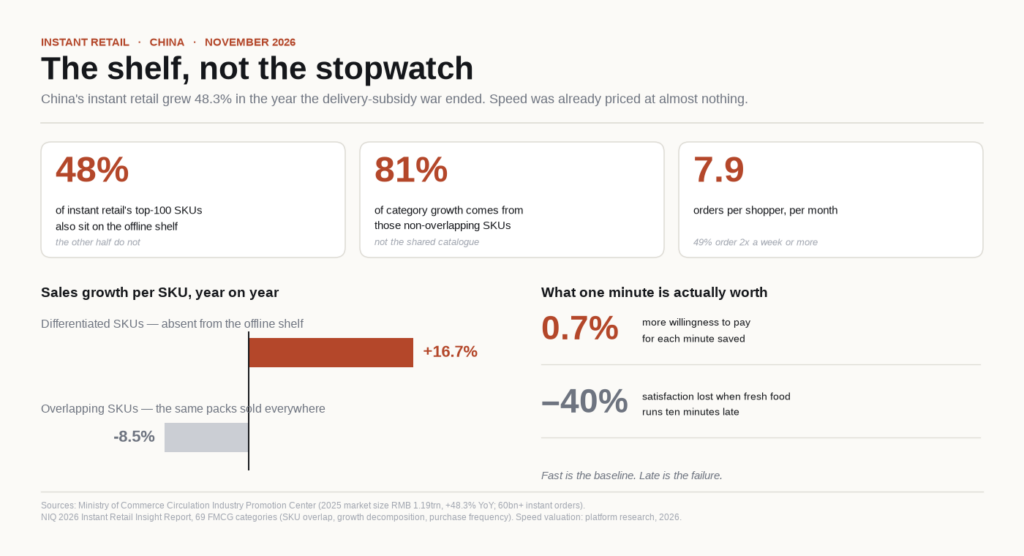
Here is the odd part. The thing everyone credits — speed — is worth almost nothing at the margin. Platform consumer research puts it at 0.7%: each minute shaved off a delivery lifts what a shopper will pay by less than one percent. Miss a promised window by ten minutes on fresh food, and satisfaction drops roughly 40%.
Fast is expected. Late is unforgivable. But faster is not the point.
The latency tax was real, and it has already been refunded
Instant delivery’s first act genuinely was a demand event. Every minute between “I want it” and “it’s here” used to filter out wants that couldn’t survive the wait — the craving decayed, the need passed, the purchase was deferred into forgetting. Collapsing that gap to half an hour didn’t accelerate existing demand. It released demand that slower commerce had been structurally suppressing.
That work is finished. The tax has been refunded across the entire market, and refunding it a second time buys 0.7%.
What creates demand now is the shelf, not the stopwatch
NielsenIQ’s 2026 tracking found that only 48% of instant retail’s top-100 selling SKUs also appear on the offline shelf. The other half don’t exist in the store down the street. They exist because a fulfilment node serving a three-to-five-kilometre radius can hold 4,000–5,000 SKUs chosen from online demand data rather than from walk-in traffic.
And that half is where the growth lives. 81% of category growth comes from those non-overlapping products. Non-overlapping SKUs grew 16.7% year on year; the overlapping ones — the same packs sold everywhere — shrank 8.5%.
You cannot buy that with a faster rider. You buy it with a different catalogue.
Frequency is the receipt
Behaviour confirms it. 49% of instant retail shoppers now order at least twice a week; the monthly average is 7.9 orders. This stopped being an emergency channel and became a grocery channel. Pre-warehouses already carry more than half of omni-channel transaction value in China — the inventory closest to the buyer, not the route to it, is what the economics reward.
High frequency with small baskets only survives if the assortment is right. A shopper ordering eight times a month isn’t waiting for a delivery. She’s re-shopping a shelf she has learned to trust.
What this means if you are the brand
Treat instant retail as a merchandising problem, not a logistics one. The 30-minute window is a distribution decision about which SKUs live within three kilometres of the buyer — and whether those are the packs already sold everywhere, or the ones that only make sense here.
The 15-minute city of commerce isn’t a city of faster trucks. It’s a city of different shelves.