The Convergence Discount: Why Every Chinese Social Platform Became a Store
Watch someone shop in China for ten minutes and you stop being able to tell where the video ends and the shop begins. A creator reviews a rice cooker, the price card slides in, and the checkout is already open. Nobody in the frame finds this strange. That is the part worth explaining.
The numbers first. In 2025, more than RMB 5 trillion moved through live commerce in China, close to a third of all online retail, reaching an estimated 660 million users. Total online retail hit RMB 15.97 trillion; physical goods alone accounted for RMB 13.09 trillion, or 26.1% of all consumer retail spending. That is not a channel anymore. That is the channel.
But the tidy story — that platforms chased transaction fees — does not survive contact with the revenue lines.
Douyin booked an estimated RMB 901.2 billion of revenue in 2025. Advertising was RMB 420 billion of it, its e-commerce business another RMB 410 billion. Of that advertising pile, roughly RMB 210 billion came from merchants buying placement inside the very feed where they sell. Read that twice. About a quarter of the entire company’s revenue is merchants paying to be seen while they pay again to be sold.
The mechanism surfaces in the rates. Douyin cut its commission take from 2.6% to 2.0% while lifting its ad take rate to 8.2–8.3%. Net take barely moved. What changed was the label on the invoice: from a share of your sale to the price of visibility. And a feed can raise the price of visibility without ever admitting the storefront was the loss leader.
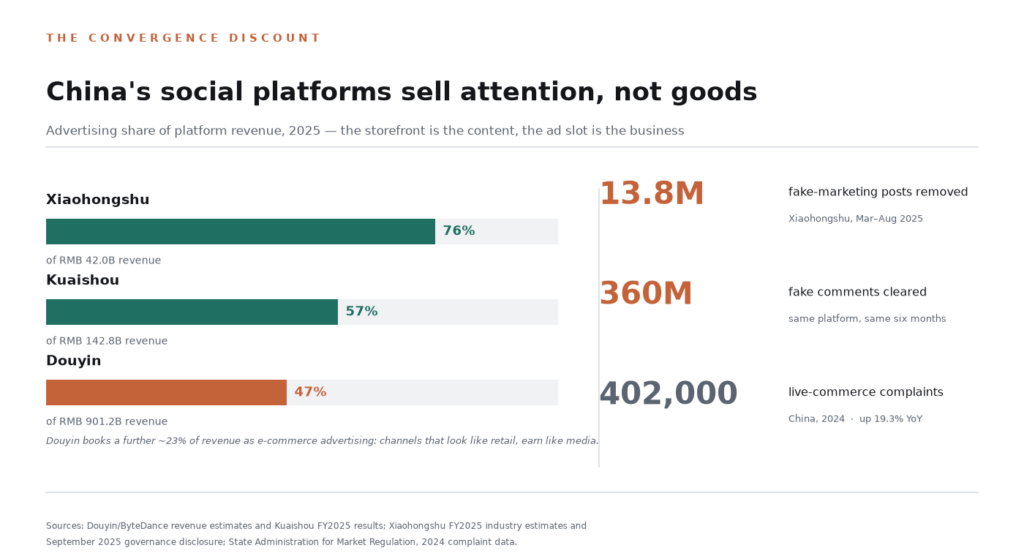
Xiaohongshu is the cleanest specimen. Advertising is 76% of its RMB 42 billion in revenue. Commerce GMV runs to RMB 850 billion, yet its on-platform order conversion rate sits at 0.7–1.2%. It is a superb billboard with a cash register in the lobby.
So what breaks?
The only number you could have used to check the pitch.
A platform now sells the reach and also grades the content that supposedly proves the reach worked. Between March and August 2025, Xiaohongshu deleted 13.76 million marketing posts, cleared 360 million fake comments, banned over 12 million accounts and cut fake-marketing exposure by 60%. That is decent work. It is also an admission. If protecting authenticity takes 13.8 million deletions in six months, authenticity was a product line, not a byproduct.
The demand side has quietly priced this in. China’s consumer association found 56% of shoppers use social commerce channels, while just 7.9% rank a favourite KOL’s recommendation among the things they care about in a company. Not outrage. Apathy, which is worse for conversion and better for nobody.
The volume curve agrees. Douyin’s year-on-year GMV growth fell from 220% to 80% to 46% to about 30% to under 20%. Monetization intensity held while the growth that justified it decayed. Regulation arrived on the same schedule: AI-generated content has needed a label since September 2025, and livestream hosts built from it must say so continuously since February 2026. The state is now supplying the disclosure the feed could not.
Treat the feed as rented distribution with a decaying half-life. Measure trust somewhere the platform cannot grade it, and build the owned relationship before the ad rate climbs again.