The “Premium Down” Pricing Trick That Keeps Working
Why launching high and walking down to your real price still beats a 50%-off banner — and why the anchor, not the discount, was always doing the work.
It isn’t a discount. It’s a staircase
Picture two shops selling the same $60 object. The first hangs a banner: WAS $120, NOW $60. The second opens at $120 for its first hundred buyers, then quietly settles at $60 for members.
The arithmetic is identical. The sentences are not. One says we were overcharging. The other says you arrived in time. Buyers don’t remember your price list; they remember which of those two sentences they heard.
The first number sets the ceiling
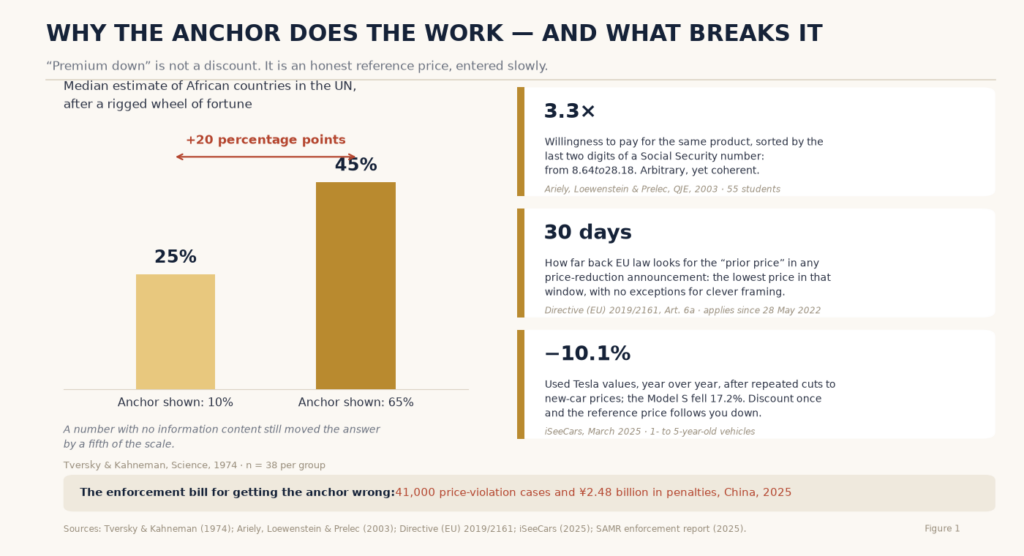
In 1974, Tversky and Kahneman spun a rigged wheel of fortune in front of participants and asked an unrelated question: what share of UN members are African countries? People who saw 10 guessed 25%. People who saw 65 guessed 45%. A carnival prop moved the answer by twenty points — and cash incentives didn’t fix it.
It gets stranger. Ariely, Loewenstein and Prelec asked 55 students to value ordinary goods using the last two digits of their Social Security number. Low digits averaged $8.64 for a cordless trackball; high digits, $28.18. A 3.3× spread, driven by digits that mean nothing. Crucially, the effect didn’t fade with experience or with market feedback.
Your launch price is that wheel.
A reference price is an entitlement, not a statistic
Kahneman, Knetsch and Thaler found the asymmetry that makes this work. Cutting an existing employee’s wage from $9 to $7 was judged unfair by 83%; hiring a replacement at $7 was acceptable to 73%. Same number. Different entitlement.
Prices behave the same way. A descent framed as founder’s rate hands the buyer a gain. A slash framed as correction confesses an error — and confessions depreciate.
What the counter-example proves
Tesla is the cautionary case, not the aspirational one. By March 2025, iSeeCars measured used Tesla values down 10.1% year over year — the steepest of ten declining brands. The Model S lost 17.2%, roughly $10,000; the Model Y 13.1%; the Model 3 10.9%. CarGurus put the fall at more than double the average used car’s. Every cut to new-car prices re-priced every used one on the lot.
Then the cuts paused, and by mid-2025 used values stopped sliding. The reference price wasn’t destroyed by selling cheap. It was destroyed by announcing cheap, repeatedly.
The compliance line moved, quietly
Europe codified the mechanism it wanted to stop. Since 28 May 2022, Article 6a of the Price Indication Directive requires any price-reduction announcement to show the prior price — the lowest price applied in at least the previous 30 days. The Commission’s stated aim: preventing traders from “artificially inflating the reference price.”
The carve-outs are where the honest version lives. Continuous loyalty benefits and genuinely personalised reductions aren’t treated as announcements at all — though a temporary member promotion still is.
China drew a harder line. Order No. 56, in force since July 2022, bars raising the posted price shortly before a discount to manufacture a calculation base, and bars bases that can’t be substantiated or compared. Where the base isn’t disclosed, it may not exceed your own lowest transaction price in the prior seven days. In 2025 alone, market regulators handled 41,000 price-violation cases and ¥2.48 billion in penalties.
Three moves that survive scrutiny
Earn the anchor before you use it. Premium-down only holds if the high number is plausible. A $500 tag on a $50 product isn’t an anchor; it’s a joke the market tells back to you.
Give the descent a reason and a door. “First hundred,” “founding member,” “introductory” — each names who you are and why now. A discount names nothing.
Never let the staircase become a chute. One slow descent preserves the reference. Five cuts in eighteen months teach buyers to wait, and waiting is the only discount that compounds against you.
The uncomfortable part
Yes, this leans on a bias. But anchoring is not optional — every price arrives after some other number. The real choice is whether the anchor is earned or invented, and invented anchors die fast: America’s deceptive-pricing rules already treat a price briefly posted then “cut” as a false claim, not a bargain.
Which brings it back to the plainest version. The move keeps working because it isn’t a trick. You built something worth $120, then let people in at $60 and told them why. That’s not manipulation. That’s a story about value, told in the right order.