China’s Recommendation Engines Reward Recency, Not Just Relevance
Two videos land in the same feed, in the same hour. Same topic, same length, same competent lighting. One of them is better — measurably better. It collects 400 views. The other collects four million.
Anyone who has published into a Chinese feed has a version of this story, and the usual explanation is lazy: the algorithm “prefers” fresh content. That’s not wrong, exactly. It’s just shallow. The interesting question isn’t whether recency is weighted. It’s why the weighting is structural — baked into the plumbing, not into anyone’s taste.
The audition nobody tells you about
Every new video gets a small, cheap test. Third-party operators consistently describe a first pool in the low hundreds of impressions, and what the system watches there isn’t taste — it’s whether people stay. Beat the threshold and you get a larger pool, then a larger one. Miss it, and the video isn’t punished; it’s simply never shown again.
So recency isn’t a bonus. It’s the door.
Freshness isn’t a preference — it’s a training loop
Here’s the mechanism most commentary skips. ByteDance’s own engineering work describes a system that trains on streaming feedback rather than nightly batches: user actions flow in, parameters update, the served model changes. When your ranking model learns from the last hour of behaviour, an item from six days ago is competing with evidence the model no longer respects.
Recency gets reinforced because the feedback loop is real-time. It’s architecture wearing the costume of editorial judgement.
The machine deletes what it stops seeing
The detail I find genuinely unsettling: in the same system, stale IDs are actively evicted. Embeddings for items that haven’t been touched in a configured period expire and are dropped to save memory. The reasoning given is reasonable — out-of-date videos “drain” resources without helping predictions.
But sit with the implication. Old content doesn’t just rank lower. In a very literal sense, it leaves the model’s memory. The feed forgets on purpose.
Seven hours, then silence
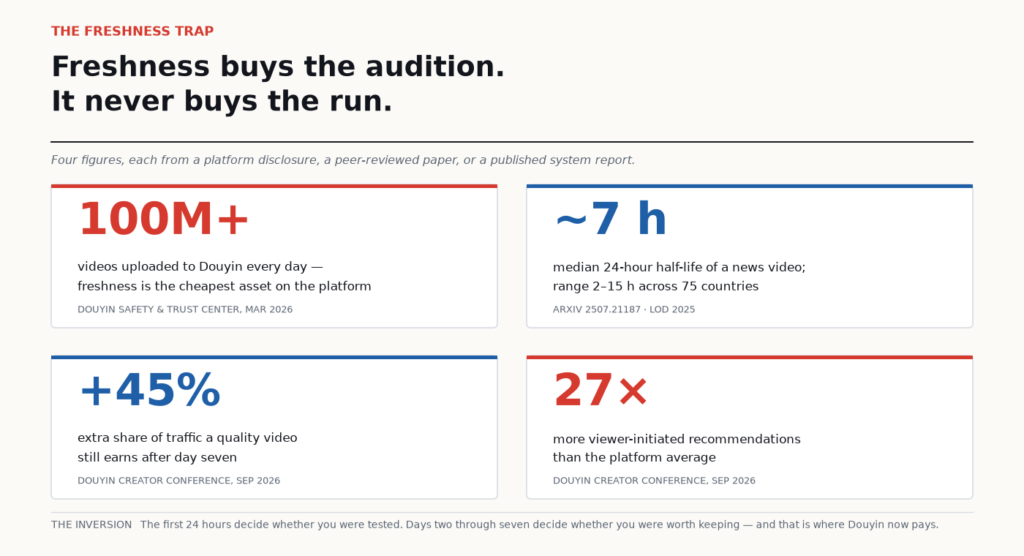
A large-scale study of 50,000+ news videos across 75 countries puts the average 24-hour half-life of attention at roughly seven hours — with a spread from two hours to fifteen. Seven hours is not a metaphor for “fast.” It’s a budget.
Then Douyin moved the goalposts
At its September 2026 creator conference, Douyin disclosed something that cuts against the whole recency narrative: quality videos earn 45% more of their total traffic after day seven than ordinary ones, and get 27× more viewer-initiated shares. The platform also widened its evaluation window from 24 hours to 7 days, and now weighs saves and repeat visits above likes.
Read that as an admission. A feed absorbing 100 million uploads a day will drown in freshness unless something durable surfaces. Recency alone is a treadmill with no compounding.
What this means if you actually publish
Stop treating cadence and quality as a trade-off. The correct sequence is: ship often enough to keep entering auditions, then build each piece so it survives past the seventh day. Saves, rewatches, and people sending your video to a friend are the signals that now pay.
The part everyone gets backwards
Chinese feeds don’t reward new content. They reward content that proves itself while it’s still new — and then keep paying for it long after “new” has expired. Freshness buys the audition. Only durability buys the run.