Why Back-Office AI Pays and Marketing AI Doesn’t — Yet
Field notes on a pattern that repeats in almost every marketing organization we look at.
There is a question I keep running into, and it is not the one people ask in meetings.
The meeting question is: which AI tools should we buy? The real question is: why does the money keep landing on the same three use cases — content generation, chat assistants, and campaign copy — when almost everyone who has actually shipped automation says the savings came from somewhere else?
The incentive is presentability, not return
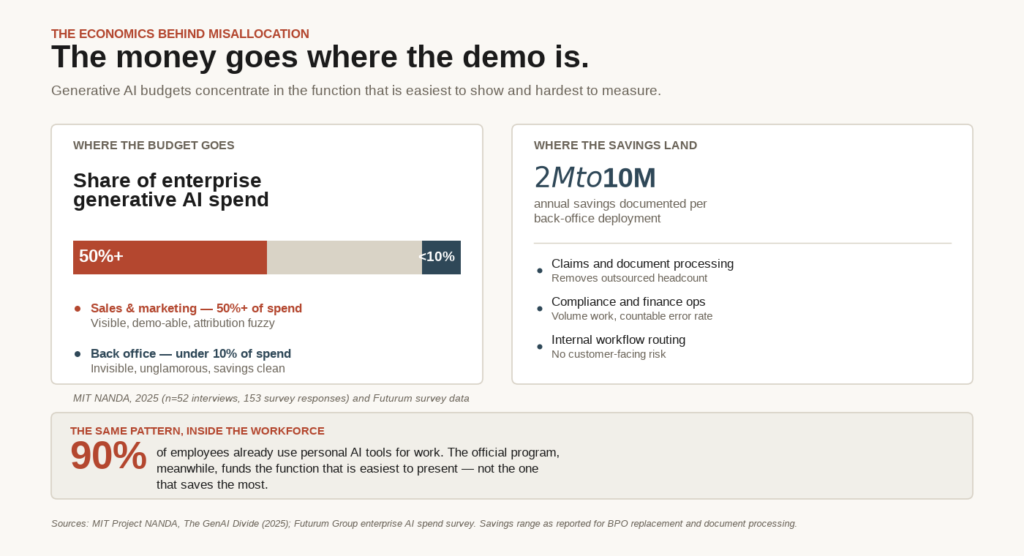
MIT’s Project NANDA put a number on the misalignment. More than half of enterprise generative AI budgets go to sales and marketing applications. The functions where the strongest returns showed up — claims processing, compliance, finance operations, internal workflow routing — received a fraction of that. Documented back-office savings ran between $2 million and $10 million a year per deployment, largely through removing outsourced processing and cutting external agency spend.
Sit with the shape of that. The money went where the demo is. The savings came from where the demo isn’t.
This is not stupidity. It is a rational response to how capital gets released inside a company. A marketing AI project has a sponsor with a budget line, a vendor with a slide deck, and a visible artifact you can show in a quarterly review. A claims-processing automation has none of those. It has an unglamorous process owner, a compliance review, and a benefit that shows up as a cost line moving in the right direction eighteen months later.
The executive who funds the visible thing is not being reckless. They are responding to the only signal their organization reliably rewards: something I can point at.
The attribution problem makes it worse
Marketing is also the hardest place to prove causation. If revenue rises after a content automation rollout, was it the automation, the season, the pricing change, or the competitor’s outage? Nobody knows, and the honest answer is that nobody can know. So marketing AI gets funded on faith and defended on narrative.
Back-office automation has the opposite property. It is boringly measurable. Headcount in a process, cost per document, error rate, cycle time. You can count the thing before and count it after. That makes it easy to prove and, paradoxically, easy to ignore — because a proven 30 percent cost reduction in invoice processing does not make a slide that anyone forwards.
So the highest-confidence returns sit in the least-funded category, and the lowest-confidence returns sit in the most-funded one. That is the mechanism.
And the workforce already routed around it
Here is the part that makes the whole arrangement unstable.
MIT’s research found roughly 90 percent of employees using personal AI tools for work tasks, including inside organizations with no official AI program at all. Microsoft and LinkedIn’s Work Trend Index found the same thing at larger scale: 78 percent of AI users bringing their own tools to work, and 52 percent declining to admit they use AI for their most important tasks — with 53 percent worried that admitting it makes them look replaceable.
Read those two findings together and a strange picture emerges. The official budget is aimed at the function leadership wants to talk about. The actual productivity gain is happening quietly, in the workflows employees built for themselves, on tools the company did not procure and cannot see.
Nobody planned this. It fell out of the incentive structure.
What actually breaks the pattern
The fix is not a better tool. It is a different question at the budgeting stage.
Stop asking which function should get AI. Ask which process has a countable before and after. That single reframe moves money toward work with a measurable denominator — and it does not require anyone to stop funding marketing AI. It requires marketing AI to arrive with a number attached.
The teams doing this well tend to run one boring automation and one visible one in parallel. The boring one proves the method. The visible one buys the permission to keep going. That pairing is not a compromise; it is how you survive a budget review with your credibility intact.
The uncomfortable implication: if you cannot describe what your AI program will make cheaper or faster in countable terms, you have not designed an automation. You have designed a demonstration.