The Review Step Is the Product: AI Translation for Global Campaigns
AI translation got good. Not uniformly good — specifically, narrowly, measurably good at the kind of content that was never the hard part. Product specs. Support macros. The forty-second email that tells someone their order shipped.
Then it stayed mediocre at exactly the content that decides whether a campaign works: the tagline, the slogan, the joke, the line that has to land in a culture it was not written in.
That gap is not a temporary engineering problem. The 2024 WMT shared task on general machine translation carries a subtitle that reads like a verdict from the field itself: the LLM era is here, but machine translation is not solved. That was two years ago. The 2026 evidence says the same thing in sharper numbers.
Here is the argument this piece makes, in one breath: the danger of AI translation is not that it produces bad words. It is that it produces plausible words, cheaply, at a volume that quietly destroys the review step. The failure mode is procedural, not linguistic. That changes what you should do about it.
What actually changed, and what didn’t
Let us give the technology its due, because the dismissive version of this argument is now wrong.
Modern translation runs on large language models, and the gap between an LLM and the phrase-based engines of fifteen years ago is not incremental. Older engines substituted words. Current models handle idiom, register, sentence rhythm, and the unspoken thing a sentence is doing. The WMT24 general task drew 28 participating teams, collected outputs from eight large language models and four commercial translation providers, and had professional annotators evaluate them across eleven language pairs. The top-ranked system overall was a general-purpose LLM. A 7-billion-parameter open-weight model also outperformed established commercial engines on several pairs, according to its own developers’ evaluation.
So yes — if your mental model of machine translation is still “sounds like a tourist with a dictionary,” update it. That model is obsolete.
What did not change is the shape of the problem. Grammatical adequacy is now cheap. Cultural resonance is still expensive. The gap between those two things is where campaigns die.
What the benchmarks are really telling you
Translation quality gets reported as a single number, which is like scoring a restaurant on the average of its food, its service and its plumbing. The number hides every dimension you would actually judge.
The most useful recent work on this deliberately scores cultural nuance instead of fluency. Seven multilingual models, fifteen target languages, five native-speaker raters per language, each scoring both full texts and individual instances of culturally loaded language. The mean across full texts was 1.68 out of 3. Modest. The strongest model reached 2.10. None came close to what a native copywriter produces.
Now look at how the scores split by category, because that is the part you can act on.
Holidays and culturally embedded concepts scored around 2.2 — solid. Idioms sat at 1.65 and were the category most likely to be left untranslated altogether. Puns and wordplay came last at 1.45, with the lowest agreement among raters, which is itself informative: even humans disagreed about whether the output worked.
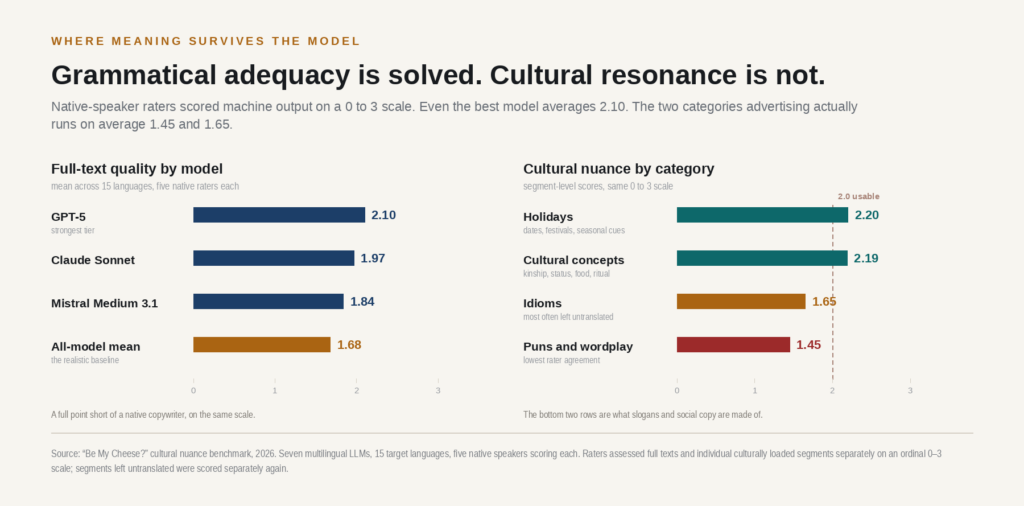
Read that chart as a budget document. If your campaign depends on wordplay, the machine is not a cost saving. It is a liability with a discount attached.
The four tiers, and where each one goes
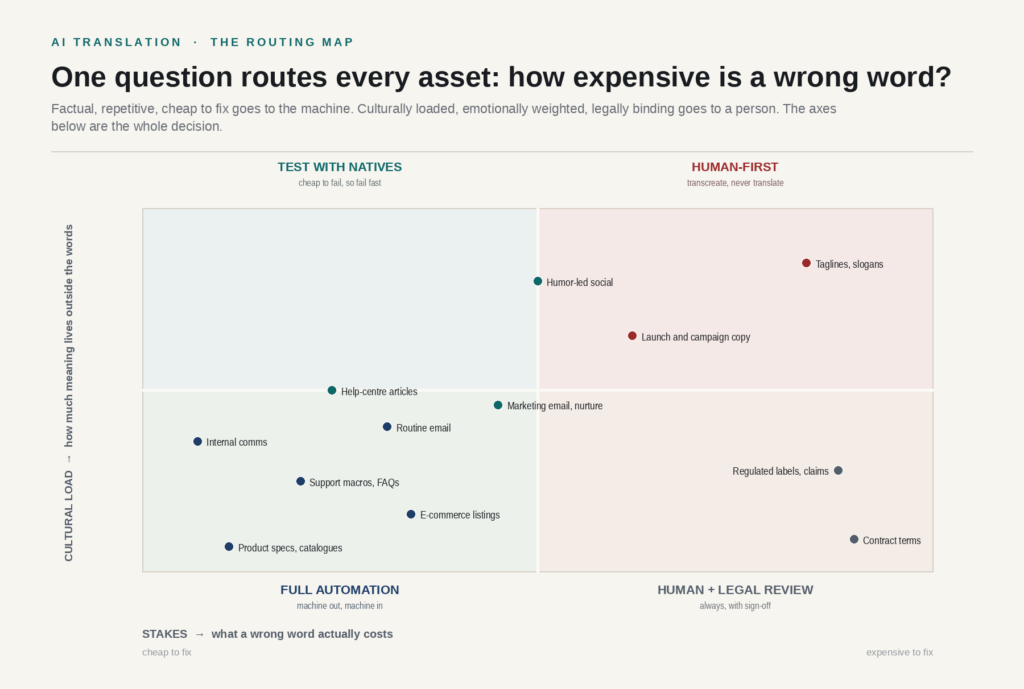
Forget the philosophical question of whether AI can translate. Ask which tier the asset belongs to, because the tiers do not negotiate.
Tier one: catalogues, specs and listings. Tens of thousands of SKUs, standardised attributes, no voice to protect. This is the machine’s home turf. Terminology consistency at this volume is genuinely easier for a governed engine with a termbase than for a rotating cast of freelance translators. Automate it, and route the exceptions rather than treating everything as an exception.
Tier two: support content and routine lifecycle email. Functional communication where being understood beats being elegant. Here the machine wins on speed, and speed is the product. But read the fine print: research on generative AI inside a real public-sector translation team found that only 11% of Finnish-to-Swedish and 16% of Finnish-to-English outputs were accepted with zero edits. Roughly half the words needed touching. Acceptable for a help-centre article, indefensible for a legal notice.
Tier three: campaign copy, launch messaging, marketing email. This is the contested middle. AI can draft, and often drafts well enough to save a native copywriter an hour. It should not ship unreviewed, because the thing that makes campaign copy work — a specific voice doing a specific thing to a specific audience — is precisely what the model cannot verify.
Tier four: regulated and legally binding content. Labels, disclaimers, claims, contract terms, patient information. Here the routing is not a judgement call. In the European Union, medicinal product labelling and package leaflets must appear in an official language of the member state where the product is marketed. That is statute, not style. Human translation, subject-matter review, documented sign-off. Every time.
Between these tiers sits a fifth, unofficial category that causes most of the damage: content that looks like tier one and behaves like tier three. A product description that happens to carry the brand’s whole personality. A help-centre article that becomes the first thing a journalist quotes.
The three-axis test
You do not need a taxonomy. You need three questions, asked in order, before anything enters a pipeline.
How expensive is a wrong word here? A mis-tuned support macro costs a ticket. A mis-tuned slogan costs a quarter.
How much meaning sits outside the words? A specification is culturally neutral. A joke is not. Nor is a gesture, a colour, a date, a number, or a national holiday that has a second meaning nobody on your team knew about.
How standardised is the source? Repetitive and templated routes to automation. Bespoke and creative routes to a human, with the machine allowed to draft.
Score an asset high on any one of those three and the answer is human-first. High on two and the answer is human-first with no argument.
The speed number is a statistical illusion you have to audit
Everybody in this industry quotes the same figure: post-editing is faster than translating from scratch. It is true. It is also the most expensive half-truth in localisation.
The largest study of the question analysed 90 million words translated by 879 professional linguists across 11 language pairs over two and a half years, using real production data rather than a lab task. Post-editing came out 66% faster on average. That is the number vendors cite, and it is accurate.
Now the distribution. English to French ran 130% faster. English to Swedish ran 7% slower than translating the thing by hand. And one language pair produced a genuine statistical trap: pooled across all tasks, English to Polish looked 18% faster, but broken out task by task, post-editing was actually 4% slower in 89% of them. The average was carried by a minority of easy jobs.
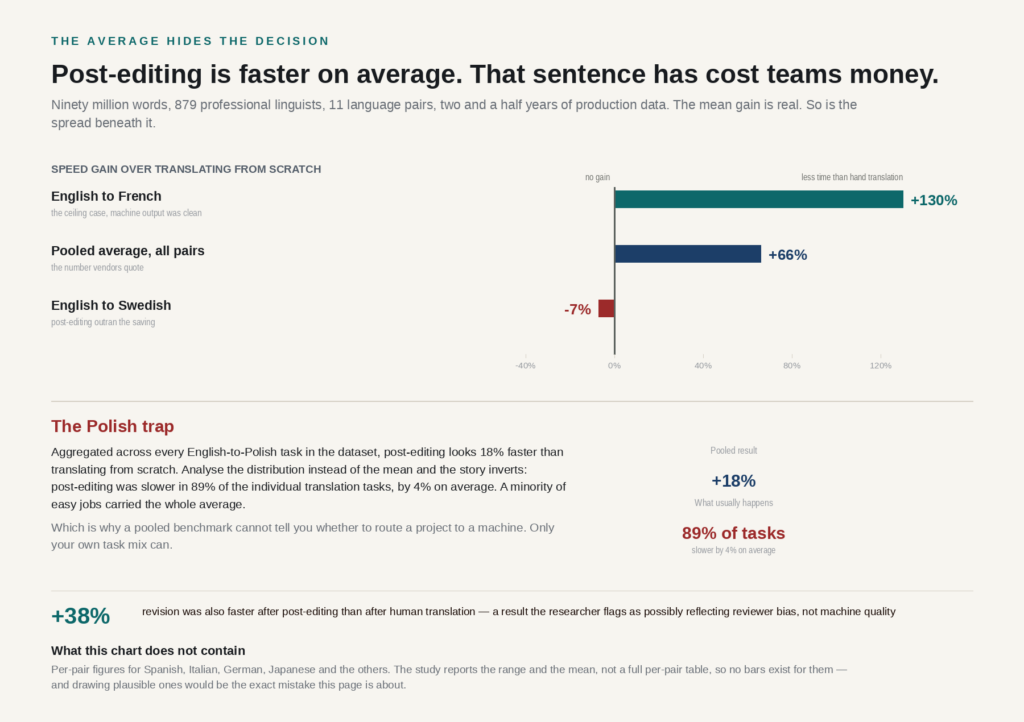
A second, independent study found the same pattern from a different angle: average gains of 14% across 908 production segments, but individual translator results ranging from slightly negative to a doubling of throughput. Same tool, same content type, wildly different outcomes — because the variable is not the model. It is the workflow.
Practical consequence: stop buying pooled averages. Measure your own edit distance, your own words per hour, your own post-delivery error rate, and re-measure whenever the model version changes. A number that describes the industry does not describe your campaign.
The failure nobody budgets for
Here is the thing traditional machine translation rarely did and generative models do: invent.
An old neural engine that got a date wrong produced something visibly wrong. A language model asked to translate a paragraph can produce a fluent, confident, well-formed paragraph containing a product claim that does not exist in the source. It reads better than the error it replaced, which is exactly why it survives review.
The research literature on document-level translation names the problem outright: hallucination and omission are the two recurring failure modes when LLMs handle long-form content. A dropped negative. A swapped unit of measure. A sentence that quietly disappears between two paragraphs because the model decided it was redundant.
The people doing the work say the same thing in plainer language. In the Finnish public-sector study, the translators’ stated problems were inconsistent terminology, missing document-level context, and no ability to customise the system — not “the output is ungrammatical.” Ungrammatical is easy to catch. Inconsistent is expensive, because it compounds: the same term rendered three ways across three files becomes three different products in the customer’s mind.
The case that should end the argument
In May 2026, Starbucks Korea ran a promotion for a line of tumblers it calls the Tank Series. The campaign went live on 18 May and was pulled within hours. The chief executive was dismissed. The group chairman apologised publicly. Starbucks’ global headquarters in Seattle apologised. Reuters reported a very significant drop in sales.
The campaign was not translated. It was written in Korean, by Koreans, for Koreans. No model was involved in the failure.
May 18 is the anniversary of the 1980 Gwangju Uprising, when the military government sent troops and armoured vehicles to suppress pro-democracy protests. Calling a tumbler promotion “Tank Day” on that date, with onomatopoeia echoing a documented official account of a student activist’s death in custody, was read as desecration. It was.
Why does this belong in an article about AI translation? Because of the mechanism the company’s own investigation described. The promotional calendar was heavy. The e-commerce team was focused on sales. Approval passed through several layers without proper review or legal scrutiny. The failure was not a language failure. It was a review failure — the exact failure that cheap, fluent, high-volume output makes more likely, not less.
Automation does not break campaigns by writing bad sentences. It breaks them by making the pipeline so productive that nobody has time to ask what the sentence means in this market, this week, against this history. The Starbucks case is what that looks like when a human team does it. Machine translation at scale industrialises it.
Buyers can hear the machine, and they leave
For years the argument for localisation rested on one number: 76% of consumers prefer to buy products with information in their own language. That figure comes from a 29-country, 8,709-respondent survey by CSA Research, and it is the most cited statistic in the field. It is also, as of this writing, six years old — nobody has replaced it at the same scale, which is worth knowing before you build a board deck on it.
The more interesting findings in that study are the awkward ones. 40% said they would never buy from a website in another language at all. 65% said they prefer content in their own language even when the quality is poor. 66% said they use machine translation themselves to read sites that were never localised.
That pair of numbers is the whole strategic picture: presence beats perfection, and quality decides what happens next.
Which brings us to the 2026 research that should worry anyone shipping unreviewed output. A survey of 800 US adults who had used websites or apps in a language other than English in the past year found that 82% believe they can tell when content was machine-translated rather than written or reviewed by a fluent speaker. 56% had abandoned a purchase because a site felt poorly adapted. 90% had noticed at least one localisation fault on a live site.
Then the finding that reframes the entire cost conversation: among consumers who rated brands’ translations as good or excellent, 54% had still walked away from a purchase over poor adaptation. Good enough to pass is not good enough to convert.
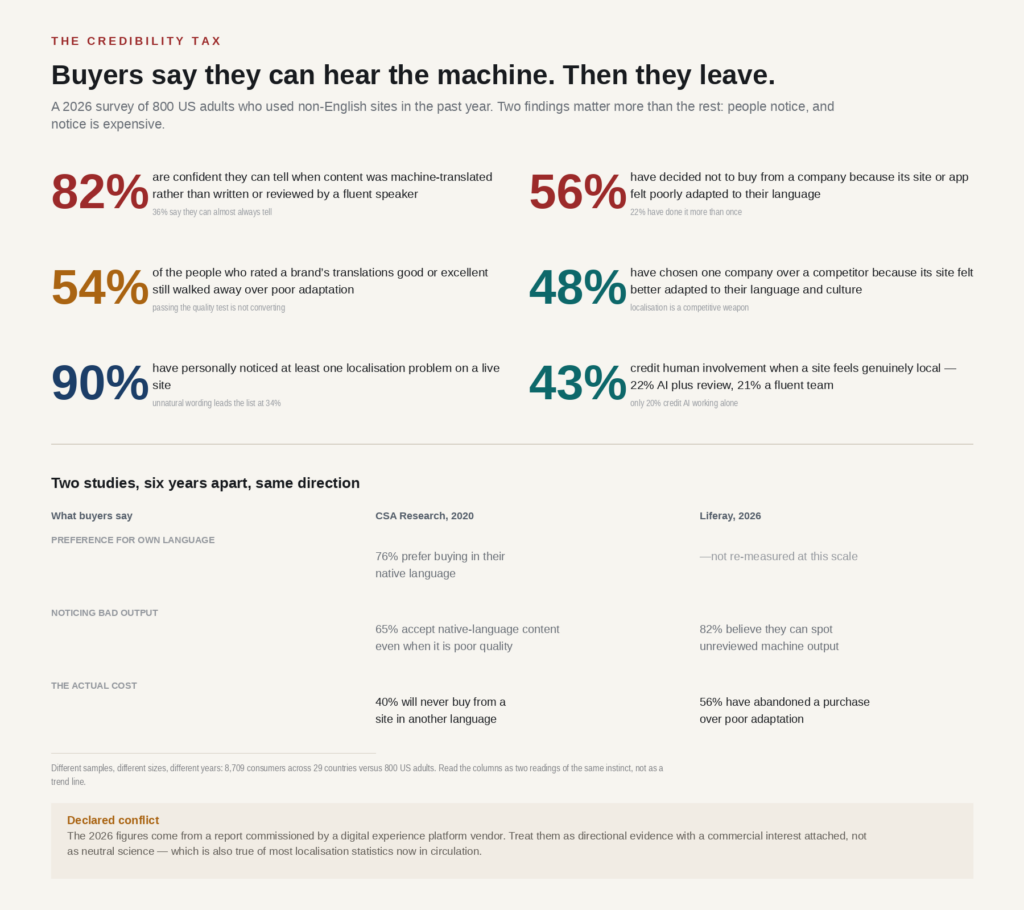
One honest caveat: that survey was commissioned by a digital experience platform vendor, so read it as directional evidence with a commercial interest, not as neutral science. The direction, though, is consistent with everything else here, including the six-year-old CSA data.
The workflow that holds up
The winning arrangement is not “AI or human.” It is a routed pipeline with three rules.
AI drafts, natives finish — and finishing is a creative job, not a proofread. For tier-three content, the native copywriter should be allowed to rewrite a sentence entirely if the literal version does not work. Brief them on intent, not on wording. The deliverable is the effect, not the fidelity.
Terminology is infrastructure, not housekeeping. One multilingual glossary: brand terms, forbidden phrases, tone rules, the words that must never appear next to your product in any language. Both the model and the reviewer work from it. Without it, the machine drifts and the reviewer spends their time rebuilding consistency instead of improving the message.
Choose the post-editing level deliberately, and write it into the contract. ISO 18587, the international standard for post-editing machine translation output, separates full post-editing from light post-editing. Light gets you comprehensible. Full gets you publication-grade. Most disputes about AI translation quality are really disputes about which of the two was ordered. Say which one you bought.
For taglines, slogans, and anything carrying the brand’s voice, stop calling it translation. It is transcreation: the brief is to produce the same effect for a different audience, not the same words in a different language. That work is written, not converted. It is slower and costs more per word, and it is the only thing that reliably works.
What to measure
Four numbers, tracked per language and per content tier.
Edit distance on post-edited content, trending over time. Words per hour by linguist, because that is where the real cost lives. Post-delivery error rate — errors found in market after publication, the only metric that reflects what the customer experienced. And conversion or engagement by language, because everything above is a proxy for that.
If any of these moves the wrong way for two consecutive quarters, the problem is your routing, not your model. Do not fix it by asking the linguists to work harder.
The uncomfortable conclusion
The economics of the last three years have been strange in a specific way. The language services industry was worth roughly 72.6 billion dollars in 2025 on Nimdzi’s accounting, while unit prices fell and demand for human-only translation kept declining. Machine translation post-editing moved from 26% adoption among providers in 2022 to nearly 46% in 2024. US Bureau of Labor Statistics projections put employment growth for interpreters and translators at about 2% over the coming decade — slower than the average occupation.
Everything got cheaper. Nothing got easier.
Because what got cheaper was the part that was never scarce. Writing a correct sentence in another language is now a solved commodity. Knowing that “Tank Day” is not a phrase you use in Korea in May is not.
So automate the catalogues. Route the support content. Review the campaigns with people who live in the market and are allowed to say no. And keep the tagline away from the model — not because the model writes badly, but because the tagline is where a brand either means something or doesn’t, and no benchmark can score that for you.