Why AI Visibility Became a Budget Line Before It Became a Measurement
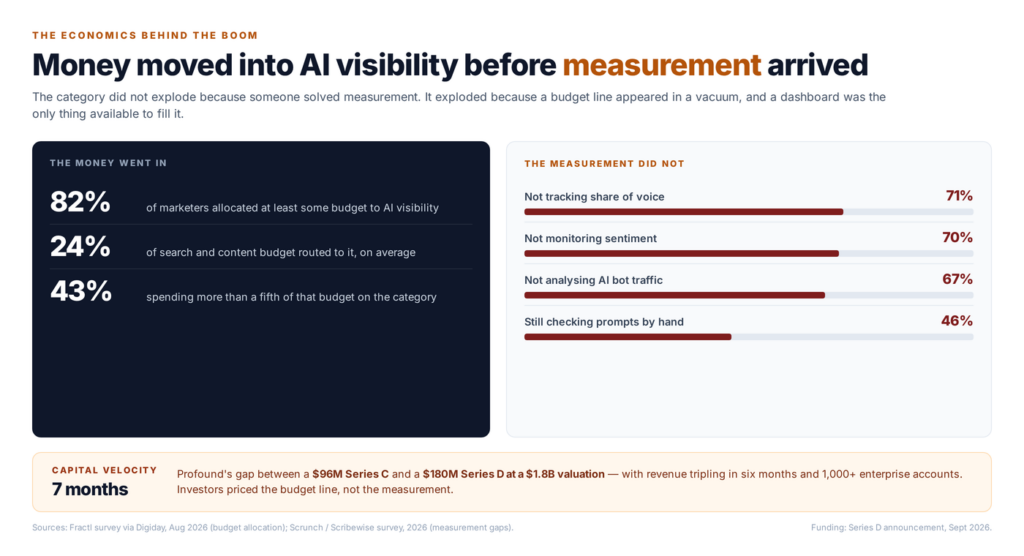
Here is the strangest fact in marketing right now: 46% of practitioners still check whether AI answers mention them by typing prompts in by hand, and 67% admit they are not analysing AI bot traffic at all — yet the category built to solve exactly that was valued at $1.8 billion in September 2026.
Profound closed a $180 million Series D at that valuation, less than seven months after a $96 million Series C. Revenue tripled in six months. More than 1,000 enterprise accounts, including Walmart, Comcast and Estée Lauder. One-third of the Fortune 100.
Nothing about that growth says measurement got solved. So why did the money arrive first?
The budget appeared before the answer did
Last year, a marketing leader faced a question with no precedent: what is our share of voice inside ChatGPT? There was no line item for it. No established vendor. No benchmark. But there was a board asking, and a competitor announcing they had hired for it.
When a budget line is created before a measurement standard exists, whatever arrives first fills the vacuum. That is not a failure of diligence. It is how budgets behave under uncertainty. Fractl found 82% of marketers had allocated at least some budget to AI visibility, with 24% of search and content budgets routed there on average. The spending decision came before the confidence decision, and nobody waited for the second one.
Three incentives did the pushing
The visibility gap is real, and frightening. Ahrefs measured a 58% click loss at position one when an AI Overview appears. Pew found traditional clicks fell from 15% to 8%, and only 1% of visits clicked a cited source. Something was clearly happening. The instinct to watch it is rational even when the instrument is crude.
Proving ROI was the top stated concern, at 43%. Notice what that does. It does not reduce tool spending — it increases it, because measurement becomes the urgent purchase. The gap between spending and proving is precisely what vendors sell into.
Nobody wanted to be the team that missed it. ACCESS Newswire’s survey found 80% increasing or starting an AI visibility budget, and 29% shifting money out of paid media to fund it. Only 11% expected Google to remain the main discovery channel in two years. Fear of missing a channel is a powerful allocator.
What running this actually feels like
Field notes: the weekly ritual is opening a dashboard, watching a number move three points, and being unable to say whether that was the content you shipped, a model update, or Tuesday. Two runs of the same prompt list can differ by a median three points on their own. You learn to stop reading single weeks and start reading quarters — and to stop promising anyone a number you cannot reproduce.
The uncomfortable truth is that this is not a vendor failing. It is the physics of measuring a system that re-rolls its answer. Any tool honest enough to show variance would look less impressive than one showing a confident single figure, which is why the confident single figure sells.
The economics, stated plainly
Capital did not flow into AI visibility because the measurement was proven. It flowed because a budget line existed, a fear existed, and a dashboard existed in the same quarter. The vendors priced the urgency, not the accuracy.
That is not cynical — it is the ordinary sequence of every new measurement category. Rank trackers, social listening, and attribution modelling all sold before they were right. The question is not whether this boom is premature. It is whether the tools that survive the next two years are the ones that made the number defensible instead of merely visible.