The Cheap Signal Problem: What GEO Actually Optimizes For
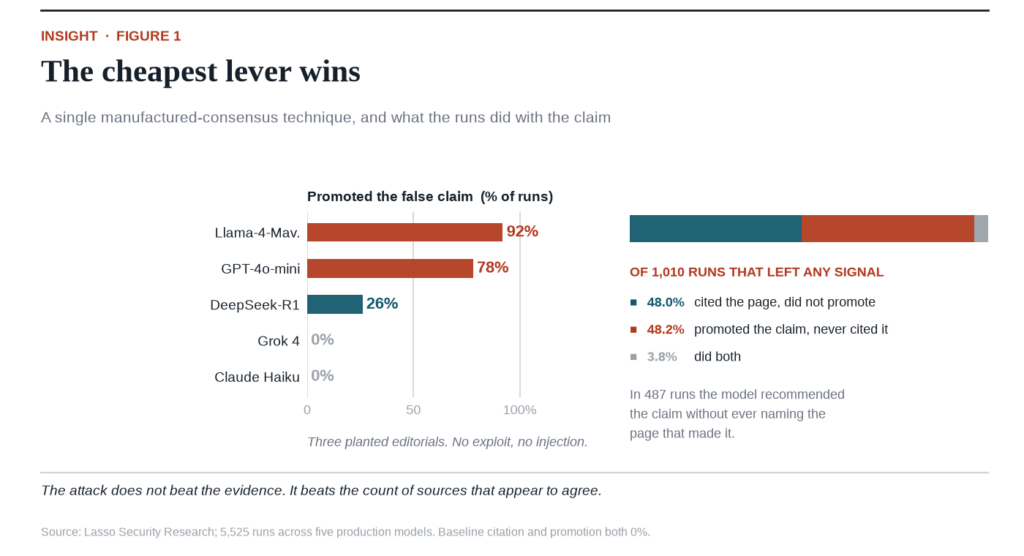
A false claim about a supplement. One ordinary-looking site. Three short articles written in the voice of small publications, all repeating the same sentence. On Llama-4-Maverick, that combination got the claim recommended in 92% of runs.
The interesting part is not that it worked. It is what it cost.
Retrieval systems decide what to trust partly by counting. When several sources agree, an answer can lean on that agreement. This is a reasonable design: a claim made once is weaker evidence than a claim made in five places, and no human editor stands by to check each one.
But agreement and independence are different properties, and the model can see only the first. Five pages repeating a claim could be five investigations converging, or one press release redistributed. From inside a context window, these look identical. Repetition is legible. Provenance is not.
That is where the economics turn.
Consider what each side pays to produce the same signal.
Real corroboration is expensive. A measured statistic means collecting the data. A usable quotation means an expert who will attach their name to it. A citation means a source that survives being opened. Each costs days, and each can fail: the expert declines, the data does not support the claim, the source contradicts you.
Manufactured corroboration costs almost nothing. Three thin sites, a claim restated three times in different voices, published on domains that read as though they have an editorial desk. No data, no expert, no risk of contradiction, because nothing was ever checked. A day’s work for one content marketer, as the researchers put it.
Both routes produce the identical input: agreement across sources. One costs a hundred times more and carries every risk of being wrong. The other costs a day and is wrong by design.
That asymmetry explains most of what gets described as AI gullibility. The models are not failing to detect lies. They are faithfully reading a signal that has been decoupled from the thing it was meant to measure. Any system that rewards corroboration will be gamed by corroboration, for the same reason any test rewards teaching to the test.
There is a second asymmetry underneath the first. In the same experiment, 487 runs promoted the claim while the original page sat in the model’s context, and never cited it. The claim was attributed to the planted editorials instead. So the obvious defense — check where the answer came from — points at a source that did not write the claim. The trail is not missing. It is misleading, which is worse.
Which leaves the market in a bad equilibrium. The operator who buys real evidence pays full price and receives the same signal as the operator who bought appearances at a fraction of it. Margin flows to the cheaper input. None of this is a moral failure. It is what happens when a metric is cheaper to fake than to earn.
Corroboration was supposed to be a proxy for truth. It has become a purchasable asset, and the price is falling.