Programmatic in 2026: The Transparency Layer Marketers Demanded
By the numbers: 36% of programmatic spend reached working media in 2023. By Q3 2025, it was 47.1% — roughly $13.6 billion recovered. Yet the median advertiser now buys across 19 supply-side platforms and 53,799 domains. Transparency arrived. Consolidation did not.
The short version
For about a decade, programmatic advertising ran on a promise nobody could audit: your money goes in here, an impression comes out there, and what happened in between is a technical detail. The technical detail was where the money went.
That era is over — mostly. What replaced it is not a cheaper channel. It is an accountable one, and accountability turned out to be worth more than cheapness ever was. But the story the industry tells about 2026 has a hole in it, and the hole is big enough to drive a supply path through.
Here is the honest version. The invoice became legible. The decision did not.
Where the black box came from
Start with the structural problem, because it explains almost everything that followed.
A single ad impression could pass through an advertiser, a demand-side platform, several ad exchanges, a handful of resellers, and finally a publisher. Every hop took a cut. None of those cuts were visible to the buyer, who saw one blended CPM and a dashboard reporting impressions delivered.
In 2020, ISBA commissioned PwC to map that chain end to end — the first attempt anyone had made to follow the money all the way through. The results were bad enough to change the industry’s vocabulary. Publishers received 51% of advertiser spend. Fifteen percent simply could not be attributed to anyone. PwC called it the unknown delta, a phrase that stuck because it was accurate and because it was damning.
Worse than the missing money was the missing data. Of 267 million impressions identified between advertisers and publishers, PwC could match only 31 million end to end — about 12%. Eighty-eight percent of the chain was unverifiable. You cannot manage what you cannot reconcile.
Then came the 2023 ANA study, which put a dollar figure on the waste. Of $88 billion in open-web programmatic spend, 23% — roughly $20 billion — was not producing value. Made-for-advertising sites, pages built to harvest ad budgets rather than to be read, accounted for 21% of impressions and 15% of spend. The average campaign in that study ran across 44,000 websites.
Twenty-one advertisers participated. Sixty-seven asked. The other forty-six could not get access to their own log-level data. That detail is the whole story in miniature: the barrier was never analytical. It was contractual.
What the transparency layer actually is
It helps to be specific, because “transparency” has become a word vendors put on slide covers.
Log-level data access. The raw record of every bid, win, fee and placement, rather than an aggregate summary. This is the foundation. Everything else is downstream of whether you can see the transaction itself.
Supply-path optimization. Pruning redundant intermediaries so a bid travels fewer hops, pays fewer tolls, and arrives with its provenance intact. The ANA’s own guidance has long recommended consolidating to five to seven supply-side partners.
Inventory classification and exclusion. Not just knowing that MFA exists, but being able to name it and block it before the impression is bought. Exclusion lists work retrospectively; inclusion lists work prospectively. The difference matters more than it sounds.
Fee disclosure and forensic audit. Third-party verification of the money trail, treated as ordinary financial governance rather than an accusation of bad faith.
The numbers that actually moved
Now the part that deserves credit, because it is genuinely rare: a structural problem in advertising that got measurably smaller.
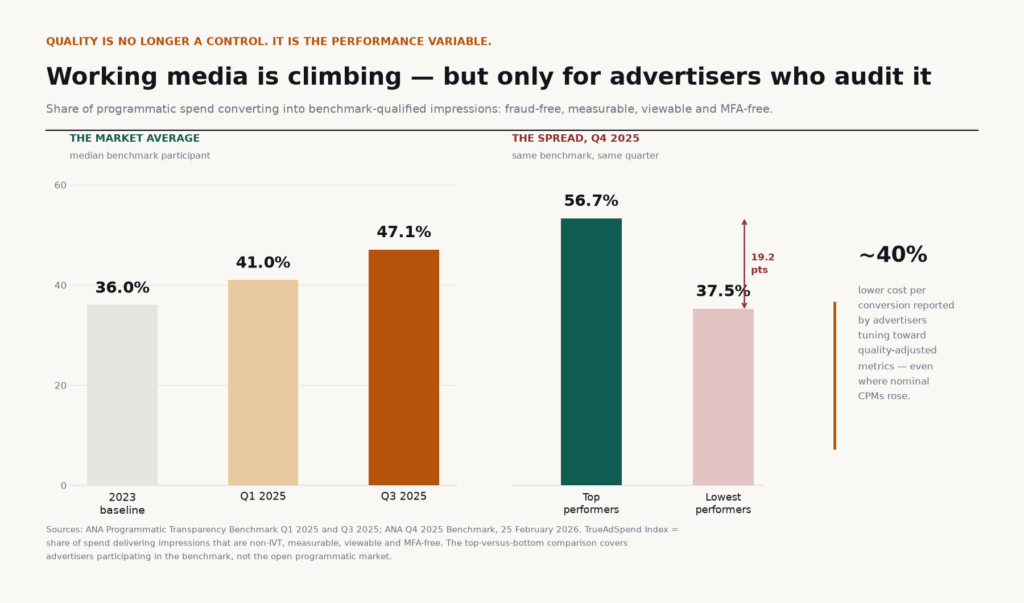
Working media — the share of spend producing an impression that is fraud-free, measurable, viewable and MFA-free — rose from 36% in 2023 to 41% in Q1 2025 and 47.1% by Q3 2025. The ANA valued the recovery at $13.6 billion.
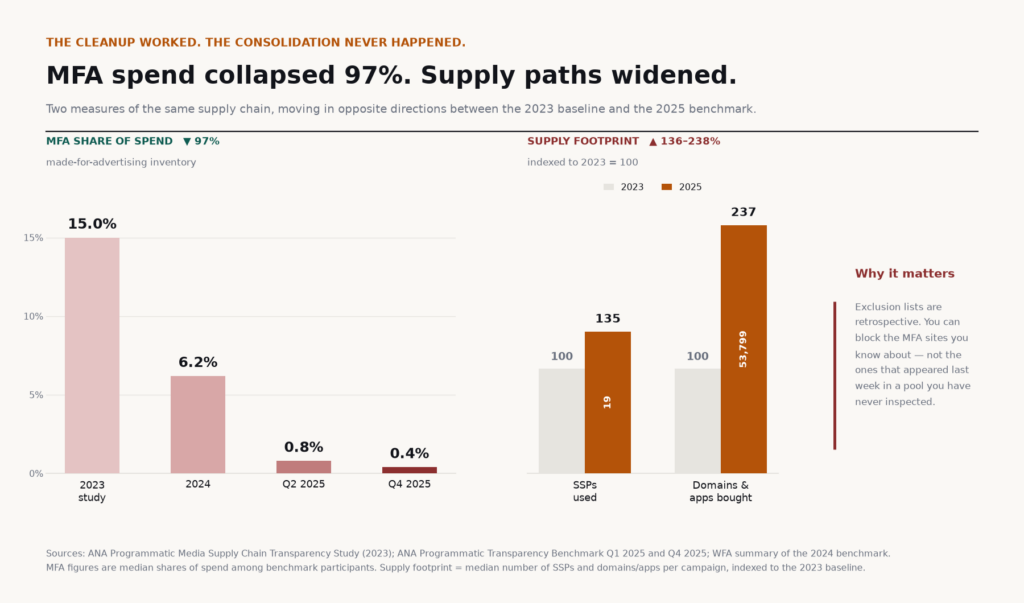
MFA exposure collapsed even harder. From 15% of spend in 2023 to around 1% in 2024, then a median near 0.4% by late 2025. That is a fall of roughly 97%, achieved not by a clever new technology but by buyers reading their placement reports and excluding what they found.
Brand safety violations in programmatic display fell from about 5.8% in 2023 to roughly 3.4% in 2026. Verification adoption among larger advertisers went from 82% to 96%.
And yet. Look at the right-hand panel of Figure 1 and the celebration gets quieter. In Q4 2025, the best-performing advertisers converted 56.7% of spend into benchmark-qualified impressions. The worst converted 37.5%. Same benchmark, same quarter, same tools available. The ANA also reported that the share of advertisers clearing the 50% threshold fell from 50.0% to 43.8% quarter over quarter.
Transparency is not a rising tide. It is a skill.
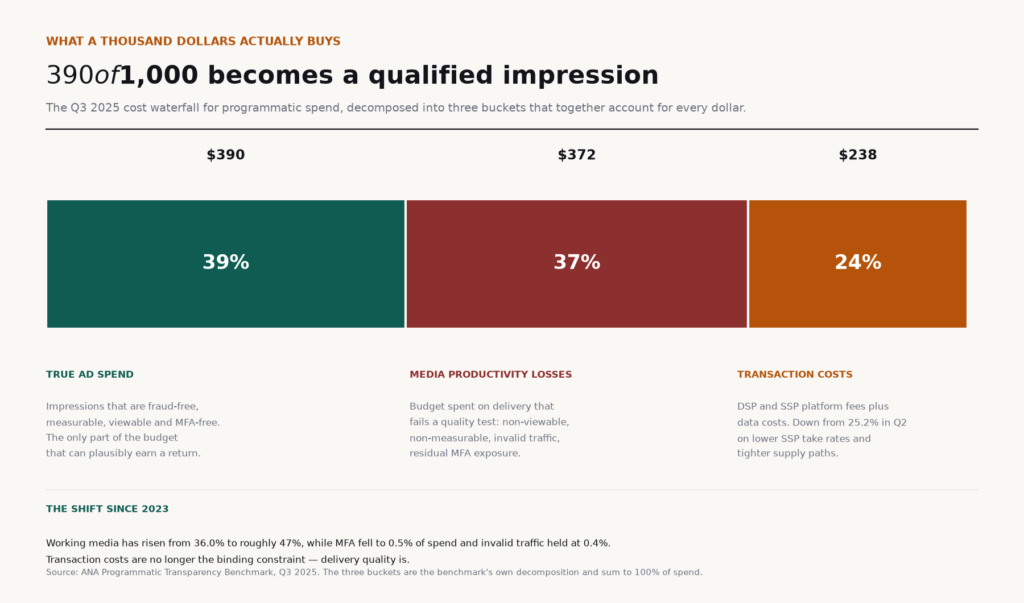
The waterfall is the clearest artifact the transparency movement has produced, because it stops arguing about averages and just decomposes the budget.
Of every $1,000 entering a DSP in Q3 2025, $390 became True Ad Spend. $372 was lost to media productivity failures — non-viewable, non-measurable, invalid traffic, residual MFA. $238 went to transaction costs: DSP and SSP fees plus data.
Here is the shift nobody predicted. Transaction costs are no longer the binding constraint. SSP costs fell from 14.7% to 12.8% of spend between Q2 and Q3 2025 as supply paths tightened. What grew, or failed to shrink fast enough, was the middle bucket — money spent on impressions that arrived somewhere and did not count.
Which reframes the entire discipline. For ten years, the fight was about fees. For the next few, it will be about delivery quality. Different problem, different tools, and a lot of teams are still bringing a fee audit to a viewability fight.
The finding that undercuts the victory lap
Supply-path optimization has been the stated strategic direction of the industry for at least five years. Every conference panel endorses it. Every ANA report recommends it.
The benchmark data says it did not happen.
Between the 2023 baseline and the 2025 benchmarks, the median advertiser’s supply footprint went from 14 supply-side platforms to 19, and from 22,634 domains and apps to 53,799. Both roughly in the wrong direction. Indexed to 2023, that is a 36% increase in exchange count and a 138% increase in the number of properties bought.
There is a mitigating detail. Ninety percent of impressions concentrated on the top 3,000 domains, so the long tail absorbs a small share of actual delivery. But the tail is where the risk lives, and exclusion lists are retrospective by nature. You can block the MFA sites you know about. You cannot block the ones that appeared last week inside a supply pool you have never inspected.
So what happened? The plausible reading is that two different audiences used the same word. Agencies and sophisticated buyers ran deliberate SPO programs — one independent agency cut from roughly 20 SSPs to single digits in a year. Meanwhile thousands of advertisers, optimizing on cost through automated buying, let their footprint expand because nothing in the system punished expansion. The median moved. The discipline did not.
That is a governance failure wearing a strategy’s clothes.
Who actually won
The redistribution is real, and it is not zero-sum in the way the pessimists feared.
Advertisers with disciplined governance recovered working media. Nearly 40% reductions in cost per conversion were reported by advertisers optimizing toward quality-adjusted metrics — achieved even where nominal CPMs rose. That is the whole argument in one line: paying more per thousand and less per outcome is a good trade, and it took a decade of data to prove it.
Premium publishers stopped subsidizing arbitrage. When MFA gets excluded, editorial inventory stops competing against clickbait on price.
Honest intermediaries got a differentiator. Transparency became a pitch, not a concession.
The losers are the familiar ones: arbitrageurs whose margin was the opacity itself, MFA operators, and the value-add-less layers that genuine SPO should have pruned. Note the tense — should have.
What is still dark
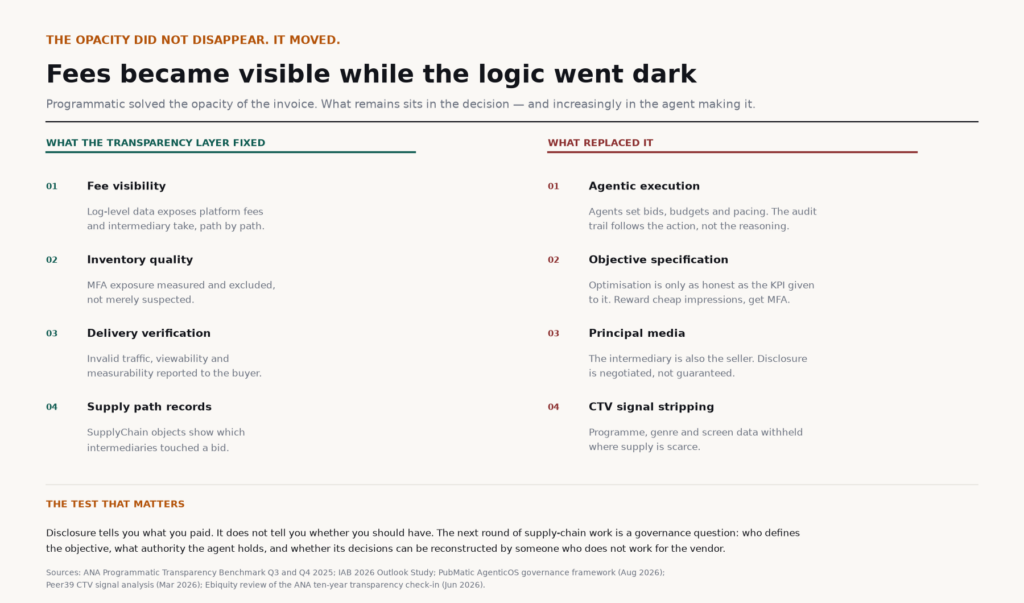
Four gaps remain, and three of them are getting worse.
Disclosure is not efficiency. Ninety percent of advertisers told the ANA they are uncertain whether their agency’s principal media recommendations serve their interests. Ninety-six percent know what principal media is; only 58% use it; over half of those allocate less than 10% of budget to it; and only 61% of contracts address it at all. Knowing about a conflict and being protected from it are different things.
CTV hides its own context. Connected TV is now around 40% of programmatic spend in the ANA benchmark and roughly 45% of digital spend on other measures. It is also the channel where buyers most often cannot say what content their ad ran against. One analysis found only about a third of CTV bid requests carried any genre data; another found 14.3% of sports-adjacent inventory carried league information. Peer39 estimates about 25% of open-exchange CTV bid requests qualify as fake CTV, dropping to just over 2% when authenticated signals are applied. This is a commercial choice, not a technical limit — scarce premium supply means sellers have little incentive to enrich signals.
Retail media is a walled garden with a receipt. Deterministic purchase data is genuinely valuable, which is exactly why each network controls its own measurement methodology and has no economic interest in letting you compare it against a rival’s. Closed-loop measurement run by the party that owns both the impression and the conversion is a disclosure problem dressed as a measurement triumph.
The AI decision is opaque by design. This is the big one. When AI sets bids, the fees stay visible and the reasoning does not. Vendors argue, reasonably, that publishing the logic makes it gameable. Buyers argue, reasonably, that you cannot govern what you cannot interrogate. Both are right, and the tension will not resolve soon.
The agentic complication
The IAB’s 2026 Outlook study found 96% of buyers aware of agentic AI for media buying and 66% increasing their focus on it. Buyers want it for analytics, creative optimization, planning and budget management. They conspicuously do not want it for negotiation and deal execution — 40% want a human in the loop, 36% want an explainable audit trail, 31% want explicit limits on agent authority.
That reticence is well calibrated, and the reason is instructive. MFA was not a fraud problem in its purest form. It was a specification problem. The industry told automated systems to maximize impressions at the lowest cost, and the systems obeyed with terrifying competence. Reward cheap impressions and you get clickbait; there is no bug in that, only a badly written objective.
Agentic buying makes specification errors more consequential, not less. An agent with more autonomy and an incomplete definition of success becomes more efficient at the wrong thing.
The industry is responding with architecture rather than exhortation. PubMatic’s AgenticOS governance framework, launched in August 2026, sets platform-wide constraints, lets buyers add budget and inventory policies, confines agents to pre-approved libraries, escalates out-of-policy decisions to a human with one-time-passcode approval, and logs every action with drift detection. The Ad Context Protocol takes a different route: a three-party trust model where an orchestrator, a governance agent and a seller each validate against a shared campaign plan, with cryptographically signed approval tokens that a regulator can verify without the vendor’s cooperation.
The design principle worth stealing: the audit trail must be verifiable by someone who does not work for the party being audited. Anything less is a vendor dependency with a compliance label.
The regulatory floor just moved
Two 2026 developments matter more than they appear.
In September, Judge Leonie Brinkema declined to break up Google’s ad tech business, imposing instead a six-year behavioral regime. The substance: Google cannot tie its publisher ad server to its exchange, cannot preference its own tools in auctions, must integrate with Prebid for indirect open-web display, must pass data signals on non-discriminatory terms, and must accept all of this globally rather than in the United States alone.
Publishers were underwhelmed, and not unreasonably. The remedies apply to open-web display — a category that increasingly excludes CTV, video, retail media and curated deals. One publisher executive put it bluntly: the puck has moved.
Separately, the UK’s CMA imposed its first conduct requirement under the new digital markets regime, ordering Google to give publishers controls over use of their content in generative AI search, along with attribution and engagement metrics. Notably, it did not include a payment mechanism, which limits its bite.
The pattern: regulation is now arriving in behavioral, interoperable, incremental form. It is creating a floor. It is not creating a ceiling, and it is not moving as fast as the technology it regulates.
What to do about it
Seven moves, ordered by how much they change.
One. Put log-level data access in the contract, not the deck. If you cannot reconcile a bid to a placement to a publisher, everything downstream is estimation.
Two. Audit your actual supply footprint before you optimize it. Most advertisers believe they have consolidated. The benchmark says the median advertiser has not. Find out which group you are in.
Three. Treat the 50% working-media threshold as a governance target with a named owner. The spread between top and bottom performers is 19 points, and it exists because somebody is accountable in one organization and nobody is in the other.
Four. Give CTV its own scrutiny. Do not inherit the trust that premium content implies. Ask for named apps, program-level signals, device-versus-browser splits, and an honest account of what the verification vendor cannot see behind server-side ad insertion.
Five. Read your agency contract this week. If it does not address principal media identification, AI trading governance and data portability, it is already out of date — and nearly 40% of advertisers have not updated theirs or do not know whether they have.
Six. Specify objectives you would actually defend. Before delegating to an agent, write down what it must not sacrifice in pursuit of the target. That document is the governance.
Seven. Stop conflating disclosure with value. A fee you can see and a fee you should not be paying are two different findings. Only one of them requires an audit.
The takeaway
Programmatic didn’t get cheaper. It got accountable, and accountability turned out to be the more valuable commodity.
The industry built the transparency layer marketers spent a decade demanding, and it worked — better than most structural fixes in advertising ever do. MFA is down 97%. Working media is up 11 points. Thirteen point six billion dollars moved from arbitrage to actual media.
But the layer is a floor, not a ceiling. The median advertiser’s supply footprint widened while the industry congratulated itself on consolidation. Fees became visible while principal media and CTV signals stayed murky. And just as the invoice finally became legible, the decision-making went into a model nobody outside the vendor can interrogate.
The next competitive advantage is not more visibility. It is the governance to act on the visibility you already have. The advertisers at 56.7% did not find a better exchange. They read the report.